An empty AI API response may contain a tool call, exhaust a reasoning budget or expose a parsing error. Check the full result before retrying.
RESPONSE DIAGNOSTICS · BLOG 162
By Token360 · Editorial review: November 5, 2026
An empty AI API response on screen does not necessarily mean the API returned nothing. The result may request a tool, contain no final answer after reaching a reasoning budget, or use a response shape your client did not parse. Inspect the complete response, endpoint contract, completion state and usage before retrying or concluding that the request was free.
The topic grows out of OpenRouter’s FAQ on usage billing, which distinguishes prompt, completion and reasoning-related charges. The operational question is narrower: what should an application inspect when its answer field is blank?
This is a diagnostic guide based on official documentation. The sample payloads and decision table are constructed examples, not captured Token360 responses or a benchmark. No paid requests were made, and no frequency or success-rate claim is implied.
Read first: Token360’s response protocol guide explains why the endpoint determines the client-facing structure. Correct parsing comes before deciding that output is missing.
Is the response empty, or is only one field empty?
Check the full response before inspecting the single string displayed by the interface. A missing text field, a null text field, an empty string and an interrupted response are different observations. Record which occurred and which endpoint you called. Do not collapse them all into the same generic “empty response” error.
Observation
First check
Do not conclude yet
HTTP 200, no displayed answer
Raw result shape and the UI’s extraction path.
The task produced a usable final answer.
Text is null; tool calls are present
Tool workflow and completion state.
The model returned nothing.
Empty text, length limit reached
Output limit and reported reasoning usage.
The same request will succeed unchanged.
Connection closes before a terminal event
Stream lifecycle and captured events.
The model completed with an empty answer.
Complete result, no usable text or other expected output
Sanitized evidence for investigation.
A specific cause without supporting fields.
Start with a saved, sanitized response rather than a screenshot of the chat bubble. Compare what the server returned with what the application selected and rendered. If your code converts every missing value to "", it removes evidence that would distinguish a parser mismatch from a genuinely empty string.
HTTP success is a transport-level observation. An application still needs an acceptance rule for its expected result: a final text answer, a tool action, structured data or another output type. Make that rule explicit for the workflow being diagnosed.
Can a tool call explain the missing answer?
Yes. In a tool-enabled conversation, the assistant may request an operation instead of returning final user-facing text. Inspect the tool-call fields and the protocol’s completion signal. The application must validate and handle the requested operation through its approved workflow, then return the matching result before expecting a final answer.
Token360’s capability documentation describes this loop for models that advertise tool support and requires preserving tool-call IDs and arguments. Do not assume a router adds tool support to a model that lacks it.
This abbreviated Chat Completions-shaped example is synthetic:
A renderer that reads only message.content would display nothing. The correct diagnosis is “a tool action was requested,” not “the model failed to generate output.” This example does not authorize an operation or prove that the named tool exists in Token360.
Do not blindly execute a returned function name. Use the application’s registered tools, argument validation and permission checks. If the tool fails or is unavailable, handle that state explicitly rather than looping the original prompt until text happens to appear.
Can reasoning use the budget before an answer appears?
Some reasoning configurations share an output allowance between internal reasoning and visible text. A request can therefore reach its limit without producing a usable answer. Inspect the finish or incomplete status together with usage details and the selected model’s supported controls. A blank answer alone is not enough to identify this cause.
OpenRouter’s reasoning-token guide, checked November 5, 2026, documents this case. For Chat Completions, it describes empty content with finish_reason: "length" when reasoning consumes the budget. Its Responses example instead uses an incomplete status and an output-limit reason. These field names belong to their respective protocols; do not mix them in one parser.
If the response supplies reasoning-token details, compare them with its total reported output usage under that API’s accounting rules. If those details are absent, retain “cause unconfirmed.” Do not infer hidden reasoning volume from elapsed time or from a blank display.
A bounded follow-up might increase a supported output limit or lower a supported reasoning setting while keeping the prompt and model fixed. Record the change and result. This is a diagnostic option, not a guaranteed fix or a recommendation to remove limits. Larger allowances can increase resource use, and not every model accepts the same controls.
Do not use a fallback such as “show reasoning whenever content is empty” to manufacture an answer. Token360’s capability guide distinguishes protocol fields and cautions against exposing hidden reasoning unless its response contract explicitly marks the content as displayable.
Could the client be reading the wrong protocol?
Yes. An application can receive a valid result and still render an empty answer if its parser expects another endpoint’s shape. Select the parser from the endpoint contract, not from the model’s publisher. Preserve the original result while testing extraction so that a UI-level failure does not trigger unnecessary inference retries.
Token360 documents separate contracts for Chat Completions, Responses and Messages. A shared model catalog does not make those response objects identical. Routing normalization also does not mean every endpoint uses a Chat Completions choices array.
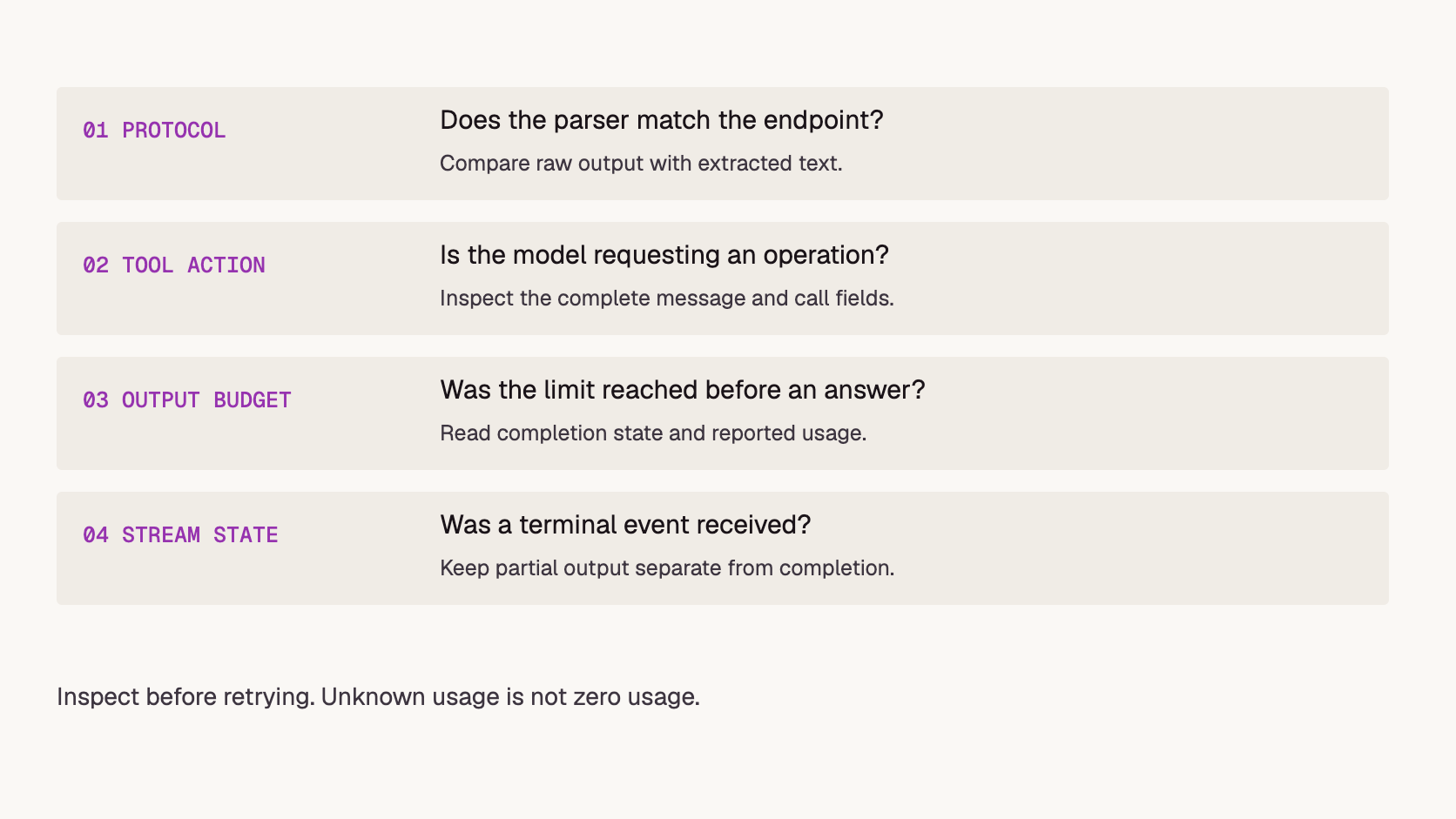
Diagnostic checkpoints, not a universal classification algorithm. More than one condition can apply.
A useful local check needs no new model call: feed an already captured, sanitized result into the application’s extraction function. Record whether the expected text or structured item is present in the raw response, extracted correctly, and then displayed. These are three separate assertions.
Keep schema errors visible in development. An optional-chain expression followed by an empty-string fallback can be appropriate for presentation, but it should not silently classify an unexpected response shape as a valid empty answer. Preserve a diagnostic state for unsupported or malformed structures.
For a multimodal request, confirm the expected output modality too. An application waiting only for prose should not label a valid non-text result as “no output.” Verify the model’s documented result contract rather than guessing from its name.
How is an interrupted stream different from a completed empty result?
An interrupted stream has an unknown or incomplete delivery history; a completed empty result has a terminal outcome that can be inspected. Record the terminal event, error event and accumulated content separately. Receiving headers or a first chunk does not establish that the stream finished normally or that final usage arrived.
Token360’s streaming capability guidance calls for handling content, supported tool/reasoning deltas, completion signals, usage when returned, and early errors or closure. Its protocol guide also warns that chunk boundaries vary. A single empty delta is not an empty final response.
Keep content accumulation separate from request status. A chunk may carry metadata or another supported field instead of text. Do not reset accumulated text to empty whenever such a chunk arrives. Conversely, partial text should not automatically be marked complete when the connection closes unexpectedly.
If the user pressed Stop, retain that event alongside the network outcome. Cancellation, transport failure and normal completion are different states. This article does not prescribe a streaming decoder or establish whether the upstream generation stopped; it focuses on avoiding a false “completed with no answer” classification.
Does an empty visible answer mean the request is free?
No. Visible text, generated tokens and billable usage are different measurements. Check the platform’s current policy and the actual request record instead of inferring cost from a blank chat bubble. A provider-specific protection for qualifying failures should not be assumed to cover every empty-looking response or to apply on another platform.
OpenRouter’s Zero Completion Insurance documentation describes specific qualifying conditions, including zero completion tokens with a blank/null finish reason, or an error finish reason. It also distinguishes model inference charges from auxiliary services that may already have run. This is OpenRouter’s policy, not a Token360 billing promise.
A reasoning-limited response with recorded output usage is therefore a different observation from a zero-token failure. Do not substitute an informal definition of “empty” for the provider’s documented conditions.
For Token360, use billing and usage records to investigate charges. If final usage was not received, record it as unavailable rather than zero. This article contains no billing experiment, refund guarantee or estimate of the cost of a failed answer.
What should you change before trying again?
Choose the next action from the evidence: continue an authorized tool workflow, correct a parser, review a supported output limit, or investigate an interrupted response. Preserve the original request first. A retry is useful when it tests a specific hypothesis; repeating every blank display can hide the cause and accumulate unnecessary work.
Evidence
Proposed next action
Verification
Valid tool request
Handle the tool through the application workflow.
Matching result is returned and the conversation advances.
Raw result contains expected output; UI does not
Repair extraction/rendering using the captured result.
The existing payload displays correctly without a new generation.
Limit reached with supporting reasoning usage
Change one supported budget/effort setting within an approved allowance.
Compare finish state, usable answer and actual usage.
Early connection close
Investigate transport and stream lifecycle.
Capture whether a terminal event is received.
Unexplained completed empty result
Prepare a sanitized support case.
Include the exact request, response, time and identifiers.
Copy blog162-empty-response-record.csv:
Timestamp,Endpoint,Public model ID,Request reference,Raw text present/null/missing,Tool fields,Finish or incomplete state,Reported output usage,Reported reasoning usage,Terminal event received,Parser extraction,Rendered output,Hypothesis,Change tested,Result
,,,,,,,,,,,,,,
. It records raw content presence, tool fields, completion state, reasoning usage, stream completion, parser outcome and the next hypothesis. It is a blank template, not an automated diagnosis or a test result.
Keep actual observations separate from assumptions in the incident record. Do not switch the model, prompt, client library and output limit simultaneously if your goal is to identify the cause. A workaround can be useful while the original issue remains unexplained; label it accordingly.
Diagnose the response you received rather than the empty space the interface displayed. These answers distinguish common observations, but they are not a substitute for the selected endpoint’s documentation. The constructed examples do not establish how often a model returns an empty answer, and no live Token360 compatibility test was performed here.
Should I always increase max_tokens?
No. That will not repair a parser reading the wrong field or complete a tool workflow. Check the finish state, usage evidence and model-supported limit first.
Is null content a failed generation?
Not necessarily. In a tool-enabled Chat Completions response it can accompany a tool request. Inspect the rest of the message and completion state.
Can I display the reasoning field as the answer?
Do not use it as an automatic substitute. Follow the response contract and distinguish permitted summaries from hidden reasoning and final answers.
Is an HTTP 200 enough for an application success metric?
It can measure transport success, but not whether the workflow received an acceptable final result. Track those outcomes separately.
What if all relevant fields really are empty?
Preserve the sanitized response, endpoint, model, timestamp and available request reference. Mark the cause unknown and investigate rather than inventing a reasoning or billing explanation.
Developer Guide
API
Build faster with one AI API.
Use Token360 to call video, image, audio, and text models with one key and one bill.


 Guides
 Guides
 Guides