Why Does My AI API IP Allowlist Block Valid Requests?
A valid API key can still fail an IP allowlist. Check egress IP, NAT, IPv4/IPv6 and policy scope before changing your Token360 access rules.
NETWORK ACCESS · BLOG 165
By Token360 · Editorial review: November 5, 2026
An AI API IP allowlist checks the request’s network origin as evaluated by the service, not just whether the API key is valid. A permitted application can still connect through an unlisted NAT gateway, proxy, deployment region or address family. Verify the actual egress path and every applicable policy before replacing credentials or broadening access.
The topic extends OpenRouter’s FAQ on authentication through its Security settings documentation: authenticating with a key and satisfying an IP policy are separate checks. The practical question for a Token360 integration is which source address and policy the request actually encounters.
This guide combines official references with an executable local CIDR-membership example. No production allowlist was changed, no API keys were used, and no live enforcement or propagation timing was tested. The local results demonstrate address-range matching only.
Read first: Token360’s security and data-handling guide describes network restrictions alongside authentication and application authorization. This article focuses specifically on diagnosing source-IP mismatches.
Why can a valid API key still be blocked?
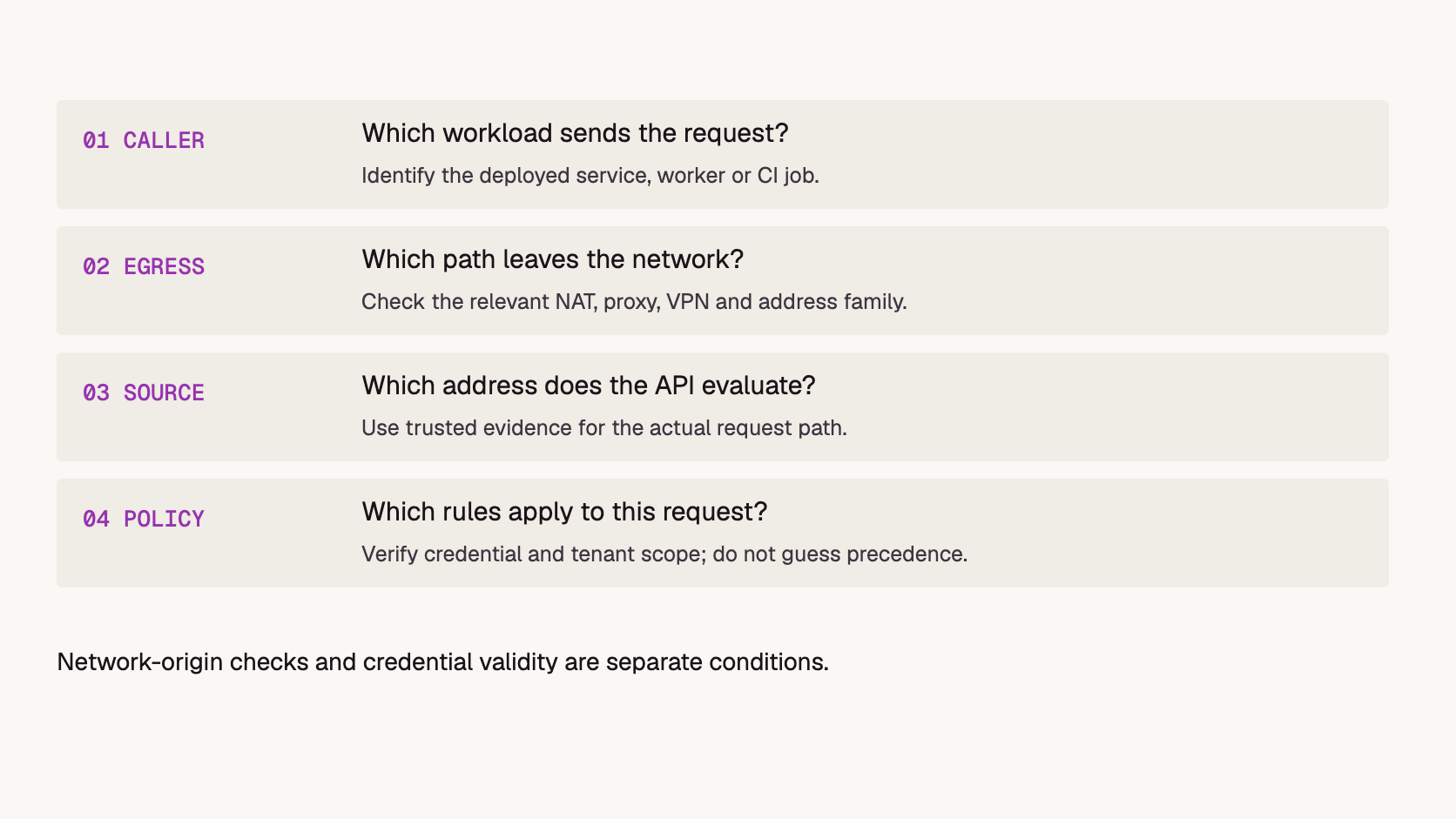
A valid key establishes one condition for access, while an IP rule establishes another. Passing authentication does not establish that the source network is allowed. First identify which layer rejected the request and what evidence it returned. Do not treat every forbidden response as an expired key or every failed connection as an allowlist error.
As checked November 5, 2026, OpenRouter’s Security settings documentation describes an Enterprise IP allowlist for covered inference keys and a 403 Forbidden response for disallowed sources. It distinguishes Management API keys from that coverage. Those details are OpenRouter-specific; they are not Token360 error-code or policy-scope guarantees.
Observation
First evidence to inspect
Conclusion to avoid
Authentication failure
Credential state and documented error body.
The network rule must be wrong.
Explicit source-IP policy rejection
Evaluated source and applicable policy.
A new secret will change the egress address.
Connection timeout
DNS, connectivity, firewall and request trace.
The API necessarily evaluated the allowlist.
Works from one deployment only
Each deployment’s actual outbound path.
Identical code implies identical source IP.
Keep the timestamp, endpoint, sanitized error and available request reference. Confirm that the failing request uses the intended environment and key identifier. Do not include the secret in a troubleshooting record. These observations narrow the cause without changing multiple controls at once.
Which IP address should the rule match?
The rule must match the address evaluated at the API’s trusted network boundary. In an internet-facing deployment, this may be a public egress address rather than a container’s private address or a developer’s laptop address. Trace the path from the actual calling workload, including any NAT, proxy or VPN, before selecting an allowlist entry.
AWS’s NAT gateway documentation provides a concrete example: private instances using a public NAT gateway and an internet gateway can appear externally through the associated Elastic IP. The instance’s private address is not the same thing as that internet-facing source. Other network designs require their own path verification.
A local test can therefore succeed while a deployed job fails, or the reverse. The code and key may be identical, but one request leaves through an office network and another through a cloud egress path. If a worker runs in a second region, verify that path separately rather than copying the first region’s address by assumption.
Prefer trusted gateway observations, controlled network logs or documentation for the actual egress configuration. A generic “what is my IP” check from a laptop does not establish the address of a backend job. Even a check from the workload can take a different route if your proxy rules vary by destination.
Do not fix an access problem by adding a client-supplied forwarding header. A service should derive trusted source information from its controlled proxy chain, not accept an arbitrary claim of origin. This guide does not establish Token360’s internal proxy implementation; it asks you to verify the source used by its policy evaluation.
What do IPv4, IPv6 and CIDR change?
An address rule covers the address family and range it actually specifies. An IPv4 host entry does not automatically authorize an IPv6 connection, and a neighboring address is not covered by a single-host rule. Check the service’s supported rule syntax, then compare the observed address with the intended network rather than relying on visual similarity.
We ran a local example on November 5, 2026 using Python 3.9.6 and its standard-library ipaddress module. The two synthetic rules are 203.0.113.8/32 and 2001:db8:42::/64. These are illustrative addresses, not destinations to configure for your application.
Example address
Matches either example rule?
Why
203.0.113.8
Yes
Exact IPv4 host match.
203.0.113.9
No
A different host is outside the /32 rule.
10.0.0.7
No
No matching range in this example.
2001:db8:42::7
Yes
Inside the example IPv6 /64.
2001:db8:43::7
No
Outside the specified IPv6 prefix.
Copy cidr-check.py:
"""Synthetic CIDR membership checks only. No network or API requests."""
import ipaddress,json,platform
from pathlib import Path
rules=['203.0.113.8/32','2001:db8:42::/64']
networks=[ipaddress.ip_network(r) for r in rules]
cases=[]
for address in ['203.0.113.8','203.0.113.9','10.0.0.7','2001:db8:42::7','2001:db8:43::7']:
 ip=ipaddress.ip_address(address)
 matches=[str(n) for n in networks if n.version==ip.version and ip in n]
 cases.append({'address':address,'matching_rules':matches,'matches_example_allowlist':bool(matches)})
result={'date':'2026-11-05','python':platform.python_version(),'scope':'Local mathematical membership only; not Token360 policy syntax, precedence, source-IP detection or live authorization. IPv4/IPv6 public-looking addresses are documentation examples.','rules':rules,'cases':cases}
Path(__file__).with_name('cidr-results.json').write_text(json.dumps(result,indent=2))
print(json.dumps(result,indent=2))
. The script makes no network requests and writes the result file beside itself. It tests mathematical membership, not Token360’s accepted configuration syntax, rule precedence or live authorization behavior.
Broadening a prefix may make a failing source match, but it also changes which other addresses match. That is an access-policy change, not merely a debugging convenience. Establish ownership and the intended network boundary before using a wider range. Where both address families are possible, validate the actual path used rather than assuming the IPv4 test covers both.
How do per-key and enterprise policies affect the diagnosis?
A request may be subject to more than the rule shown on one key’s settings page. Identify the account, tenant and credential scope of each applicable control before editing a local entry. If policy composition is not documented, verify it with an administrator or support instead of assuming that a key-level allowance overrides a broader restriction.
A useful incident record lists the key identifier, tenant, environment, intended source, observed source when available and policy owner. Keep the configured scope distinct from the request’s result. “The key contains this address” is not equivalent to “every applicable policy permits this request.”
Trace the request path before changing the rule. This diagram does not specify Token360’s internal network architecture.
Also distinguish control direction. An inbound inference allowlist governs requests reaching the API. It does not automatically configure an outbound webhook destination, a media download permission or inference data residency. Those paths and commitments need their own documented controls.
How should you test a change without widening access blindly?
Test both an intended permitted path and an intended denied path in a controlled environment, using the same relevant policy scope. Record the effective configuration and evidence from each request. A single successful call establishes little about the boundary; a denied call alone also does not establish that the intended application can still operate.
Inventory all legitimate callers first: production servers, background workers, scheduled jobs, deployment checks and any approved operational access. For each one, identify the owner and egress arrangement. Avoid assuming that a cloud platform’s broad public address range is equivalent to a dedicated source controlled by your organization.
Use a minimal authorized request appropriate to the documented policy coverage. A successful unrelated endpoint may not test inference-key enforcement. If a model invocation is required, use the agreed test workload and record its actual cost rather than asserting that validation is free. No such calls were made for this article.
Repeat the relevant checks from alternate production paths that are supposed to remain available, such as a failover region or replacement worker pool. This is a proposed validation plan, not a claim that every infrastructure setup changes addresses. Capture the evidence needed to show whether the path stays inside your intended policy.
When the observed source is unknown, obtain that evidence before changing the rule. If you cannot verify a denied path, record the missing validation rather than marking the deployment secure because an allowed request succeeded.
What should the rollback and support record contain?
A rollback record should identify the previous policy, the authorized operator, the trigger for reversal and the access path needed to make the change. Preserve enough request evidence to diagnose the mismatch afterward. Avoid emergency changes that silently turn a narrow boundary into unrestricted access without an owner, justification or review point.
Before enforcement, agree how an administrator will recover from accidental exclusion. Confirm the management workflow for your account rather than assuming that a competitor’s management-key exception applies. Record change times and the observed behavior; do not promise immediate propagation or zero downtime without evidence.
For support, provide the policy scope, sanitized failure response, timestamp, request reference and a description of the calling environment. Include trusted source-address evidence if you have it. Network information can itself be sensitive, so share it through the approved support channel rather than publishing a production allowlist in a blog comment.
Rotating a compromised key remains a separate action. An IP rule can narrow where a credential works, but it does not establish who is using it from an allowed network. Token360’s security guide treats origin restrictions, credential hygiene and application authorization as distinct controls.
An IP allowlist restricts the request origin under a specific service policy. It is not a general proof of identity, data residency or browser compatibility. Use the observed network path and documented scope to interpret failures. The local example only checks CIDR membership and cannot certify any account’s live access configuration.
Should I allowlist my laptop’s private IP?
Only use an address that matches the service’s actual evaluated source under the relevant network design. For internet traffic through NAT, a laptop’s private address normally does not describe the public egress address.
Does an IPv4 rule cover IPv6 too?
Not by itself. Check which address family reaches the API and the platform’s supported rule syntax. Our local example tests the two families separately.
Will creating a new API key fix an egress mismatch?
Not necessarily. A new key does not change the network path. It can also remain subject to the same enterprise policy.
Is this the same issue as CORS?
No. Browser origin controls and source-IP policy are different checks. Identify the actual failure evidence rather than treating a browser error as proof of an IP rejection.
Does the local script prove that Token360 will allow a request?
No. It only evaluates two example network ranges. Live source detection, policy scope, authentication and other controls were not tested.
Developer Guide
API
Build faster with one AI API.
Use Token360 to call video, image, audio, and text models with one key and one bill.


 Guides
 Guides
 Guides