Can AI Context Compression Remove Important Facts?
Context compression can remove facts a task needs. Compare truncation and summaries, check retained requirements, and validate before sending a request.
CONTEXT INTEGRITY · BLOG 163
By Token360 · Editorial review: November 5, 2026
Yes. AI context compression can make a request fit while removing a requirement, exception or unresolved decision that the answer depends on. Treat input fit and information preservation as separate acceptance checks. Before sending shortened history, verify the facts the task needs, their sources and any relevant tool-call relationships.
OpenRouter’s FAQ discusses endpoint and SDK compatibility. Following that integration question into its documentation exposes a separate issue: the request format may be compatible while an optional preprocessing step changes the content. This article examines that issue using its Message Transforms documentation and Token360’s published API references.
Our original contribution is a small, executable local fixture that checks whether three required strings survive a deliberately shortened history. It does not call a model or reproduce a provider’s compression algorithm. The results establish what the local transformation removed, not how well any model reasons or how often compression fails.
Read first: Token360’s model capability guide explains which limits and features need checking for the selected model. This article focuses on preserving information, rather than choosing the largest context window.
What does context compression actually change?
Context compression changes the input available for a later generation. Depending on the implementation, it may remove messages, shorten their contents or replace material with a summary. Those operations have different failure modes. Ask what is transformed, which layer performs it and what evidence remains, rather than assuming that “compression” preserves every fact.
As checked November 5, 2026, OpenRouter’s Message Transforms documentation describes a context-compression plugin that removes or truncates material from the middle to fit a model’s window. It explicitly positions the feature for situations that do not require perfect recall. That is a specific mechanism, not a definition of every vendor’s context management.
Approach
What changes
What to verify
Message truncation
Some original messages or parts are absent.
Required facts and complete interaction pairs remain.
Natural-language summary
Original wording is replaced with a new account.
Exceptions, uncertainty, values and sources remain accurate.
Curated task record
Selected facts are explicitly retained for a defined task.
Selection is complete, current and traceable.
No transformation
The application submits the original material.
The request fits and the model still uses the relevant evidence correctly.
This is a conceptual comparison, not a performance ranking. An excellent summary can suit a conversational recap, while verbatim evidence may be necessary for checking an exact instruction. The right acceptance rule depends on the task; fewer bytes or messages alone is not a quality measure.
Why can a request fit but still lose a critical condition?
Fitting a context window only establishes that the submitted input meets a size constraint. It does not establish that every task-critical fact survived preparation. A missing budget, negative instruction or pending approval can change the answer without producing an API error. Define the necessary facts before evaluating the shortened record or its output.
Consider a fictional procurement assistant. The opening asks it to compare vendors, and the latest message asks for a recommendation. Between them, the user supplied a budget cap, a required region and a note that approval is still pending. Keeping the opening and the latest request preserves the conversational outline while losing the actual decision constraints.
An apparently coherent answer would not show which facts were absent. Even a successful response with valid JSON would only establish its structure, not the completeness of the evidence behind it. Inspect the input transformation separately from output formatting and model behavior.
Not every omission matters equally. Removing a greeting is different from removing “not yet approved.” Before shortening, identify facts whose loss would change a decision. Do not decide importance only by message age or position: a requirement can be introduced once in the middle and remain applicable for the rest of the conversation.
What did our local preservation check show?
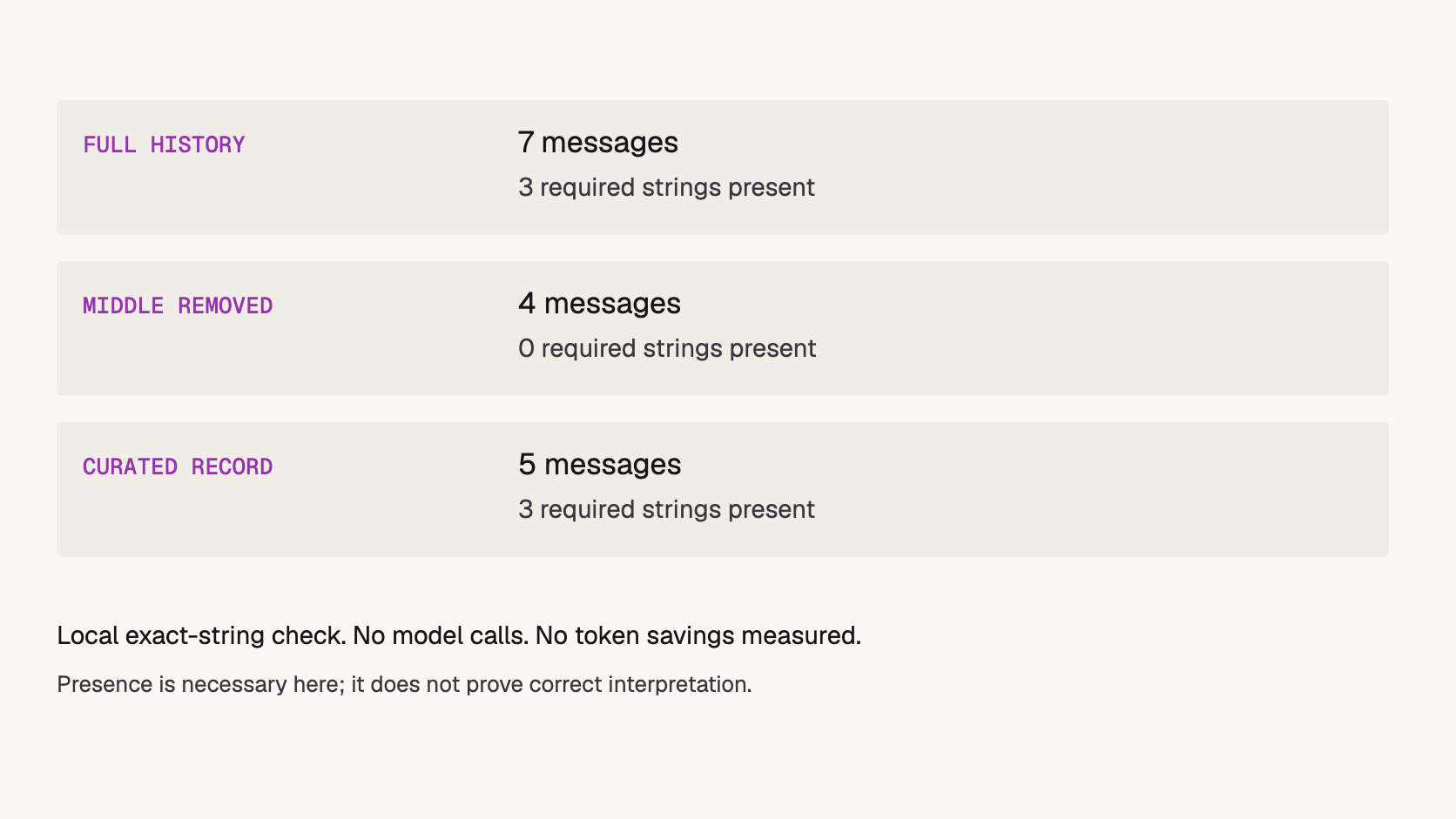
The local fixture starts with seven synthetic messages and checks three exact strings. Removing the three middle messages leaves four messages and none of those strings. Adding a manually curated requirements record produces five messages with all three strings present. These are deterministic input checks, not model accuracy results or measured token savings.
We ran the Python script shown above on November 5, 2026. The required strings are USD 12000, Procurement approval: PENDING and Required delivery region: EU. The full fixture gives each fact a fictional source reference. The shortening operation is simply first two messages plus last two messages; it is intentionally not a reproduction of OpenRouter’s implementation.
Local case
Messages
Required strings present
Observation
Full synthetic history
7
3 of 3
Baseline contains the supplied conditions.
Middle messages removed
4
0 of 3
The selected transformation deletes all three.
Curated record inserted
5
3 of 3
The manually retained record restores these strings.
Copy context-preservation-check.py:
"""Local synthetic fixture: exact-string retention, no model/API/tokenizer calls."""
import json
from pathlib import Path
messages = [
 {'id':'m1','role':'system','content':'Draft a vendor recommendation from the supplied facts. Do not invent approval.'},
 {'id':'m2','role':'user','content':'Compare the two proposals for Project Cedar.'},
 {'id':'m3','role':'user','content':'Budget cap: USD 12000. Source: finance-note-7.'},
 {'id':'m4','role':'user','content':'Procurement approval: PENDING. Source: approval-log-4.'},
 {'id':'m5','role':'user','content':'Required delivery region: EU. Source: requirements-2.'},
 {'id':'m6','role':'assistant','content':'I will compare the proposals against the supplied requirements.'},
 {'id':'m7','role':'user','content':'Write the recommendation now.'}
]
required = ['USD 12000','Procurement approval: PENDING','Required delivery region: EU']
# Deliberately remove the three middle messages. Not a vendor algorithm replica.
trimmed=messages[:2]+messages[-2:]
# Manually authored preservation record, not an AI summary.
record={'id':'curated','role':'user','content':'Budget cap: USD 12000 [finance-note-7]. Procurement approval: PENDING [approval-log-4]. Required delivery region: EU [requirements-2].'}
curated=messages[:2]+[record]+messages[-2:]
results=[]
for name,items in [('full_history',messages),('middle_removed',trimmed),('curated_record',curated)]:
 text='\n'.join(x['content'] for x in items)
 missing=[s for s in required if s not in text]
 results.append({'case':name,'message_count':len(items),'missing_required_strings':missing,'required_strings_present':not missing})
report={'scope':'Synthetic application-side exact-string check; no LLM inference, semantic evaluation, token count or vendor compression test.','date':'2026-11-05','required_strings':required,'cases':results}
Path(__file__).with_name('context-preservation-results.json').write_text(json.dumps(report,indent=2))
print(json.dumps(results,indent=2))
. It uses Python’s standard library and makes no network requests. Running it writes the results JSON beside the script.
The check has deliberate limits. Exact-string matching can miss equivalent wording or accept a string inside an incorrect statement. The curated record was manually written with knowledge of the required facts; it does not demonstrate an automated summarizer’s reliability. No tokenizer, API cost, response quality or provider behavior was measured.
Local synthetic fixture: message counts and exact-string presence, not token counts or model scores.
What should be preserved beyond the words themselves?
Preserve the meaning, authority and provenance of each requirement, not just its vocabulary. Keep pending decisions distinct from approvals, current facts distinct from superseded facts, and quoted material distinct from instructions. Where the workflow uses tools, retain the protocol relationships needed to interpret a call and its result without creating an orphaned interaction.
A compact record can use fields such as fact, status, source, effective time and superseded-by. For the fictional approval note, the status must remain pending even if the final request says “write the recommendation now.” A new request to draft an answer does not itself establish that an earlier approval condition changed.
Summaries also need scope. A record sufficient for selecting a vendor may omit wording needed for an exact quotation task. Keep source material available under the application’s access and retention rules, so a later request can retrieve the evidence it needs instead of treating an old summary as a complete archive.
For supported tool workflows, Token360 documents preserving tool-call IDs and arguments, retaining the assistant call and returning a result with its matching ID. A generic history slicer should therefore not delete one side of an interaction without respecting the endpoint contract. Our local fixture does not test tools; this is an additional integration requirement to validate.
What should Token360 integrations verify before enabling it?
Verify the selected endpoint and model instead of copying another platform’s compression switch. Identify any client-side summarizer, request middleware and documented API controls separately. A field appearing in a schema does not establish that every model supports the same behavior. Test the exact configuration and record unsupported behavior rather than silently assuming equivalence.
Token360’s Create response reference lists context-management and input-truncation fields. It also documents restrictions on stored response state, including unsupported stateful conversation and previous-response operations. These are reasons to check the actual contract, not evidence that a particular automatic compression policy has been tested here.
Do not paste OpenRouter’s plugin object into a Token360 request and assume identical behavior. This article has not verified that mapping. If a framework shortens history before making the request, the API may never receive the omitted material, regardless of the model’s advertised context size.
Use the response protocol compatibility guide to establish the endpoint family, then check the model-specific requirements. Record the input before and after transformations you control. For transformations you cannot inspect, ask for documented behavior and evaluate task-level results; do not claim knowledge of the exact input seen upstream.
When should the application reject rather than shorten?
Reject or pause when shortening would remove information required for the requested decision and no validated replacement is available. For lower-stakes recaps, an explicit summary may be acceptable. Make that choice part of the application’s task policy, with a clear fallback, instead of allowing an invisible transformation to decide which requirements matter.
A useful acceptance policy distinguishes three outcomes: all required evidence is retained; evidence can be recovered from authorized sources; or evidence is unavailable. The third should produce a clarification or an explicit inability to complete the task, rather than an answer that appears to have considered the whole record.
Possible alternatives include retrieving a smaller relevant source set, asking the user to narrow the task, or choosing a compatible larger-window model. These are options to evaluate, not verified fixes from our fixture. Retrieval can miss evidence too, and a larger window does not establish correct reasoning.
Keep permissions outside free-form summaries when they control real actions. A generated recap saying “approved” should not replace the application’s authoritative approval record. Similarly, do not promote quoted document text into a higher-priority instruction simply because it appears in a newly created summary.
How can you evaluate a compression change before rollout?
Compare the original and transformed inputs against a task-specific checklist before comparing answers. Then test whether the resulting answers respect the retained requirements and cite usable evidence. Hold other settings stable where practical. Report preservation and task performance separately, because passing one does not imply passing the other across future requests.
Build a small set of representative cases with known expected facts: a mid-conversation correction, a negative condition, an unresolved approval, a tool interaction and a requirement introduced early but still active. Include cases where the expected behavior is to ask for missing information. These are proposed evaluation cases, not additional experiments run for this article.
For each case, record the transformation version, original source references, retained facts, missing facts and output assessment. Measure request size using the appropriate tokenizer or documented accounting if size is part of the decision; message count from our fixture cannot stand in for tokens.
A rollout decision should consider both acceptable task results and operating costs observed on that workload. We have no measured cost reduction to report. Preserve the ability to disable a transformation when evidence loss appears, and avoid changing the prompt, model and compression policy together if you need to understand which change caused a regression.
Context compression is an input-management choice, not a guarantee that a model has all the evidence it needs. These questions address the distinction between shortening a record and preserving its meaning. Provider-specific controls still require their own documentation, and the local fixture only measures exact-string presence in an application-created input.
Is context compression the same as prompt caching?
No. This article uses compression to mean changing or selecting input content. It does not evaluate caching behavior, cache eligibility or cached-token prices. Do not use the terms interchangeably when reporting a change.
Does a summary guarantee that important facts survive?
No. Check the actual requirements, exceptions and source references. A fluent summary can still omit a condition, and exact-string presence alone is not a full semantic check.
Will a larger context window solve this?
It may allow more input, but it cannot restore material a client removed before submission. Verify the complete path from history storage to the submitted request.
Did this test show that a provider loses procurement requirements?
No. We deliberately removed the middle of a synthetic local history. No provider or model received the fixture. The result demonstrates the local operation’s effect only.
Can I use a successful API response as the preservation test?
No. Keep a separate check for required input evidence and another for the answer’s correctness. A successful request does not certify either.
Developer Guide
API
Build faster with one AI API.
Use Token360 to call video, image, audio, and text models with one key and one bill.



 Guides
 Guides
 Guides