Stop automatic retries for confirmed content policy errors. Distinguish blocked content from technical failures and prepare a clear review record.
AI API OPERATIONS · BLOG 156
By Token360 · Editorial review: November 5, 2026
A confirmed AI API content policy error should leave the automatic retry loop and enter a review path. It is different from a temporary capacity failure or an invalid parameter. Read the documented error code and job state, preserve the available identifiers, and explain the outcome without guessing which part of the request triggered it.
A media workflow can treat every unsuccessful generation as “try again” and still be wrong about what happened. When the response identifies a policy block, a longer delay does not address the stated reason. The application needs a separate outcome that users, support and operations can understand.
This article develops that review path for teams integrating AI APIs through Token360. It uses published documentation and synthetic acceptance scenarios, not live moderation tests. It does not measure false-positive rates, promise that revised content will be accepted or claim that Token360 exposes the same error fields as another platform.
Read first: Token360’s limits, timeouts and retries guidance explains the broader separation between transient failures and conditions needing intervention. This article focuses specifically on confirmed content-policy blocks and their review workflow.
What does a content policy error actually establish?
A content policy error establishes that the service classified a request or result as blocked under its checks. It does not, by itself, identify the exact offending word, prove deliberate misuse or establish a technical outage. Use the documented response as evidence of the decision, and keep any explanation within the detail actually provided.
The fal Model APIs FAQ, checked November 5, 2026, asks why a request was rejected for a content policy violation. It describes content_policy_violation as a non-retryable HTTP 422 error. This question supplies the topic here; it is not a claim about Token360’s error schema.
For an enterprise application, the immediate business question is what to do with the affected task. A confirmed block should be distinguishable from “still processing,” “temporary service failure” and “completed successfully.” Otherwise, dashboards and customer messages can report activity while the same blocked request is repeatedly resubmitted.
Use measured language such as “The service blocked this request under its content checks.” Do not say “Your image definitely contains prohibited material” unless the evidence supports that specific statement. A broad category or generic message may be insufficient to identify an individual asset or passage.
How is a policy block different from validation or a transient failure?
Classify the documented reason before choosing an action. A policy block calls for review; invalid parameters call for a corrected request; a documented transient failure may allow bounded retry. An HTTP status alone is too coarse for this decision. Unknown or ambiguous results need investigation rather than a default assumption that retry is safe.
Observed condition
Next action
Do not infer
Explicit, documented content-policy block
Stop automatic resubmission; route to review.
That waiting or changing the seed resolves it.
Missing field or unsupported parameter
Correct the documented input requirement.
That the content was judged unsafe.
Documented temporary capacity failure
Apply the endpoint’s bounded retry policy.
That all failures from the endpoint are transient.
Submission timeout with unknown task state
Reconcile the original task before creating another.
That no generation work started.
Unrecognized error or incomplete response
Preserve context and investigate.
That it belongs to a known policy category.
The fal error reference uses machine-readable error types and warns against parsing message prose for conditional logic. Its policy error can include broad categories, but those categories are optional. The page also notes that some endpoints do not yet strictly follow the documented structure. Checked November 5, 2026.
That is a reason to build endpoint-aware handling, not to copy one provider’s object shape into every integration. Keep the original response available under your approved logging policy, then translate confirmed meanings into your application’s own outcome categories.
Can a task be accepted before a policy failure appears?
Yes, an asynchronous service can acknowledge a task before its final outcome is known. Treat acceptance and completion as different events. A successful submission response does not prove that generation finished or that content checks passed. Inspect the eventual task state and its documented failure reason before displaying a completed result.
As a concrete example, Luma Agents’ error-handling documentation, checked November 5, 2026, distinguishes synchronous errors from asynchronous failures discovered while polling. Its failure-code table separates content_moderated from generation_failed and gives them different retry guidance. This is a Luma-specific example, not a Token360 response contract.
Consider an application that gets a job identifier, shows a progress indicator, and later receives a documented policy failure. The correct state transition is from pending to blocked or review-required. Keeping the task “pending” forever, or silently creating a replacement task, hides the terminal result from the user.
Token360’s asynchronous timeout guidance says to poll the returned resource after submission and warns that a client timeout does not prove upstream work never started. Apply the selected endpoint’s actual task schema; do not invent a universal moderation field.
What should happen after the application confirms a policy block?
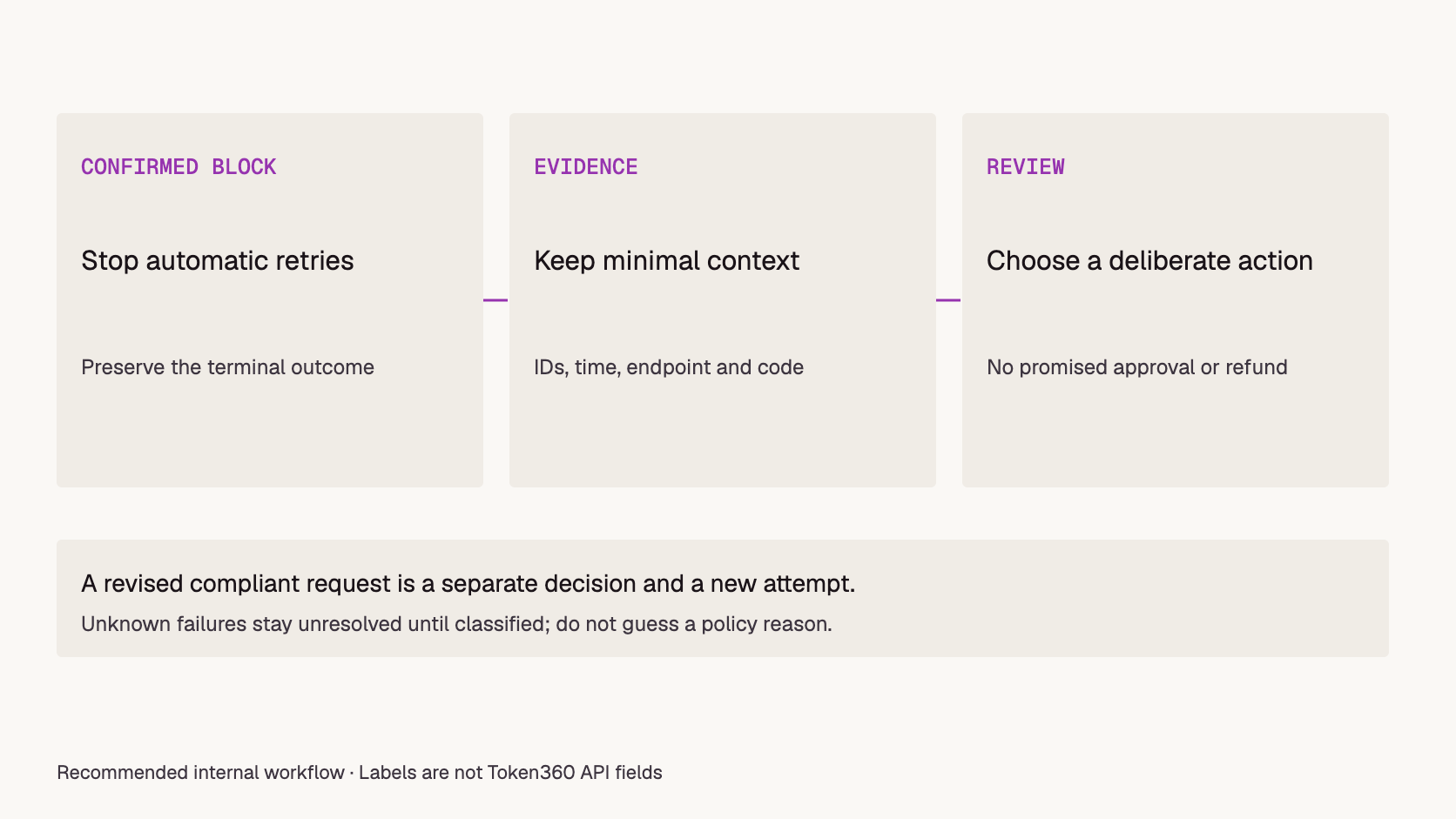
Stop the automatic attempt chain, retain a minimal review record and present an explicit blocked outcome. Allow a deliberate next action after the request has been reviewed against the applicable policy. Keep this path separate from transient-failure recovery so that a generic retry button or fallback rule does not silently restart the same rejected work.
Close the attempt. Record the known terminal state and correlate it with the original task. Do not continue showing it as active generation.
Hold automatic retries. Ensure the worker, queue consumer and user-interface retry behavior agree on the result.
Preserve useful evidence. Keep identifiers, timestamps and the documented code with the relevant model and endpoint.
Offer review. Let the user inspect the applicable policy or request support review where available.
Record any later decision. A deliberately revised, compliant request is new work with its own record, not proof that the initial block was mistaken.
Recommended application workflow. These labels are internal states, not Token360 API fields.
A fallback policy deserves the same distinction. An infrastructure failover and a content-review decision serve different purposes. Do not automatically route a confirmed block elsewhere merely to obtain the rejected result. If the content appears compliant, seek clarification or revise the task to meet the applicable rules rather than disguising it.
This is a workflow recommendation, not a claim that every platform offers an appeal endpoint or will reverse a block. Your application should explain the actual available next step.
What should the customer-facing message say?
Tell the user what is known, what has stopped and what action is available. Avoid accusations, unsupported explanations and promises of a refund or future acceptance. A useful message identifies the blocked outcome without revealing sensitive request content and gives a reference the support team can use to locate the attempt.
Example wording for your own application: “This request was blocked by the service’s content checks. Automatic retries have stopped. Review the applicable content policy or contact support with reference [reference].” Replace the placeholder with a safe customer-facing reference; do not expose credentials or internal access details.
Only offer an action that exists. If your product has no support-review process, do not label a button “Appeal.” If the reason is unspecified, do not fabricate a category. If no charge decision has been confirmed, keep the billing status separate from the generation status.
For a revised request, make clear that submitting it starts a new attempt and may have separate processing and billing consequences. Whether a failed or blocked request is charged depends on the applicable service terms and recorded usage. This article does not assign Token360 a blanket refund rule for content blocks.
What evidence should be kept for a suspected false positive?
Keep enough information to locate the decision and explain the intended use, while avoiding unnecessary copies of sensitive inputs. Mark a suspected false positive as a reviewer’s hypothesis, not a confirmed diagnosis. Record the service’s stated reason separately from the user’s interpretation, and use an approved support channel for any additional material requested.
Token360’s support guidance requests the UTC time range, public model, endpoint, HTTP status, error code, request ID and trace ID. It instructs users to remove prompts, files, authorization headers and API-key secrets unless support requests secure transfer. Those fields help locate an event; they do not establish why a classifier made its decision.
For internal review, add a short description of the legitimate intended task, the stage where the failure appeared and the exact scope of uncertainty. For example: “A policy code was returned after submission. We have not established whether the input or generated result triggered the check.” Use that wording only when it accurately reflects the available evidence.
The record should distinguish “review requested,” “response received” and “outcome confirmed.” No response is not approval, and a later successful generation is not by itself proof that the earlier block was erroneous. Avoid making a false-positive-rate claim from a few support cases.
How can a team validate this workflow without a live moderation experiment?
Use synthetic response fixtures to check the application’s behavior, then separately verify compatibility with the selected endpoint. Fixtures can show whether your queue stops, your interface updates and your records remain traceable. They cannot measure a provider’s moderation accuracy, acceptance rate or billing behavior, and they should never be presented as live generation results.
Copy blog156-policy-review-fixtures.csv:
Synthetic scenario,Expected behavior,Actual behavior,Pass/fail/not run,Reviewer/date,Evidence reference
Immediate confirmed block,Stop retries and show blocked state,,Not run,,
Accepted then policy failure,End pending state; preserve task ID; no replacement job,,Not run,,
Validation sharing HTTP status,"Correction path, no policy accusation",,Not run,,
Unknown failure code,Preserve original and investigate,,Not run,,
User retry after block,"Review decision, no automatic unchanged resubmission",,Not run,,
Support export,Minimal diagnostic context; no secrets or unnecessary input,,Not run,,
. The file contains six proposed cases and blank fields for actual results. It is a test plan; these tests have not been executed in your application.
Synthetic scenario
Expected application behavior
What to inspect
Immediate confirmed policy rejection
Stop retries; show blocked outcome.
No additional submit attempt from the worker.
Accepted task, later documented policy failure
End progress state; preserve original task ID.
No replacement job created automatically.
Validation error sharing an HTTP status with a block
Show the documented correction path.
No unsupported policy accusation.
Unknown failure code
Escalate classification rather than guess.
Original code retained for investigation.
User clicks retry after a confirmed block
Require a deliberate review decision.
No hidden resubmission of unchanged rejected work.
Support export
Export minimal diagnostic context.
No API key or unnecessary input content included.
Run the cases against the layers that can initiate work: the client, application backend and background worker. A correct message on screen is insufficient if another component continues retrying. Record observed behavior rather than marking a scenario passed because the intended logic looks reasonable.
These answers distinguish a documented policy decision from assumptions about causes, charges or model quality. Follow the selected endpoint’s current documentation and the terms applicable to your account. The proposed review workflow does not establish a universal error schema, guarantee a successful revision or replace the service’s own content policies.
Will waiting longer fix a content policy error?
Waiting does not address the stated policy reason. A confirmed non-retryable block should leave the automatic retry path and be reviewed.
Does every HTTP 422 mean content was blocked?
No. Validation errors and policy errors can share a status. Inspect the documented machine-readable reason rather than the status alone.
Does changing the seed guarantee acceptance?
No. This article has no evidence that a different seed resolves a block. Do not treat seed changes as an automatic policy-error recovery mechanism.
Does a content block prove that the model is unreliable?
No. A policy outcome and a technical availability failure are different observations. Neither one isolated result nor the synthetic cases here establishes overall model reliability.
Are blocked requests always refunded?
Do not assume that. Check the applicable billing terms and usage record; the content decision alone is not a refund confirmation.
Developer Guide
API
Build faster with one AI API.
Use Token360 to call video, image, audio, and text models with one key and one bill.


 Guides
 Guides
 Guides