How Do You Choose a Text Summarization API for Work?
Choose a text summarization API by testing required facts, source evidence and review effort. Compare the full cost of an accepted business brief.
Choose a model for summarization by the facts it must preserve, the sources it must reference and the document volume it can process. Test the proposed API on the same approved document set before comparing cost. A shorter or more fluent brief is not necessarily the more useful business result.
An executive digest, a support-case handoff and a summary of a supplier report can all be called “summarization.” They need different selection rules. Before comparing providers, define who will read the result and which decision it is meant to support.
This article is a procurement framework for document and text workflows, not a model ranking. Official documentation was reviewed on November 17, 2026. No summarization benchmark was conducted for this article; its examples and worksheet are proposed evaluation materials.
Do you need a dedicated summarization endpoint?
Not necessarily. A general language-model endpoint can perform summarization when the application supplies the source and appropriate instructions. A specialized service may package additional controls or processing. Compare what is included—input handling, output structure, evidence and operations—rather than requiring the word “summarize” in the endpoint name.
Ask whether the quoted service accepts plain text, uploaded files or externally hosted documents. File extraction, OCR and table handling may be separate steps. If the workflow starts with PDFs, resolve the PDF input path before judging the generated brief.
Component
What to establish before buying
Input preparation
Who extracts readable content and detects missing pages or sections?
Model call
Which model, input limits and output controls apply?
Evidence
Can the application preserve source IDs and verifiable locations?
Review and delivery
Who checks the brief and sends it to the authorized reader?
Operations
Who handles failures, model changes and revised source documents?
What should the business specify before a pilot?
Specify the audience, purpose, required information and allowed exclusions before testing models. A generic instruction to “summarize this” leaves the model to choose what matters. A useful buying brief states the output format and rejection conditions while leaving enough room to preserve important qualifications, uncertainty and conflicting evidence.
For a supplier-status report, the purchasing team may need delivery risks, affected orders, unresolved questions and the report date. A general overview that highlights the supplier’s history could be accurate yet unhelpful. Relevance is part of acceptance, not just factual correctness.
Workload
Reader needs
Potential rejection condition
Support-case handoff
Current issue, attempted remedies and unresolved state
A failed remedy is presented as a resolution
Supplier-status brief
Current risks, dependencies and affected items
A conditional estimate becomes a firm delivery date
Internal policy digest
Applicable scope, changes and exceptions
An exception disappears from the relevant rule
Research reading brief
Claims, limitations and source identity
The source’s uncertainty becomes the model’s certainty
These are hypothetical acceptance examples, not observed failures. Choose only the requirements that matter for the planned workflow; a reading aid and an operational handoff should not automatically share the same template.
If the source is a recording, first choose the video-to-text workflow that supplies the speech or visual evidence the summary requires.
What evidence should accompany a business summary?
Important summary points should remain traceable to the supplied source. Decide whether the application needs document IDs, section references, quotations or native citation objects, and verify the implementation. A citation makes review easier only when it leads to supporting content; its presence alone does not establish that the claim is correct or the summary complete.
Evaluate the brief as a business deliverable, not just a generated paragraph.
Anthropic documents citation support for supplied documents. If that capability matters, confirm support in the exact model route and response format you plan to buy. Do not assume that a prompt requesting page numbers provides the same behavior.
Keep the source version with the result. If a report changes, the old brief should not silently appear to describe the new version. Also preserve access restrictions: a summary should not expose restricted source information to readers who cannot access it.
For long inputs, ask how the system detects truncation and what content actually reaches the model. A larger advertised window is not proof of complete processing. The long-context model guide addresses that capacity decision in detail.
How can you compare candidates without rewarding style?
Use a common evaluation pack with reviewer-defined required facts and explicit rejection rules. Test the same source versions and document preparation, then inspect coverage, unsupported claims, qualifiers and correction effort separately. Assess readability after those checks. A pleasant writing style should not compensate for an error that changes the business meaning.
Build the pack from representative, approved material rather than a single easy report. Include the structures your team encounters: long appendices, tables, repeated updates or contradictory statements where relevant. Reserve some examples for evaluation after prompt development.
A practical review record can separate five questions:
Were the required facts included?
Does every material claim have support in the supplied source?
Were conditions, dates and uncertainty preserved?
Can the reader follow the evidence and identify the source version?
How much correction was needed before the result was usable?
Use the blank summarization API evaluation worksheet to record those observations by document class. It contains no fabricated scores. Set the pass threshold with the business owner; do not infer a universal standard from a vendor’s aggregate benchmark.
Evaluate the task the API will actually perform. Shortening conversation history for another model is a different workload, covered by the context-compression review.
How should you estimate the cost of accepted briefs?
Include input processing, model usage, retries, evidence handling and human correction when estimating cost. Compare equivalent documents and output requirements, not different-length summaries billed under different conditions. Separate one-time integration from recurring work, and record whether the application processes each document once or regenerates several versions for different audiences.
A shorter output can reduce generated text without reducing the input that must be processed. Splitting a document into sections may also introduce additional calls and a final synthesis step. These are implementation choices to measure, not automatic cost savings.
Ask for usage records from a bounded pilot before projecting production spend. Keep small, ordinary and large documents distinguishable; a single average can hide expensive outliers. Include manual correction as an operational cost even if it does not appear on the model invoice.
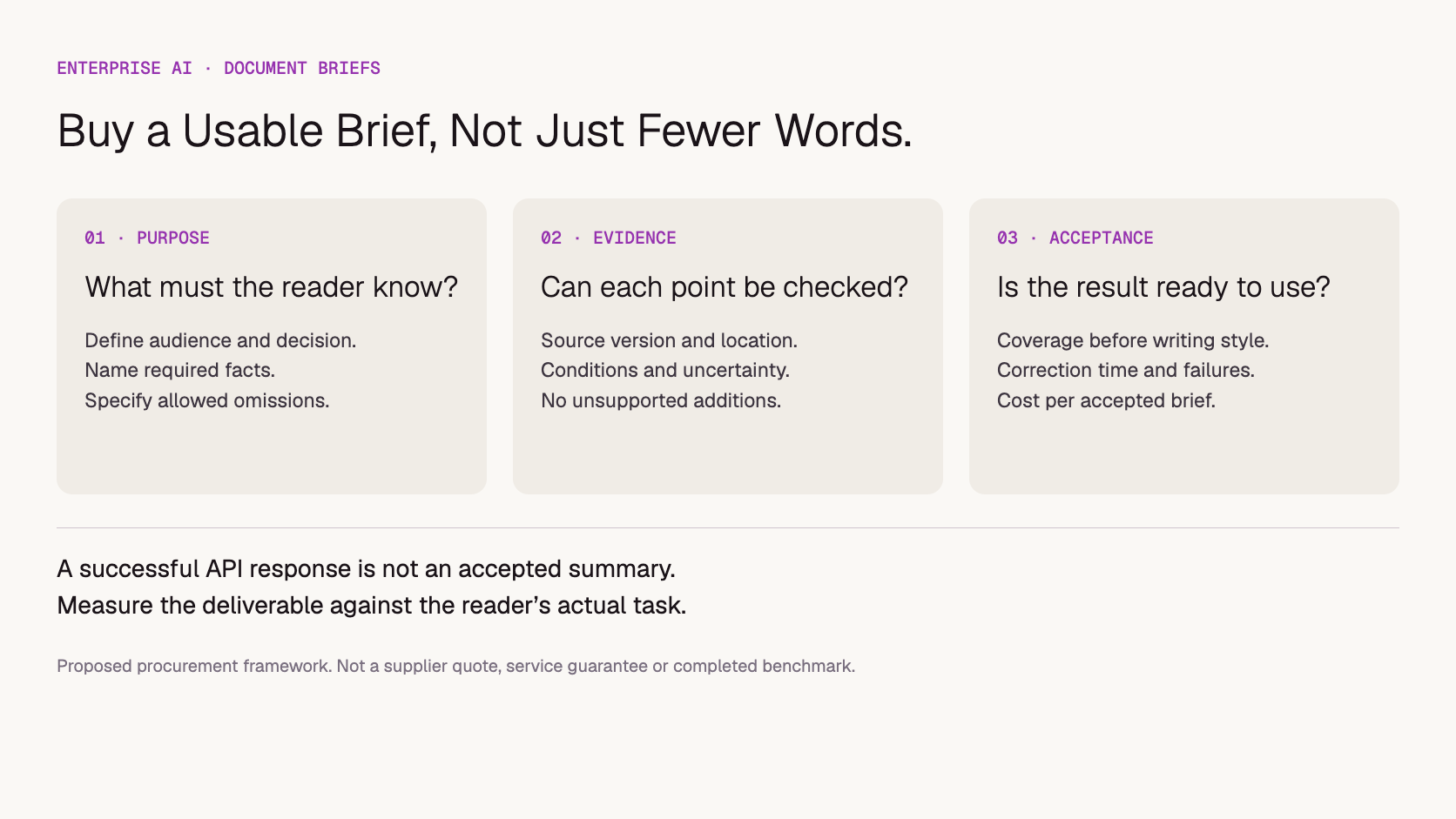
The useful comparison is the cost and turnaround of an accepted brief for the intended reader. Do not count a returned response as accepted merely because the API request succeeded.
What should you confirm with Token360?
When evaluating through Token360, confirm the selected language model, supported input path, output limits and commercial scope for your summarization workflow. Model access does not by itself establish document connectors, native citation support or a complete review application. Bring the acceptance pack so that technical and commercial discussions refer to the same deliverable.
Token360’s enterprise page describes model access, usage-based pricing and technical support. Check the current model catalog for candidate availability and verify the exact requirements before implementation. See About Token360 for company context. No summarization quality guarantee is established by this article.
Frequently asked questions
Is the shortest summary the best?
No. A shorter brief is useful only if it preserves the information required for its purpose. Define what may be omitted and what must survive before setting a length constraint.
Can one prompt work for every department?
It can be a starting point, but departments may need different facts and evidence. Test templates by document class and reader purpose rather than assuming one successful example transfers to every workflow.
Do citations guarantee factual accuracy?
No. Check whether the cited passage supports the claim and whether the brief omitted important information elsewhere. Traceability and completeness are separate acceptance checks.
Should the summary replace the original document?
Usually it should remain linked to the source as a reading aid. Define when users must consult the original and how corrections or source changes trigger a new brief.
Document ID,Source version,Document class,Reader purpose,Required facts,Model and prompt version,Missing fact,Unsupported claim,Changed qualifier,Source link valid,Correction minutes,Total processing cost,Accepted,Reviewer note
Enterprise AI
API
Bring your next idea to life.
Create a video scene in Creator, or explore models for images, audio, and text to find the right capabilities for your project.



 Guides
 Guides
 Guides