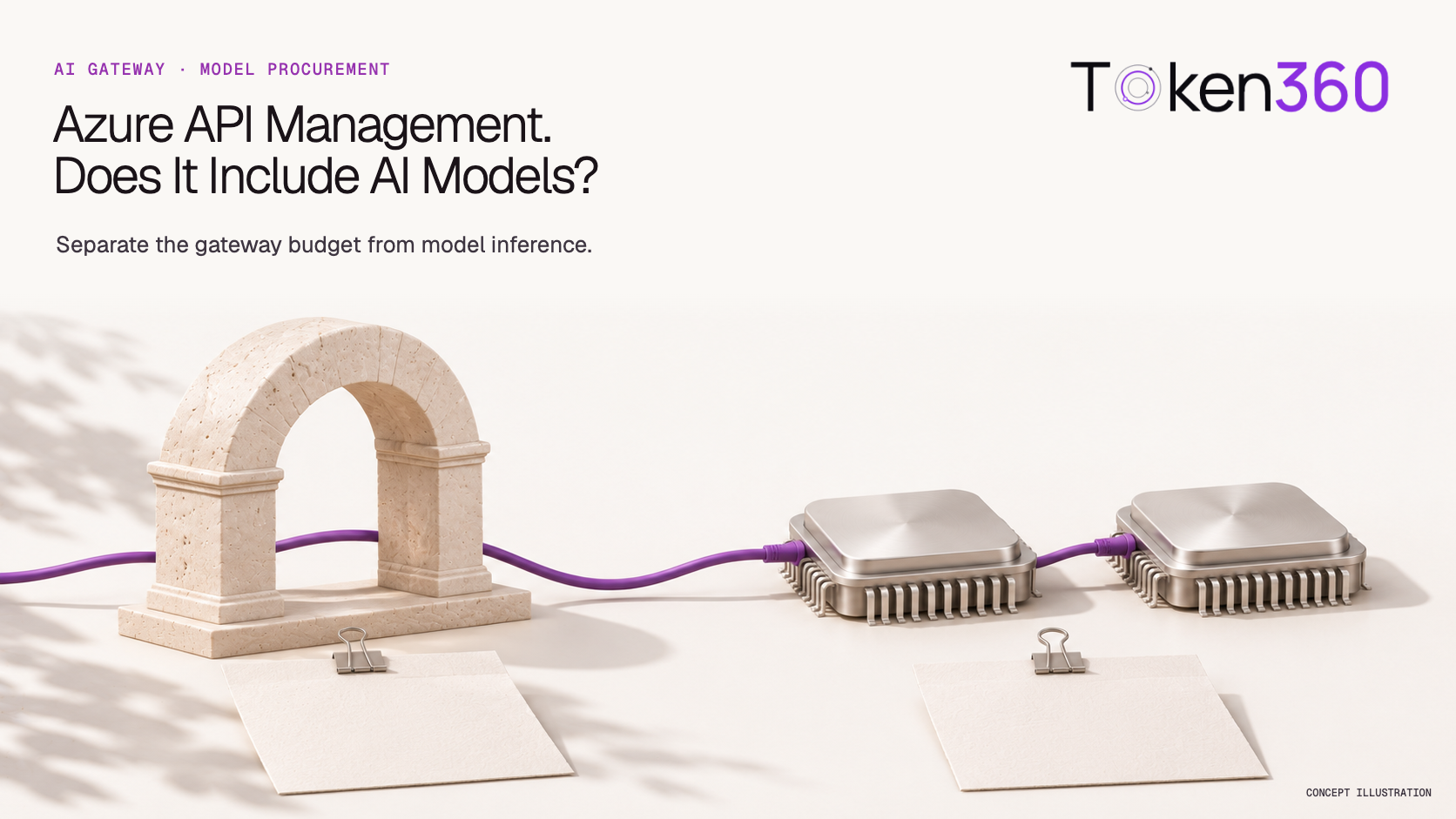
Buying Azure API Management does not, by itself, buy the AI model inference behind it. Separate the gateway order from the model service order. Even when both appear on an Azure bill, access rights, usage meters and capacity commitments can belong to different resources.
This is a documentation-based procurement analysis, not an Azure–Token360 integration test or a current regional price quotation.
What does Azure API Management pricing actually cover?
Azure API Management pricing covers the selected API management service and its applicable usage charges. Treat model execution as a separate budget line unless a written offer explicitly includes it. An API published in a gateway is a managed route to a backend, not evidence that backend inference has been purchased.
Microsoft describes API Management as a way to publish and manage APIs hosted in Azure, on-premises and other clouds. Its pricing page distinguishes service tiers, request allowances and additional scale units. Those are gateway commercial terms; they are not a list of included language, image, audio or video model credits.
Price-check limitation, November 22, 2026: the public page retrieved for this review displayed placeholders for some regional prices and said pricing details for the AI Gateway tier were coming soon. Obtain the configured calculator estimate or written quote for the actual region, tier, currency and agreement. This article intentionally does not substitute an assumed monthly dollar amount.
Separate the purchase scopes before comparing a total
| Purchase scope | What to confirm | What it does not establish |
|---|
| API Management | Tier, region, gateway units, request allowance and applicable excess charges | Prepaid inference for every backend |
|---|
| Model service | Exact model, endpoint, billing unit, usage rate and access rights | An included enterprise gateway deployment |
|---|
| Backend capacity | Shared limits or specifically purchased capacity and its conditions | More model throughput merely because gateway units increased |
|---|
| Supporting services | Which logging, cache, networking and security resources the design actually uses | That every optional component is necessary or included |
|---|
The practical approval question is: “Which resource pays for the response?” If the quote names only API Management, the model-service budget remains unresolved. For the broader architectural choice, see our AI gateway versus direct API comparison; the decision here is the scope of an Azure purchase already under consideration.
How should you budget for the gateway and the model?
Build the estimate from separate gateway, inference and supporting-service lines, then reconcile them against the same workload. Do not multiply gateway requests by a model token rate. A gateway operation, a model request and a billable model unit describe different quantities, and one application action may involve several upstream calls.
Use this planning expression, not as an Azure price formula: monthly project spending = applicable gateway charges + model service charges + selected supporting services. Put implementation effort in a separate project-cost line if procurement needs a full investment comparison. Our AI API total cost of ownership analysis owns that broader calculation.
Consider a hypothetical internal assistant. Staff submit questions through APIM; the application may call an embedding service and a generation model. Finance should ask the application team to list those calls instead of assuming one employee question equals one charge. The model estimate should distinguish input, output and any other billable units required by the chosen service.
The same discipline applies when a new supplier replaces only the inference backend. Retained gateway costs belong in both scenarios; charge only the changed model rates, added resources and migration effort to the change. Otherwise, a comparison can appear to save the full gateway bill even though the organization plans to keep paying it.
- Record the gateway estimate: configured SKU, region, scale, traffic assumption and estimate date.
- Record the model estimate: model/version, expected usage mix, rate source and capacity arrangement.
- Record dependencies: identify each separately provisioned resource and its owner; do not treat an unpriced dependency as free.
- Record reconciliation: define how application request records will be matched to gateway and supplier usage records without exposing credentials or unnecessary prompt content.
Ask for a low-use and expected-use scenario, plus the specific event that would trigger a larger bill. This is more useful than a single total whose request and token assumptions cannot be reconstructed.
Does an APIM subscription key buy access to a model?
An APIM subscription key authorizes calls to APIs published through that API Management instance. It is not proof of a model supplier account, funded inference balance or model entitlement. Procurement needs both the permission to use the published route and a confirmed arrangement for the backend that fulfills the request.
Microsoft explicitly distinguishes an API Management subscription from an Azure subscription. This terminology can confuse a purchase discussion: a developer can be given an APIM key while the organization still needs to arrange the upstream service and authentication.
Ask the implementation owner to explain two access decisions in plain language: who may call the gateway, and how the gateway or application is authorized to call the backend. Record the relevant service owner for each. Do not copy secret values into a procurement worksheet.
Publishing an API also differs from purchasing it. Microsoft's import-and-publish tutorial describes a gateway configured in front of a backend URL. Importing a definition establishes a route and its configuration; it does not establish commercial rights to any arbitrary backend named in that definition.
A useful acceptance record contains the approved backend URL, exact model identifier, non-secret account reference, authorized use and billing owner. That is stronger evidence than a screenshot showing an API in a developer portal. If a supplier proposes a bundle, ask the quote to identify the included model usage and any exclusions explicitly.
Will a larger gateway plan increase model throughput?
A larger gateway deployment does not automatically increase the model backend's capacity. Approve gateway sizing and model capacity as separate decisions. The available end-to-end throughput depends on the actual route and workload, so neither a gateway request allowance nor a configured token limit should be read as purchased inference capacity.
Microsoft's AI gateway documentation says backend AI services must also be scaled when gateway capacity grows. It describes token quotas and traffic controls as management capabilities. Applying a control to consumption is different from arranging supply to satisfy that consumption.
For a launch, ask the supplier and platform team different questions. The platform team should explain whether the selected APIM configuration can carry the expected request pattern. The model supplier should identify the model-specific limits or purchased capacity available during the same period. The application owner should provide realistic input lengths, output lengths and concurrency.
Do not infer that two routes with the same model name have identical limits or commercial commitments. Nor should procurement accept “unlimited gateway requests” as an unlimited-model promise. The quote must state which service the allowance describes.
Before approving additional capacity, require a defined test window, workload and acceptance threshold. This article supplies no benchmark and makes no latency claim. If measured demand is below the backend's available capacity, buying more reserved inference merely because a gateway is being upgraded may address the wrong constraint.
What must pass before an external model route is approved?
Approve the exact external model route only after its required behavior, access controls and usage records have been checked together. A gateway's general support for an API schema is not verification of every supplier endpoint. Treat compatibility as a scoped acceptance result, with a documented configuration and explicit exceptions.
Microsoft documents AI backend management capabilities with availability that varies by tier. This provides a basis for evaluating a route, not evidence that Token360 has been tested with your selected APIM configuration. No such test was performed for this article.
Proposed purchase acceptance checks; these are not reported test results
| Check | Evidence to request | Decision affected |
|---|
| Required request types | Successful examples for each required endpoint, including streaming or media only where needed | Whether the route covers the purchased workload |
|---|
| Authentication and errors | Allowed and denied calls; clear ownership for expired credentials and upstream failures | Whether access and support responsibilities are workable |
|---|
| Usage attribution | A small controlled set of calls matched to applicable usage records and billing units | Whether the estimate can be reconciled after launch |
|---|
| Data handling | A map of data sent to each service and configured logs, plus relevant agreed terms | Whether the proposed route meets the buyer's requirements |
|---|
| Workload acceptance | Buyer-defined latency, error and output-quality checks under representative demand | Whether the implementation is ready for the intended use |
|---|
A successful text response does not cover every integration requirement. If the buyer needs streamed answers or image inputs, include those in the acceptance scope rather than assuming they follow from a basic chat test. Keep general gateway governance evaluation in the enterprise AI gateway checklist; this purchase record should identify only the requirements of this APIM-to-backend route.
What should you ask Token360 to quote separately?
Ask Token360 to quote the model service your company needs, while identifying the existing Azure gateway as part of the proposed environment. Request confirmation of the exact models, billing scope and integration requirements. Do not describe Azure APIM compatibility, reserved capacity quantities or particular compliance controls as already verified.
Token360's company-confirmed business covers enterprise access to text, image, audio and video models. Enterprise quotes are tiered: higher usage receives lower quoted rates under the agreed scope. Token360 does not charge a separate service fee; this does not remove charges for independently purchased Azure resources. See about Token360 and its enterprise inquiry page.
Send a request that makes the buying boundary visible:
We already operate, or plan to buy, Azure API Management in [tier and region]. We need [model and endpoint requirements] for [workload], with expected usage of [input/output or other applicable units]. Please quote the model service separately, identify any minimums or capacity conditions, and confirm what must be validated for our proposed APIM route. List unverified or unsupported requirements rather than treating them as included.
Attach the acceptance checklist and ask who owns each unresolved item. Capacity, contract and compliance requirements can be discussed for the engagement; the signed scope must identify what is actually provided. No Azure partnership, native APIM connector, marketplace billing arrangement or integration certification is established by this article.
The approval package should contain two clear service scopes even if a commercial arrangement consolidates billing: the gateway that manages the route, and the model service that produces the output. That lets procurement compare a model quote without accidentally treating existing gateway management as included inference.


 Guides
 Guides
 Guides