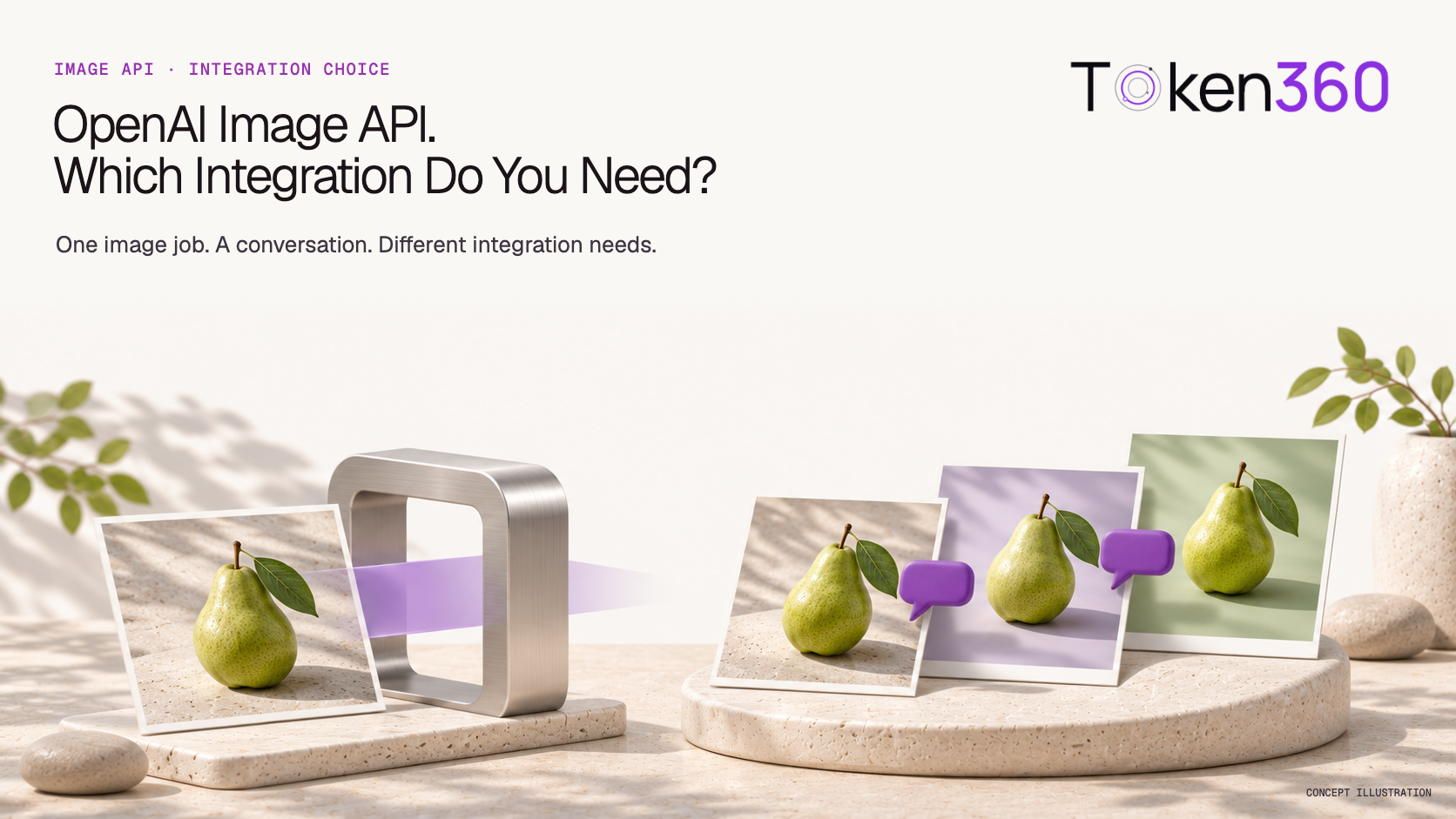
Choose the OpenAI Image API for a standalone image request; evaluate the Responses API image-generation tool when creating images is part of a conversation. For enterprise procurement, specify the workflow and interface separately from the model name. A supplier offering an image model has not automatically demonstrated support for your application's requests, revision history or output handling.
A marketing platform may need one generated asset for each submitted brief. A design assistant may need to remember which image a user is revising when they say, “Keep the product, but change the setting.” Both create images. They place different demands on the application and on the service being purchased.
The decision here is which API workflow to integrate and accept. If your question is whether to create a new picture or modify an existing one, start with image generation versus image editing APIs. If you need to inspect uploaded pictures rather than produce them, use the separate image analysis cost guide.
Scope: OpenAI's official documentation reviewed November 22, 2026; procurement recommendations are editorial analysis. No Token360 image-model request, Image API integration or Responses image-tool integration was tested for this article. Examples are hypothetical requirements, not customer case studies.
Which OpenAI image workflow fits the application?
Start with the user interaction: an independent image job or an ongoing conversation that creates and revises images. OpenAI documents both routes. Choose the simpler integration that covers the required interaction, then confirm the exact model and features. The decision concerns application behavior, not a promise that one route produces better pictures.
OpenAI's image-generation guide describes dedicated generation and editing endpoints, alongside a built-in image-generation tool in Responses. The latter brings image creation into conversational context. The guide also distinguishes direct image-model selection from a Responses request that uses a supported mainline model and an image tool. Those are different request contracts.
Integration choice: official API distinction plus enterprise acceptance questions.
| Requirement | Standalone image job | Conversation with image creation |
|---|
| Likely starting point | Image API | Responses API image-generation tool |
| Example interaction | Submit a complete asset brief | Refer to an earlier image and revise it |
| What the buyer should specify | Job input, final artifact and completion behavior | Image tool behavior, context and revision lineage |
| Acceptance question | Can the application save and use the returned image? | Can it revise the intended image without losing the user's context? |
These are starting points, not mutually exclusive product categories. A team can build its own revision experience around separate image requests. In that case, the application must deliberately manage the relevant assets and instructions. A conversation interface on screen does not prove that a particular backend conversation API is required.
Hypothetical boundary: a form that submits a fully specified banner request can be evaluated as a job workflow. A chat that lets two colleagues branch from different versions needs an explicit revision policy. Write that policy before asking suppliers to quote “image generation,” or they may quote different scopes.
What does image API compatibility actually need to cover?
Compatibility should cover the exact requests and responses your application uses, including the model selector, input representation, output payload and completion behavior. A successful text request or a familiar SDK is insufficient evidence. Ask the supplier to identify supported operations and exceptions, then test those claims with your application's own integration path.
The OpenAI Images reference documents fields such as b64_json in image responses and distinguishes supported response formats by model. The image-tool guide instead shows generated image results in image_generation_call output items. Do not assume a text-response parser can retrieve either artifact correctly.
Translate that distinction into a concrete handoff: engineering names the response field it reads; the supplier identifies the contract it returns; a pilot confirms that the application decodes, stores and displays the artifact. “The server returned success” is not the same acceptance condition as “the intended image reached the user.”
- Request surface: record the API path, operation, supported model identifier and any mandatory tool configuration.
- Inputs: record the actual representation used by your client, such as bytes, an image URL or an uploaded-file identifier. Confirm support rather than treating these as interchangeable.
- Output: record how the client obtains the final image and distinguishes it from text, partial output or an error.
- Controls: list only the dimensions, formats and other settings the application actually needs. Confirm their behavior for the selected model and route.
A supplier can satisfy the business outcome through a different interface, but that requires an implementation estimate. Separate “works with our current client” from “can work after an adapter.” Procurement should see the engineering change, ownership and acceptance work rather than treating both offers as equivalent access.
Do not use a broad “OpenAI-compatible” label as the complete specification. Ask whether the claim covers the Images route, the Responses tool route, both, or only text endpoints. An answer limited to one operation should remain limited to that operation in the purchasing record.
Who should own image revision history?
Assign ownership of revision history before choosing the integration. The application must know which asset a user is changing and how a follow-up refers to it. Provider-managed continuation can help, but it does not replace your product's rules for version selection, branching, user access or recovering an interrupted editing session.
OpenAI's conversation-state documentation describes both supplying history and linking responses with previous_response_id. Its image documentation shows continuation for image revisions. These mechanisms describe OpenAI's interface; they are not evidence that a different provider can resolve the same identifiers or preserve the same history.
Consider a hypothetical user who creates version A, revises it to B, then returns to A and asks for a different background. The application needs to identify A explicitly. If it silently submits B, a plausible new image may still be the wrong result. A visual-quality check alone would miss the integration failure.
A practical revision record can include an application-owned asset ID, the parent asset, the user's instruction, the supplier request reference and the saved output location. Treat that as a suggested application design, not a list of fields any provider already exposes. Store only the information your access and retention policies permit.
Ask what happens when a session expires, a file reference is unavailable or the chosen provider changes. Confirm whether the application can resubmit the necessary authorized inputs or must start a new workflow. Avoid promising that conversation or file identifiers are portable merely because two services accept similarly named parameters.
What should an enterprise image integration pilot prove?
A pilot should demonstrate the required end-to-end workflow, not merely return an attractive image. Define separate checks for transport, artifact delivery, revision targeting and visual acceptance. Use the intended client and account configuration, record unsuccessful cases, and obtain written agreement on what constitutes a pass before treating the integration as production-ready.
Suggested acceptance cases; no results are claimed for these tests.
| Test case | Evidence to retain | Failure it can reveal |
|---|
| Independent image request | Sanitized request, output and successful application display | Unsupported fields or an incompatible response parser |
| Follow-up on a selected version | Chosen parent asset and resulting revision | Wrong image or missing context |
| Return to an earlier version | Application version selection and request lineage | Implicit use of the latest image |
| Unsupported setting or unavailable input | Error surfaced to the user and recovery decision | Silent fallback or a misleading success state |
| Interrupted request | Known completion state and handling of any retry | Lost output or duplicate work |
Keep visual acceptance separate: did the intended subject remain, did the requested change occur, and is the artifact usable for the approved purpose? An interface can behave correctly while the image needs creative revision. Conversely, a beautiful image can arrive through a workflow that loses its version history. Record both findings without merging them into a single vague quality score.
Test streaming only if the product actually needs progressive delivery. The Images reference documents partial and completed image events; the client should distinguish previews from the final artifact. Do not assume that streaming support, event names or behavior carry across routes or suppliers.
Set buyer-specific criteria for waiting time, expected request volume and recovery behavior. This article supplies no benchmark or universal threshold. The image integration acceptance worksheet leaves supplier confirmations and pilot results blank so the team can attach real evidence.
How should the chosen integration appear in an enterprise quote?
The quote should name the model access and workflow being supplied, identify required integration work and state how usage will be measured. Tie acceptance to the agreed request and output contract. A model name and unit rate alone do not describe who handles conversation state, artifact storage, unsupported options or changes to the interface.
Ask for a scope statement with three parts: the confirmed service, the application work you retain, and the open requirements. For example, if a proposed service handles standalone requests but your product needs revision branching, record who builds that layer and whether the implementation is acceptable. Do not bury that difference inside a generic compatibility checkbox.
For cost review, request an example usage record for each required route and a mapping to the proposed billing terms. Include the planned revision pattern so finance does not evaluate a first-image-only estimate for a product built around repeated changes. This is a quotation requirement, not a claim that either route is always cheaper.
The broader OpenAI API enterprise budget guide covers budgeting and quote comparison. Here, keep the commercial question narrower: does the quote cover the integration actually accepted by engineering? If it covers a different route, return it for clarification before comparing the totals.
Also agree how a changed model or interface will be communicated and rechecked. A pilot validates a defined configuration at a point in time. The approval record should make that configuration identifiable without suggesting that it guarantees every future model version.
What should Token360 confirm before you proceed?
Ask Token360 to confirm the particular image model, API route and workflow your application requires before discussing a production commitment. Separate confirmed availability from features that still need testing. General access to image models does not establish support for OpenAI's Images endpoints, Responses image tools, uploaded-file identifiers or conversation continuation.
Token360's company-confirmed scope covers enterprise access to text, image, audio and video models. Enterprise quotations are tiered: higher usage receives lower quoted rates under the agreed scope and conditions. The company confirms no separate service fee; that does not mean inference is free or that every requested interface is included. See about Token360 and the enterprise inquiry page.
Unverified in this article: availability of any specific OpenAI image model through Token360; Images or Responses compatibility; image-tool support; file-ID handling; revision continuity; and streaming behavior. No successful integration test is claimed. Ask for a supported configuration and test evidence rather than interpreting this article as a compatibility announcement.
We need [standalone image jobs / conversational image revisions] for [application]. Our client uses [API route, input representation and output contract]. Please confirm the model and features you can supply, identify any adapter or application changes, and provide a volume quote for the agreed scope. Mark unsupported and untested requirements explicitly.
Proceed when the confirmed service, the application's responsibilities and the pilot acceptance record agree. If they do not, revise the scope or evaluate another arrangement. The purchasing decision is about a usable image workflow, not simply access to a model with a familiar name.
Worksheet template
Requirement,Buyer requirement,Supplier confirmation,Pilot evidence,Owner
Workflow,,,,
Model identifier,,,,
API route,,,,
Input representation,,,,
Output contract,,,,
Revision parent selection,,,,
Earlier-version branching,,,,
File reference lifecycle,,,,
Streaming if required,,,,
Unsupported setting behavior,,,,
Interrupted request recovery,,,,
Visual acceptance,,,,
Usage record and quote mapping,,,,
Unverified requirements,,,,


 Guides
 Guides
 Guides