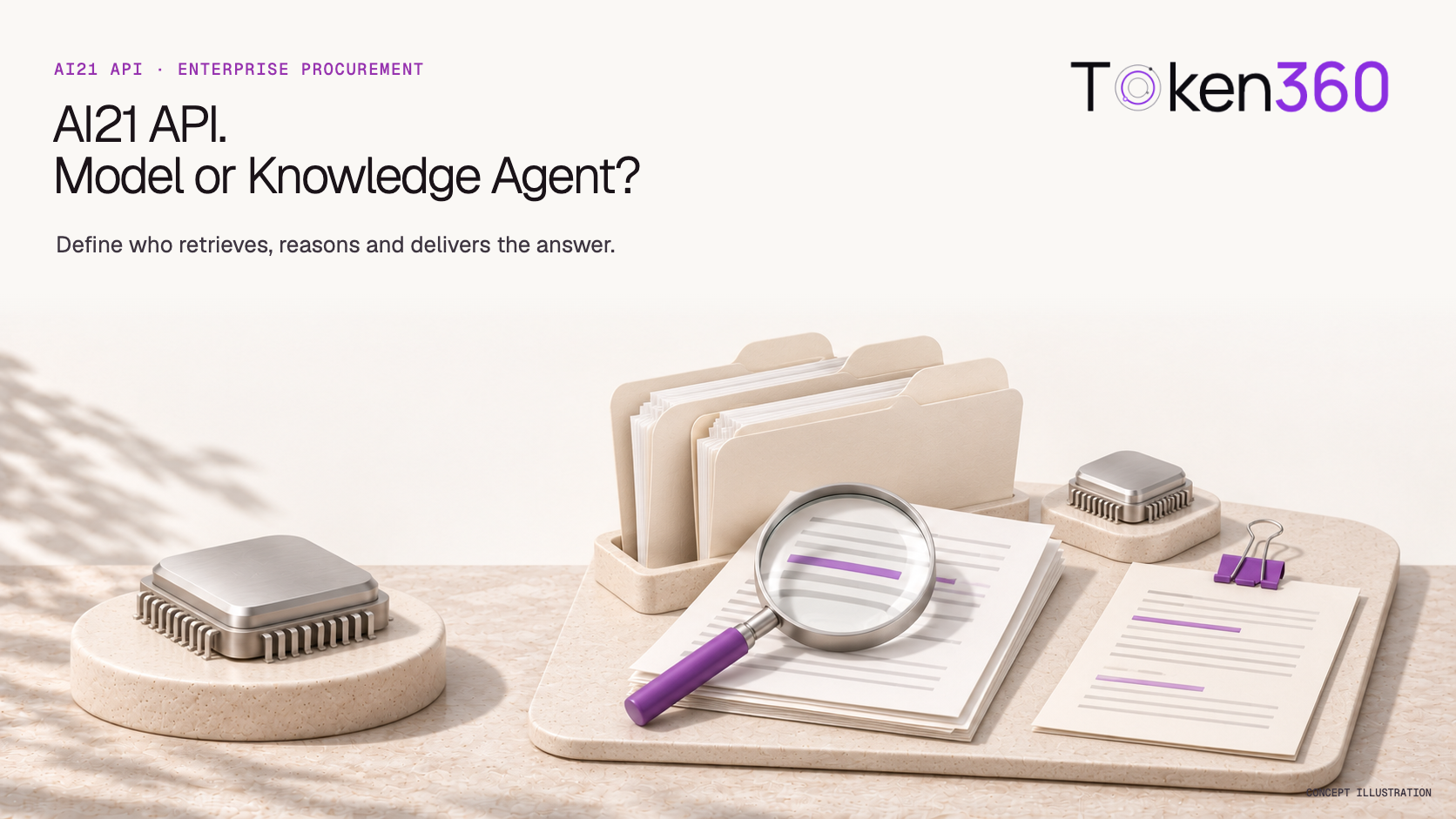
An “AI21 API” requirement is not specific enough for procurement. Jamba is a family of foundation models; Maestro is a system for knowledge agents. Decide whether your company needs model responses inside its existing application or wants a service to perform document retrieval and coordinate a larger task.
This is a documentation-based buying analysis. No Jamba, Maestro or Token360 integration was tested for this article, and no accuracy or cost advantage is claimed.
What are you buying through the AI21 API?
Specify Jamba model access or a Maestro knowledge-agent service before requesting a quote. A model endpoint produces responses from the input supplied to it; a knowledge-agent system can coordinate retrieval and other steps. The distinction determines what your application must still provide and what the supplier should demonstrate before purchase.
AI21's platform overview identifies both offerings. Its Jamba documentation describes a model family available through API access and private deployment options. Those options should not be treated as the same managed service or assumed to have identical operating responsibilities.
AI21 describes Maestro as a planning system that can call models and tools. It is model-agnostic: a Maestro run is not necessarily a single Jamba call. The documentation describes execution traces and validation reports, but those artifacts still need to be evaluated against your business requirements.
Two procurement scopes, not a ranking of output quality
| Buying decision | Jamba model access | Maestro knowledge agent |
|---|
| Primary object | A named model and deployment route | A task configuration with models and tools |
|---|
| Input preparation | Your application supplies the relevant input | Confirm configured document sources and tools |
|---|
| Retrieval responsibility | Name the system that selects evidence | Verify the managed retrieval scope you will use |
|---|
| Acceptance evidence | Model response behavior under the application contract | Task result plus evidence about the steps used |
|---|
| Quote boundary | Model usage or the agreed deployment service | Agent service and any separately billed dependencies |
|---|
Neither column removes the need for an application owner. Buying a richer service may transfer some implementation work, but procurement must identify exactly which work is transferred. For the general software-versus-component decision, use our AI software versus model API guide; this article narrows that decision to AI21's product boundaries.
Who owns document retrieval after the purchase?
Name the owner of document ingestion, evidence selection and document updates before choosing the API. If your company already operates retrieval, model access may fit the missing component. If retrieval is part of the purchase, evaluate its behavior with your documents instead of assuming that a model's context capacity supplies it.
Maestro's RAG overview describes file search, web search and automatic indexing of supported uploaded documents. The File Library documentation describes document organization, filtering, metadata changes and deletion. These are distinct lifecycle functions, not merely a larger input window.
Consider a hypothetical procurement team answering questions about supplier policies. Its application may already select the approved policy and send a relevant passage to a model. In that design, changing the model should not silently introduce a second document repository. Alternatively, if the team expects the new service to find the policy, document ingestion and selection belong in the purchased scope.
Ask who updates a replaced policy, how an outdated version is excluded and what happens when two documents disagree. Record whether web information is allowed or whether answers must use approved internal sources only. These are proposed evaluation questions, not claims that either AI21 product fails them.
Use a small set of representative, permitted documents for evaluation. Include an obsolete version and a question the documents cannot answer. A polished response to one easy document does not establish that the service retrieves the right evidence across a changing collection. The broader context-window decision is covered in our long-context model analysis.
Can a model endpoint replace a Maestro integration?
Do not assume a model endpoint can replace a Maestro integration by changing its URL. Identify the application's expected requests, tools and response artifacts first. A call that returns useful prose may still omit the trace, validation information or document workflow the application expects from a knowledge-agent service.
AI21 provides an SDK and authentication guidance, but sharing a vendor or SDK does not make two product contracts interchangeable. Write down the operations the application actually invokes and the fields it consumes. Ask the implementation team to demonstrate those operations rather than approving a route solely because both services return text.
For Jamba, confirm the exact model version and deployment route. AI21's model documentation recommends dated versions to reduce disruption from model changes. For Maestro, record the chosen model-selection approach, enabled tools and task configuration. Do not equate an agent name with a fixed underlying model.
The practical migration checklist is short: preserve required inputs, produce the expected output artifacts, handle errors in the application's existing flow, and establish who owns stored configuration and documents. Where the replacement does not provide an expected artifact, identify the application work required to replace it. That work belongs in the decision before a supplier is chosen.
This is a product-contract comparison, not an implementation recipe. No working endpoint substitution or Token360 compatibility is demonstrated here. Our agents versus workflows article addresses the broader orchestration choice without duplicating this AI21-specific integration question.
How should procurement compare the two quotes?
Compare quotes against the same business deliverable, with implementation and operating responsibilities stated explicitly. A model token rate and a knowledge-agent charge are not automatically equivalent measures. Ask what each proposal includes, which dependencies remain separately billed, and what evidence will show that the purchased service completes the required task.
AI21's pricing documentation says costs depend on the access platform, endpoints and any custom payment plan. Do not transfer a price from one hosting route to another. Obtain the applicable commercial offer for the exact product and configuration; this article does not quote an unverified Maestro rate.
Maestro's documentation describes a budget setting that changes the amount of planning and validation effort. Do not read that setting as a contractual dollar cap without explicit confirmation of billing and enforcement. Ask the supplier to explain how the chosen configuration is charged and what the usage record will expose.
A practical worksheet should have separate rows for the service being purchased, retained application components, new integration work and ongoing ownership. For each row, record the responsible party and the applicable quote or estimate. Label assumptions, especially any estimate of how often a task needs another attempt or human review.
For example, a lower model-only bill does not establish a lower project cost if the buyer must build retrieval that the other proposal supplies. Conversely, a managed agent may duplicate systems the buyer already runs. Compare the missing capability, not the number of features on a product page. Keep the general calculation in our AI API total cost analysis.
What should a Jamba or Maestro pilot prove?
A pilot should prove the responsibility being purchased, not just produce an impressive answer. Test Jamba within the application's intended input and output contract. Test a Maestro configuration against its intended retrieval and task requirements. Use the same business questions where appropriate, while inspecting different evidence for each purchased service.
Proposed acceptance plan; no results are claimed
| Case | Evidence to inspect | Decision it supports |
|---|
| Known answer in an approved document | Correct answer and the evidence supplied or retrieved | Basic task fit |
|---|
| No answer in permitted sources | Whether the response handles missing evidence as required | Boundaries of acceptable output |
|---|
| Document update | Which version is used after the agreed update process | Ownership of knowledge freshness |
|---|
| Conflicting sources | Whether conflict is surfaced or resolved by the defined policy | Suitability for the buyer's decision process |
|---|
| Expected load and service errors | Measured completion behavior, failure records and applicable usage charges | Operational and commercial readiness |
|---|
Set thresholds before the pilot and retain the configuration with the result. Decide who labels an answer acceptable and when a human must review it. A vendor-provided validation report is useful evidence to inspect; it is not an independent guarantee that every claim is correct.
Keep data access review separate from answer quality. Document which parties receive source material, what is stored and how removal is handled under the selected service and agreement. Do not assume that a privately deployed model's data path also describes a managed agent service using external tools.
The pilot can justify moving forward, requesting changes or choosing a narrower scope. It cannot establish universal accuracy from a small sample. Report the workload, configuration and observed limitations instead of turning one successful demonstration into a product-wide claim.
What should you ask Token360 before requesting AI21 access?
Ask Token360 to confirm the exact model or service you need before discussing price. State whether you want Jamba inference inside an existing application or Maestro's broader knowledge-agent functions. Token360's general model-access business does not establish availability of either product or compatibility with the application's AI21 integration.
Token360's company-confirmed scope covers enterprise model access across text, image, audio and video. Enterprise pricing uses tiered quotes, with lower quoted rates at higher usage under the agreed scope. Dedicated capacity, contracts and compliance requirements can be discussed for an engagement; specific commitments must be confirmed. See about Token360 and its enterprise inquiry page.
We need [exact model/version or agent service] for [business task]. Our application already owns [retrieval, storage and orchestration components]. We expect the supplier to provide [missing capability]. Please confirm availability, deployment route, supported operations, billing scope and the acceptance checks you can support. Mark anything unavailable or unverified separately.
No Jamba or Maestro availability through Token360, AI21 SDK compatibility, managed File Library, private Jamba deployment or Maestro BYOK route is verified by this article. Do not infer those capabilities from a general offer of model access.
A usable procurement decision names the missing service and its owner. If your team needs only inference, assess the model route. If it needs retrieval and coordinated task execution, assess that larger service scope. In either case, approve the quote only when the promised deliverable and the pilot evidence match.
About the author
Yuki Yu is Marketing Manager at Token360.


 Guides
 Guides
 Guides