← All posts

Guides

Two-Speaker Product Explainer Audio: Script and Handoff

Plan a two-speaker product explainer as audio: assign roles, approve a concrete script and define revisions without promising a finished video demo.

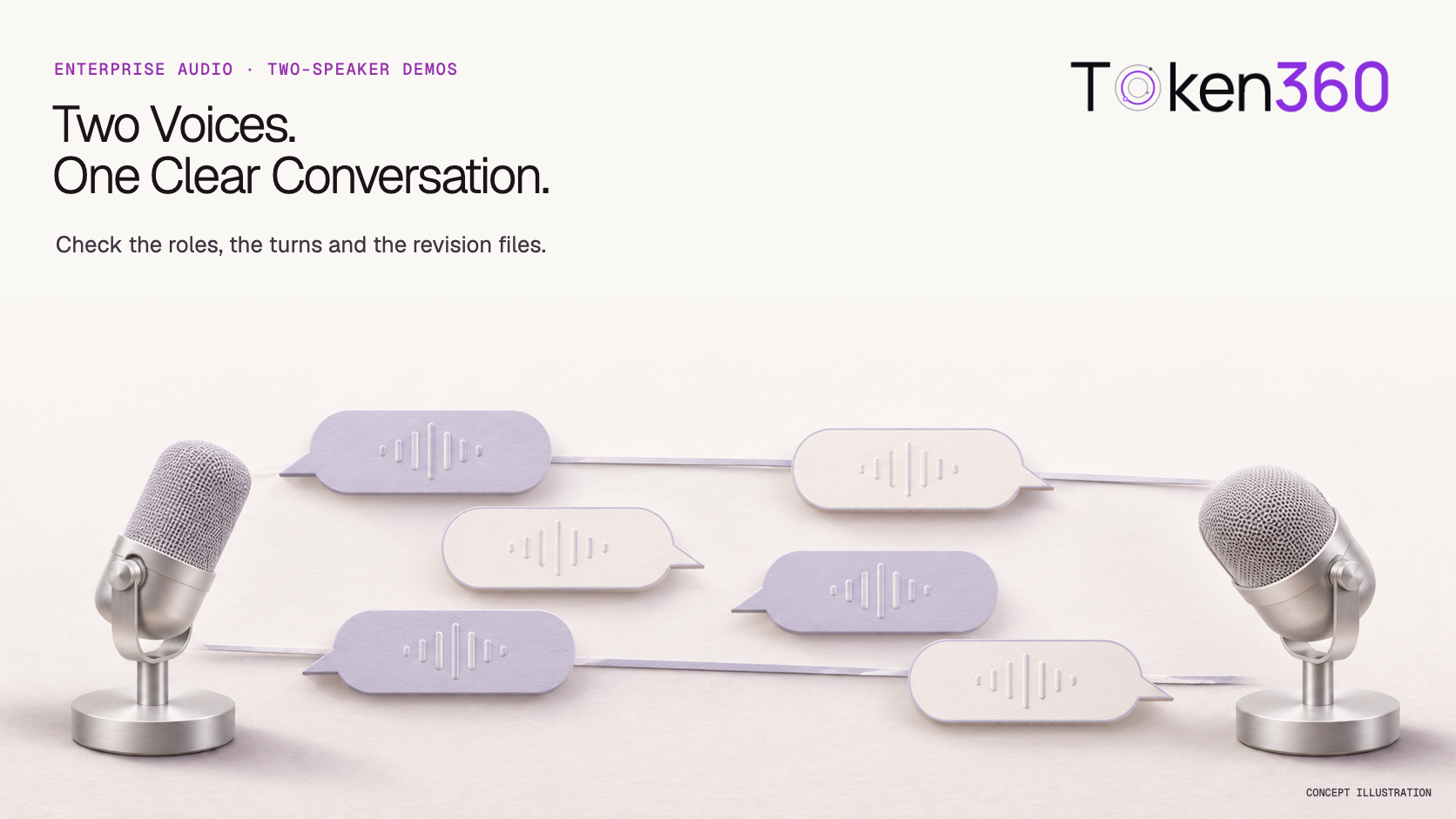
A two-speaker product explainer is an audio deliverable: a host asks a useful question and a specialist answers it in a distinct voice. Approve the script, role assignments and revision boundaries before generating speech. A completed audio exchange does not include screen capture, avatar animation, lip synchronization or a finished video demo.

This worked script uses a fictional file-review product called Review Desk. It demonstrates an input and handoff specification, not a generated recording or a Token360 product feature. Listening quality, timing and speaker consistency have not been tested.

What should the two speakers actually say?

Write an exchange that explains one user action rather than a conversation about buying an API. The host represents a new user; the specialist explains the workflow. Give each turn a stable ID so a later factual correction can be traced to the affected line without rewriting the whole conversation.

TurnRoleApproved teaching script
H01HostHow do I know which file the client approved?
S01SpecialistOpen the review page and select the version marked approved. Check its version number before exporting.
H02HostWhat if the client sends another change?
S02SpecialistCreate a new version and request approval again. Keep the previous version in the review history.

The sample describes the fictional product only. Before using this structure for a real product, have its owner verify every instruction and the actual interface labels. Do not publish generated speech that introduces a feature absent from the approved script.

Should the deliverable be one mix or separate turns?

Choose a combined dialogue when reviewing the entire exchange is the priority. Choose separately managed turns when the editor needs precise replacements. These are production strategies, not promises that an endpoint returns stems or speaker-isolated files. Confirm what the selected service actually returns before planning the edit.

fal’s Gemini TTS API documentation describes a multi-speaker speech workflow. That establishes a documented capability to evaluate; it does not establish that separate turn exports or the same model are available through Token360. No unverified request fields are prescribed here.

Required outputTeaching specificationMust be verified on real output
Role assignmentHost reads H01/H02; specialist reads S01/S02No swapped voices or spoken role labels
Audio deliveryOne approved listening mix; retain turn IDs in the edit logActual format, channels and duration
RevisionReplace S02 after product-owner approvalWhether a new request alters nearby delivery
VideoOutside this article’s scopeSeparate screen capture, picture edit and synchronization

How do you handle a one-line revision?

Revise the script first, regenerate or re-record the affected material, and review the assembled exchange again. Retaining a turn ID makes the change auditable; it does not guarantee that a model will preserve timing or produce an identical voice on a later request.

For example, replace S02 with “Create a new version, add the change note, and request approval again.” The product owner must verify that change notes exist. Keep S02-r01 and S02-r02 distinct, then check the transition from H02 and the end of the mix for pacing and artifacts. This is a proposed revision, not an observed successful replacement.

The line-replacement audio guide covers the surrounding-text and join review. The emotion-direction guide addresses delivery choices; neither substitutes for checking role assignment in this script.

What evidence completes the audio example?

Attach the actual generated exchange, its approved script, the speaker assignment record and a reviewed revision pair. Listen for complete wording, stable roles, natural pauses and clean joins. Mark the output pending until those files exist; a script table and provider documentation are not evidence of listening quality.

For Token360’s business scope, see the company introduction. A specific multi-speaker endpoint and delivery contract must be confirmed separately. If the project needs a video demo, it also needs a capture plan, synchronized picture, captions and review of the complete export.

About the author

Yuki Yu is Marketing Manager at Token360.

  • Enterprise AI
  • API

Build faster with one AI API.

Use Token360 to call video, image, audio, and text models with one key and one bill.

Get started