Use inference keys for model calls and scoped management keys for administration. Map Token360 credentials, endpoints and grants before deployment.
ENTERPRISE INTEGRATION · CREDENTIAL BOUNDARIES
By Yuki Yu · Documentation analysis · Reviewed November 7, 2026
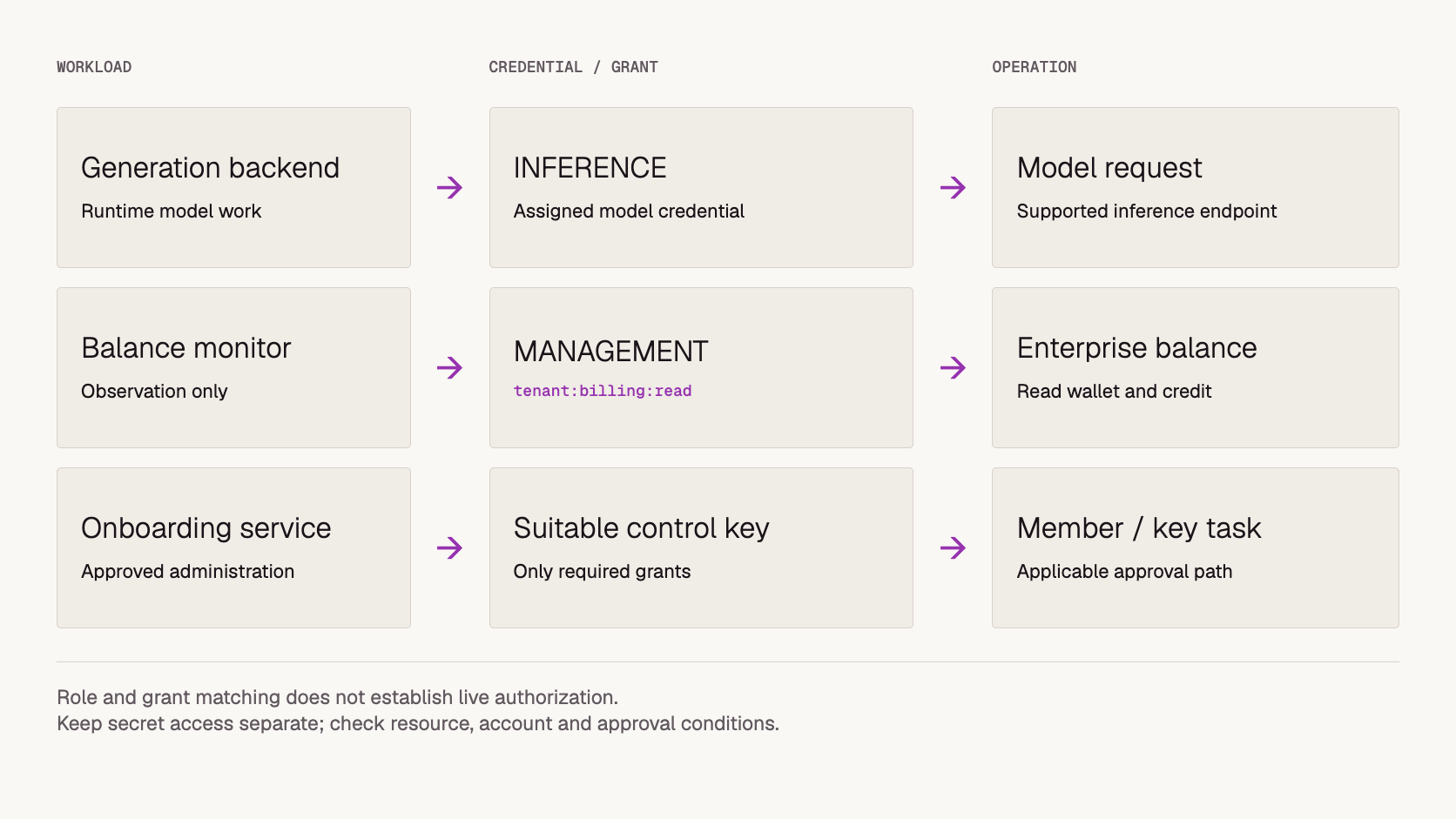
An inference API key runs model requests; a management API key authorizes administrative operations within its permitted scope. They are different credentials, not interchangeable levels of the same model access. For Token360, choose the operation first, then the required key type and grants. A working model key does not establish enterprise-control access.
A team may need a generation backend, an account-onboarding service and a balance monitor. Giving all three the same secret feels simpler until one component needs a permission the others should never receive. Separating these jobs makes the credential configuration easier to review and the consequences of a mistake easier to contain.
This article reviews the documented Token360 credential boundary and provides an original, eight-case local configuration example. The example checks a small declared mapping; it does not authenticate against Token360, create credentials or test production enforcement. No model calls, paid tests or customer security incidents are represented here.
Read first: Token360’s authentication guide explains how a backend sends a credential. This article addresses which credential belongs to which operation.
What is the difference between inference, management and provisioning keys?
Separate credentials by the job they authorize. Inference is model execution; management is scoped enterprise administration; provisioning is a narrower administrative role. A key’s label does not replace its effective permissions. Review both the credential category and the documented operation rather than assuming that an administrator’s secret can substitute for a model key.
The distinction is not unique to Token360. OpenRouter’s management-key documentation also separates administrative credentials from completion requests. Its documented account-level permission model is different, however. Reusing a term from another platform does not establish identical scope names, endpoint paths or resource boundaries.
In an integration inventory, record the credential’s intended consumer as well as its type. “Billing monitor” is more informative than “master key.” A useful record states the service owner, allowed task, effective grants, secret-manager reference and expected denial cases. It should never contain the secret itself.
Which Token360 endpoint should each credential call?
Match the exact operation and credential contract before troubleshooting the secret. Similar-looking URLs can describe different resources, and the same Bearer-header syntax does not imply interchangeable authorization. Keep a small operation map in the application configuration so developers can distinguish a model request, an individual key’s budget and an enterprise balance read.
Operation
Documented interface
Credential selection
Run a compatible model
The model’s supported inference endpoint, such as POST /v1/chat/completions
Inference key; model and account conditions still apply
Read one key’s budget
GET /v1/key
The inference key being inspected
Read enterprise wallet and credit
GET /enterprise/v1/billing/balance
Management key with tenant:billing:read
Use enterprise Control MCP
/enterprise/mcp
A suitable control key and the required permissions
The budget and balance distinction comes from Token360’s Billing and Usage documentation. These are different readings, not two spellings of the same endpoint. For the agent interface, the Control MCP page states that management and provisioning control credentials serve enterprise administration; model execution still uses the inference API.
The table is a selection aid, not a complete endpoint catalog. Before implementation, check the current endpoint reference, required scopes and resource identifier. Do not paste a REST payload into an MCP client just because the business task sounds the same.
Why should a balance monitor not receive default management permissions?
A monitoring service needs enough authority to observe its assigned resource, not to change unrelated settings. Choose explicit read permissions and verify the resolved grants before deployment. Omitting a scope list can have a service-specific default; it is not a reliable way to request the smallest possible permission set.
Token360’s Control Keys and Scopes guide, reviewed November 7, 2026, says omitted or empty scopes select defaults that include writes. For enterprise balance monitoring it specifies an explicit tenant:billing:read scope. Control-key issuance belongs to the enterprise owner’s signed-in session; a control key cannot issue another management key.
That is a reason to separate credential creation from the monitor’s runtime. Store the issued monitoring secret where only the monitoring service can retrieve it. The generation worker does not need that secret merely because it also reports spending to an internal dashboard.
This recommendation follows OWASP’s authorization guidance on least privilege and checking permissions. An application should define which action each service may perform, then verify the permission decision at the relevant boundary. Successful authentication alone does not establish that the requested operation is authorized.
Application design example: keep the credential for each workload separate. A role match does not bypass account policy or required approvals.
How should a SaaS team separate onboarding from generation?
Give the onboarding component and the generation component different responsibilities and secret access. Onboarding changes administrative resources; generation submits model work. Even if both run in one product, their permissions should be reviewed independently. A compromise or programming mistake in a public-facing generation path should not automatically expose the administrative credential.
For a constructed design, consider three services:
Generation backend: reads its assigned inference secret and sends approved model requests.
Balance monitor: reads the dedicated monitoring secret and stores the permitted balance reading.
Onboarding worker: performs only the approved account or key-management tasks, using the documented administrative role and grants.
This is an application design proposal, not a report of a Token360 customer deployment. A separate variable name is useful, but it is not sufficient isolation if every process can read every variable. Review runtime secret access, deployment identities and which component receives each credential.
Use the API Keys and Workspaces guide for service ownership and credential lifecycle. Whether your commercial arrangement permits issuing access to external customers is a separate contractual question; do not infer resale rights from the existence of a provisioning interface.
If the design also uses customer-supplied provider credentials, the BYOK versus gateway key guide explains which service receives each secret.
Can you check the credential plan without calling a model?
You can catch some configuration mismatches locally before sending any request. A static check can compare a declared key type, its resolved grants and a proposed operation. It cannot establish that the secret is valid, the tenant is correct or the remote service will authorize the call. Treat it as an early configuration check.
For this article, we ran an
Copy credential-plan-check.py:
"""Illustrative static configuration check, not a Token360 authorization client.
Input scopes are resolved grants, NOT an API create-key payload.
No requests, credentials, model inference, or production policy enforcement.
"""
import json
RULES = {
    "model_request": ({"INFERENCE"}, None),
    "own_key_budget": ({"INFERENCE"}, None),
    "enterprise_balance": ({"MANAGEMENT"}, "tenant:billing:read"),
    "member_key_inventory": ({"MANAGEMENT", "PROVISIONING"}, "tenant:keys:read"),
}
def check(kind, scopes, operation):
    types, scope = RULES[operation]
    if kind not in types:
        return "wrong_credential_type"
    if scope and scope not in scopes:
        return "required_grant_missing"
    return "role_and_grant_match_only"
CASES = [
    ("inference_model", "INFERENCE", [], "model_request", "role_and_grant_match_only"),
    ("management_model", "MANAGEMENT", ["tenant:keys:read"], "model_request", "wrong_credential_type"),
    ("inference_tenant_balance", "INFERENCE", [], "enterprise_balance", "wrong_credential_type"),
    ("billing_monitor", "MANAGEMENT", ["tenant:billing:read"], "enterprise_balance", "role_and_grant_match_only"),
    ("keys_reader_balance", "MANAGEMENT", ["tenant:keys:read"], "enterprise_balance", "required_grant_missing"),
    ("provisioning_balance", "PROVISIONING", ["tenant:keys:read"], "enterprise_balance", "wrong_credential_type"),
    ("provisioning_inventory", "PROVISIONING", ["tenant:keys:read"], "member_key_inventory", "role_and_grant_match_only"),
    ("billing_reader_inventory", "MANAGEMENT", ["tenant:billing:read"], "member_key_inventory", "required_grant_missing"),
]
if __name__ == "__main__":
    results = []
    for name, kind, scopes, operation, expected in CASES:
        actual = check(kind, scopes, operation)
        assert actual == expected, (name, actual, expected)
        results.append(dict(case=name, type=kind, effective_scopes=scopes, operation=operation, result=actual))
    print(json.dumps({"scope":"Local synthetic mapping check; not a live authorization test. Grants are resolved input values, not create-key defaults.", "cases":results}, indent=2))
follow the example’s declared rules. Selected cases show why type and scope are separate checks:
Declared configuration
Proposed operation
Local result
Inference key
Model request
Role matches only
Management key with key-read grant
Model request
Wrong credential type
Management key with billing-read grant
Enterprise balance
Role and grant match only
Management key with key-read grant
Enterprise balance
Required grant missing
Provisioning key with key-read grant
Enterprise balance
Wrong credential type
The script receives effective grants, not a create-key request. It therefore does not emulate the server’s omitted-scope defaults. It also does not check credential expiry, IP rules, tenant membership, model access, funding or approval state. The matching cases are deliberately named role_and_grant_match_only, rather than “authorized.”
Use that distinction in a real acceptance plan. First review configuration. Next, perform approved read-only checks for the intended account. Test writes only against agreed disposable resources, with an owner and a recovery plan. A local mapping result should never be reported as successful remote access or evidence that a sensitive write is safe.
What should happen when the role is right but the request is denied?
Inspect the precise failure before broadening access or trying another key. A correct credential category can still lack a required scope or encounter an account condition. An administrative write can also be waiting for approval rather than executed. Keep these outcomes distinct so a troubleshooting step does not silently expand the service’s authority.
The enterprise approvals guide applies its approval workflow only to tenants where that control is enabled. It distinguishes accepted operations from execution, and machines cannot approve for the human owner. A monitoring read does not require that approval flow. Confirm the applicable tenant behavior rather than assuming all administrative calls execute immediately.
For support, capture the operation, credential display identifier, timestamp, effective scopes, returned error and available request reference. Do not include the secret or Authorization header. Follow Token360’s error-handling reference instead of treating every rejection as a transient model failure.
If the wrong role was selected, correct the operation-to-credential mapping. If a grant is missing, have its owner review the required access. If an approval is pending, preserve the operation identity. None of these observations justifies silently substituting a more permissive credential from another service.
Frequently asked questions
Does a key’s name prove what permissions it has?
No. A label such as “read-only” describes intent. Review the issued credential metadata and effective grants. An application’s configuration name is not an authorization policy.
Does giving a model more reasoning time solve a key-permission error?
No. Model reasoning and credential authorization address different problems. Diagnose the rejected operation and its access contract rather than changing generation settings.
Does management access include permission to resell inference?
Do not infer that. An API permission describes a technical action; customer-facing redistribution and commercial use require the applicable terms and agreement.
Has this article tested Token360’s live enforcement?
No. The evidence is official documentation and a local synthetic configuration check. Live positive and negative authorization tests remain separate work for an authorized account owner.
Read next: use Control Keys and Scopes to review the actual grants, then consult Approvals and Retries before implementing administrative writes. About Token360 provides platform context; this article does not promise a particular enterprise SLA, certification or commercial entitlement.
Developer Guide
API
Bring your next idea to life.
Create a video scene in Creator, or explore models for images, audio, and text to find the right capabilities for your project.


 Guides
 Guides
 Guides