Sonilo Text to Music API: Prompts, Pricing, and Nine Test Results
Nine music samples were accepted by the tester, with a 13.48-second median wait and $0.0874125 cost per clip; one run took 69.11 seconds.
Documentation checked and test records received October 19, 2026. Nine original samples; manually timed waits and tester-reported listening judgments.
The Sonilo text to music API turns a written music brief into an audio candidate. Token360’s listed model ID is sonilo-text-to-music, with a public reference rate of $0.00291375 per second, equivalent to $0.174825 per minute. The observed charges in this pilot match that rate on a thirty-second requested-duration basis. Musical suitability still requires listening in context.
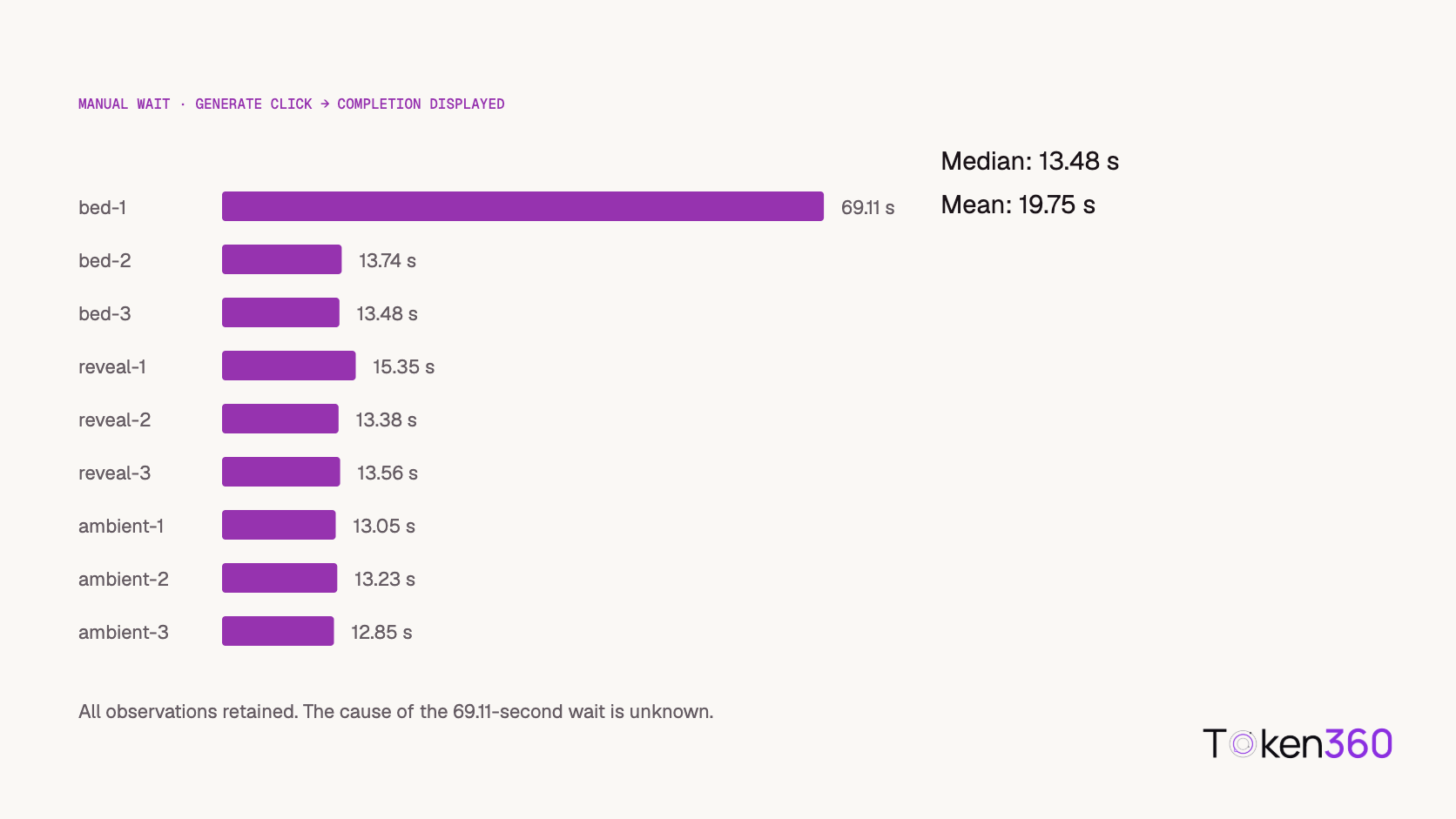
In a nine-run Token360 pilot, the tester accepted all nine thirty-second music candidates. The median manually timed wait was 13.48 seconds, while the mean was 19.75 seconds because one run took 69.11 seconds. Each run was reported at $0.0874125 USD. All original files are included below, together with the prompts, timing records, and a specific caveat about variation in the background-music brief.
Text-to-music takes a description of the desired soundtrack rather than a recording to transcribe or sentences to read aloud. A useful description identifies the music’s purpose, instrumentation, energy, and progression. The output is a candidate that still needs listening and, where relevant, review alongside the intended video or narration.
The Token360 listing describes a single non-streaming audio output. Although its internal category uses AUDIO_TEXT_TO_SPEECH, the intended task is music generation. Do not treat that category label as a promise of a narrated voice, voice cloning, or speech timing.
The music and sound-effects models also serve different briefs. Use music for an arrangement, background bed, or musical cue. Use Sonilo Text to Sound Effects when the desired output is a sound such as rain, footsteps, or a contact. A passing result in one workflow does not establish quality or reliability in the other.
Token360 parameters and provider differences
Field
Current Token360 configuration
Practical implication
Model
sonilo-text-to-music
Select the music route explicitly.
Text input
input
Write a music brief, not a narration script.
Duration
5–360 seconds; default 10
Set duration explicitly for repeatable comparisons.
Audio format
MP3, WAV, M4A; default MP3
Inspect the returned file rather than assuming a codec from its extension.
Output
One audio output; non-streaming
Measure the wait to completion, not first streamed audio.
These are configuration values, not independently tested limits. Sonilo’s native documentation describes a different service contract: a dedicated text-to-music endpoint with streaming and asynchronous modes, as well as additional options. Those native options should not be assumed to pass through Token360 unless the route explicitly supports them.
The fal Sonilo music schema also differs: it uses prompt, documents a 90-second default and a maximum of 600 seconds, and exposes num_samples. Its documented billing rounds seconds up and applies a ten-second minimum per sample. These are fal’s documented settings, not Token360’s billing rules.
The integration lesson is simple: always fix the duration, sample count, and format where supported, then record what actually comes back. Comparing a ten-second default with a ninety-second default would tell you little about relative performance.
Test results: a 13.48-second median, with one 69.11-second wait
The tester manually timed each run from clicking Generate until the interface displayed completion, following the established test protocol. These are user-observed waiting times, including interface and human reaction effects, not isolated model inference times or instrumented API latency. Reported hundredths are retained without implying hundredth-of-a-second measurement accuracy.
Brief
Manual waits, seconds
Mean
Median
Tester acceptance
Background bed
69.11 / 13.74 / 13.48
32.11 s
13.74 s
3/3, with variation noted for bed-2
Product reveal
15.35 / 13.38 / 13.56
14.10 s
13.56 s
3/3
Ambient cue
13.05 / 13.23 / 12.85
13.04 s
13.05 s
3/3
Across all nine runs, the mean was 19.75 seconds, the median was 13.48 seconds, and the range was 12.85–69.11 seconds. Eight waits fell between 12.85 and 15.35 seconds. The longest run remains in the primary statistics; the records do not establish whether queuing, initialization, network conditions, or another factor caused it.
Manual timing from Generate click to completion displayed. All nine observations are included.
The tester accepted every candidate but described bed-2 as more pop-like, with greater variation than bed-1. We retain that acceptance judgment and the caveat together. The observation illustrates why “usable” and “consistent across repeated prompts” should be reported separately. Overall acceptance does not demonstrate identical arrangements or perfectly constant energy.
All nine supplied files decoded to 1,323,008 frames at 44.1 kHz, approximately 30.00018 seconds each, with two channels. This confirms delivered length and decodability, not musical quality. No audio was trimmed or repaired before being included here.
How much does Sonilo music cost per minute?
At the public Token360 reference rate checked for this article, the following calculations apply if the requested duration is the billed duration:
Requested duration
Calculation
Reference estimate, USD
10 seconds
10 × $0.00291375
$0.0291375
30 seconds
30 × $0.00291375
$0.0874125
60 seconds
60 × $0.00291375
$0.174825
Nine 30-second runs
270 × $0.00291375
$0.7867125
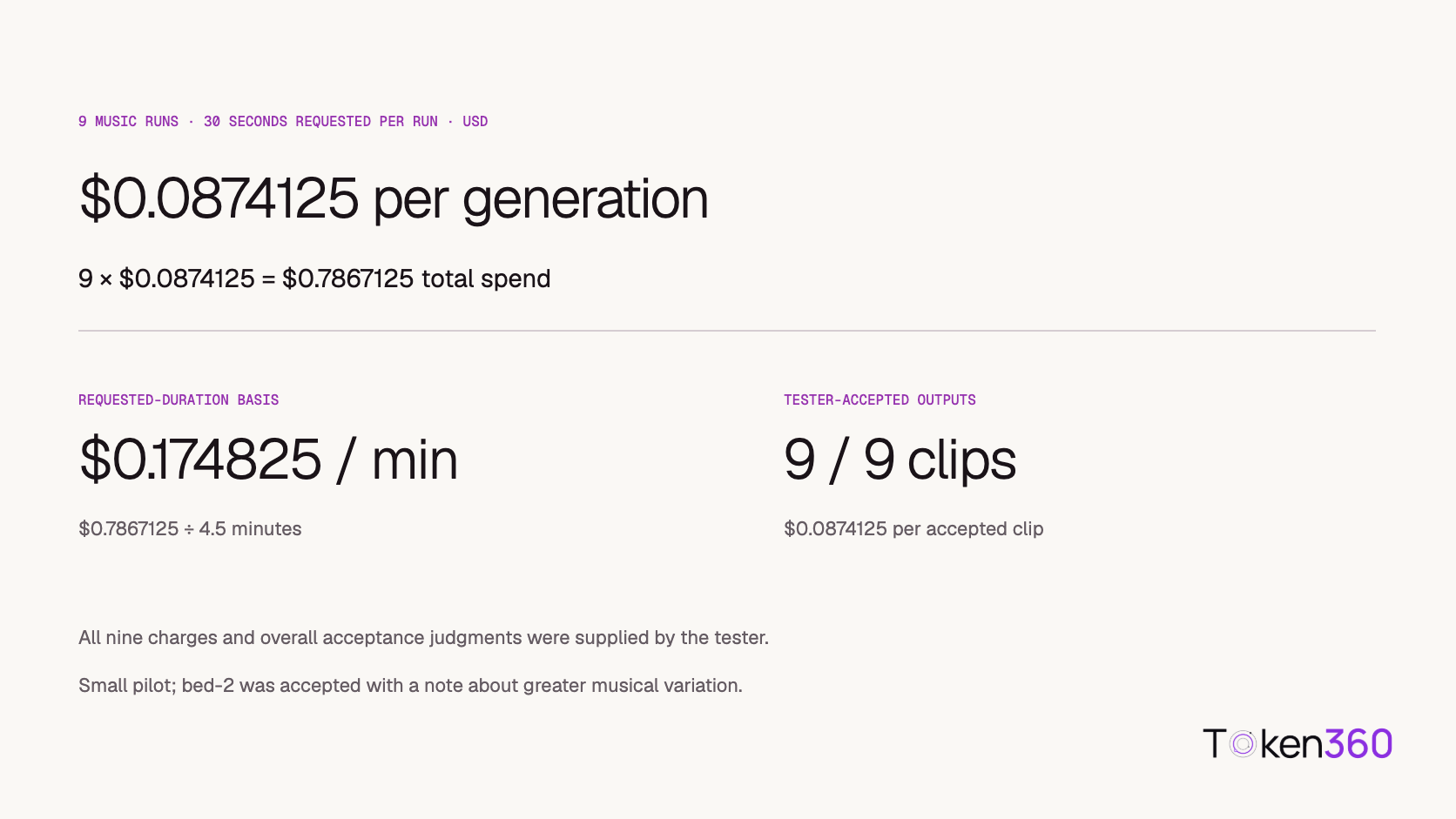
The thirty-second and nine-run totals match the tester-reported USD charges exactly. The ten- and sixty-second rows remain calculated reference examples, not additional tests. Keep actual charges when estimating production spend; this pilot does not establish every account’s rate or every route’s billing behavior.
The nine actual charges total $0.7867125. Because the tester accepted all nine clips, the observed cost per accepted clip is $0.0874125. On the requested-duration basis of 4.5 minutes, generated-minute and accepted-minute costs both equal $0.174825. Using the decoded duration instead gives approximately $0.174824 per minute. These figures exclude human review time and apply only to this small pilot.
For a broader application budget, use the AI API cost management guide to connect recorded attempts, accepted outputs, and total spending.
For production budgeting, track two different metrics:
Cost per generated minute =
  total billed spend ÷ (total generated audio seconds / 60)

Cost per accepted minute =
  total billed spend across all attempts ÷ (accepted audio seconds / 60)
Measure file duration for the first denominator. For the second, define whether an entire track must pass or whether a shorter edited excerpt can count. Do not silently credit a complete thirty-second track when only five seconds are usable. If no candidate passes, cost per accepted minute is undefined, while total spend remains a real expense.
How to write a useful music brief
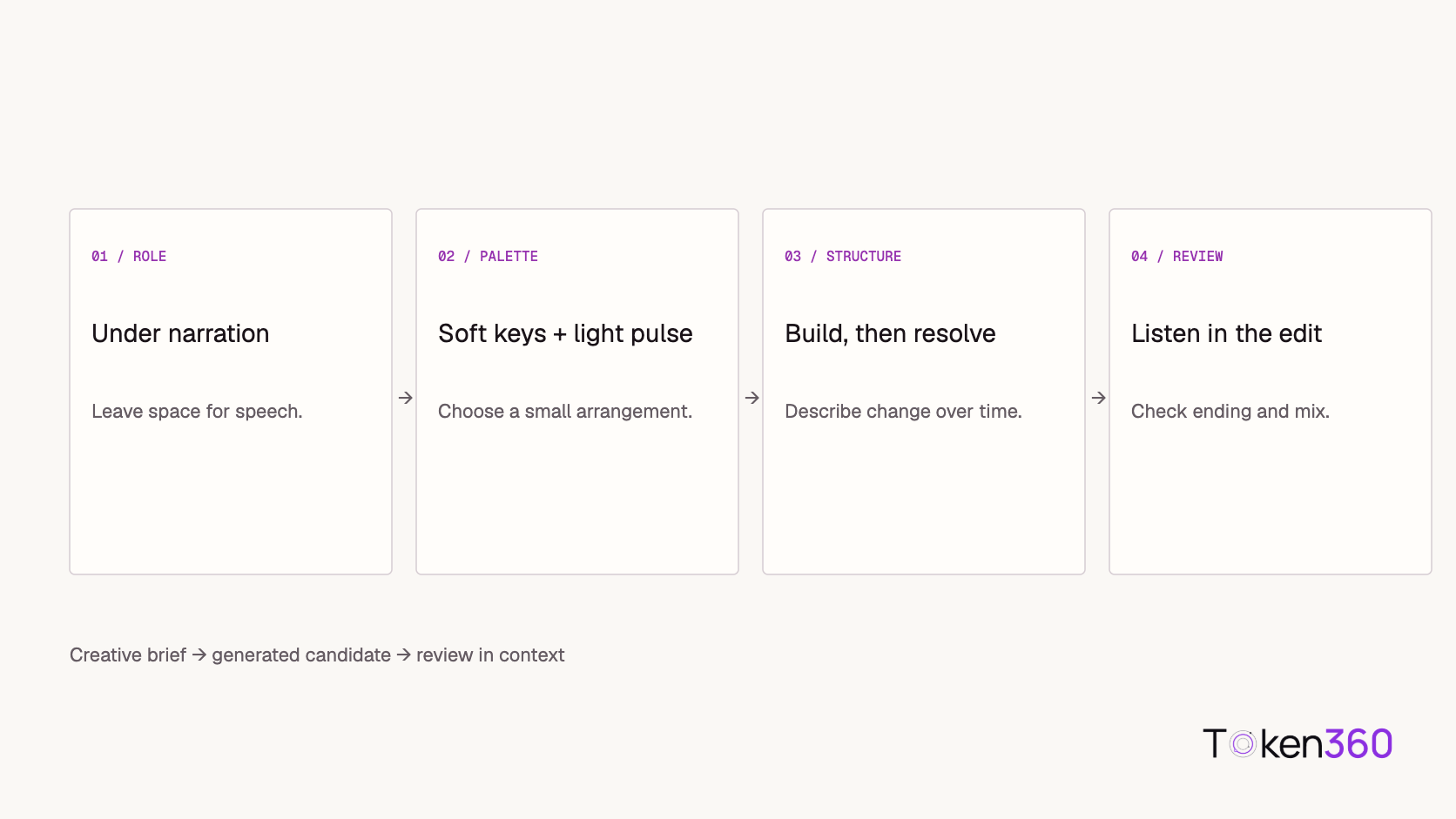
Begin with the job the music must perform. An understated bed for spoken narration has different requirements from a reveal cue intended to draw attention. “Cinematic” alone does not distinguish those roles.
Choose a limited sound palette, describe the energy, specify whether vocals are wanted, and say how the track should end. When progression matters, describe the change in plain language. Treat timing phrases as creative instructions to assess, not guaranteed automation points.
For an initial test, avoid asking for a specific artist’s identity or an entire genre history in a single prompt. A concrete arrangement and a small number of observable requirements make feedback easier: “no voices,” “light percussion enters later,” or “the final chord decays before the file ends.” An attractive melody can still fail one of those requirements.
Three tested prompts and all nine original music samples
The pilot used the requested settings of MP3 and thirty seconds, with three candidates per brief. The following are the supplied test prompts and unedited files. Playback lets readers judge the outputs for themselves; the observations are the tester’s reports, not a separate blind listening review.
1. A restrained background bed
Create a 30-second instrumental background bed for a calm product explainer. Use soft electric piano, warm sustained chords, and a very light rhythmic pulse. Keep the arrangement sparse and the energy steady throughout. No prominent lead melody, dramatic build, heavy drums, vocals, humming, or spoken words.
Name the outputs bed-1.mp3 through bed-3.mp3. Check three requirements: no audible voice or humming; a sparse arrangement without a dominating lead; and steady energy without a dramatic build or interruption. This is only a first-pass arrangement review. It does not prove that a real voiceover remains intelligible; that requires playback with the same narration and mix settings.
Create a 30-second instrumental cue for a product reveal. Begin with sparse, soft piano. In the middle, gradually add warm strings and light percussion so the second half is clearly fuller than the opening. Resolve on a final chord and let it decay naturally before the clip ends. No vocals, humming, or spoken words.
Name the outputs reveal-1.mp3 through reveal-3.mp3. Check that the opening is sparse, the second half is audibly fuller, and the ending resolves without an abrupt cut. Record unwanted voices separately as a rejection condition. This tests broad structural change, not precise synchronization to a particular video frame.
Create a 30-second instrumental ambient cue with warm sustained pads and occasional soft piano notes. Keep it calm, spacious, and free of drums or sudden changes. During the final five seconds, gently fade the music to silence so the ending feels complete. No vocals, humming, or spoken words.
Name the outputs ambient-1.mp3 through ambient-3.mp3. Check the absence of voices and drums, whether the texture stays calm without sudden changes, and whether the ending fades rather than cutting off mid-sound. Note whether the fade actually occurs near the end. Do not label this a seamless loop: a fade-to-silence brief and a loop brief are different tests.
Separate preference from compliance. “I prefer version two” is useful editorial feedback, but it is not a reason to mark version one as failing a requirement it actually met. Use the written checks above for pass/fail, then record a separate preference if several tracks pass.
The planned review checks are described with each prompt. In the completed pilot, the tester supplied overall “meets requirements” judgments rather than a separate score for every criterion. Accordingly, the reported 9/9 is overall tester acceptance, not nine independently verified passes for every musical property. A follow-up study should record each criterion and any edits separately.
Record
What to capture
Identity
Filename, model ID, prompt, requested duration, format, date, request ID if available.
Waiting time
Manually time from clicking Generate until completion is displayed; mark the method as manual.
Cost
Actual per-run USD charge, including charged attempts that fail the listening review.
Output
Original file, actual duration, codec, sample rate and channels when inspected.
Review
Each criterion, overall pass/fail/uncertain, and the reason.
Report each brief separately before combining totals. If background beds pass and reveal cues fail, an aggregate score can hide the distinction. Nine runs can expose useful problems, but they cannot establish broad quality rankings or reliable tail-latency statistics.
Integrating the result into a production workflow
Keep the creative brief, generation record, and delivered file together. A download alone is not enough to explain why an asset was selected or reproduce the conditions later. Retain unsuccessful candidates as evaluation evidence, even if they are never shipped to end users.
Before implementing requests, use the current Token360 documentation and confirm a successful response for this model. The public configuration inspected here includes a speech-style endpoint description alongside a pending-verification note. A working music request should resolve that ambiguity before an executable API example is published. Availability in a selector and independently verified API behavior are different observations.
For a timed video, review the music against the actual cut rather than assuming the written build lands on the desired moment. If the edit needs a precise change at a particular scene, measure that offset in the editor and decide whether regeneration, editing, or a different workflow is appropriate.
Before commercial delivery, confirm the terms covering the account and provider route used to generate the file. A license statement for Sonilo’s direct product or a fal endpoint should not automatically be treated as the terms of a Token360 request. Keep the applicable documentation with the asset record.
FAQ
What does the Sonilo text to music API produce?
It produces music from a text description. Token360’s listing describes a single audio output for sonilo-text-to-music. This is distinct from generating spoken narration or isolated sound effects.
How much does thirty seconds cost?
At the checked public reference rate, thirty seconds calculates to $0.0874125 USD. All nine thirty-second requests in this pilot were reported at that charge, totaling $0.7867125 USD.
How long did generation take?
The median manually timed wait was 13.48 seconds and the mean was 19.75 seconds, including a 69.11-second run. Eight of nine waits were between 12.85 and 15.35 seconds. This is a small user-timed pilot, not a latency guarantee.
Can I request instrumental music without vocals?
All three prompts requested no vocals, humming, or spoken words, and the tester accepted all nine outputs overall. Separate vocal-presence scores were not supplied, so this pilot does not establish a measured no-vocals reliability rate. The original samples are available above.
Does Token360 stream the music while it is generated?
The inspected Token360 listing describes this route as non-streaming. Sonilo’s native documentation describes additional modes, which should not be assumed to be available through this route.
Can a prompt control the exact ending?
A prompt can request a resolution or fade. Whether it happens as requested must be checked in the generated audio. A requested duration alone does not prove that the musical phrase ends naturally.
Are Token360 and fal parameters identical?
No. The inspected schemas differ in field names, defaults, limits, and exposed options. Match the request to the service being used and compare the actual delivered files and charges.
What should I measure besides generation time?
Record actual spend, duration, prompt compliance, and whether the ending is usable. For narration work, add an in-context listening test; for loops, add a repeated boundary check.
Can I publish the generated music commercially?
Confirm the license and terms applying to your provider route and account. This pilot does not independently establish commercial rights.
Start with the soundtrack’s job
A useful music evaluation begins with the edit’s requirements: support speech, build energy, or finish quietly. Use one brief, retain repeated attempts, and calculate cost using the outputs that actually meet the brief. That produces evidence for choosing a workflow rather than a collection of hand-picked demos.



 Launch
 Launch
 Tutorial