Protect public AI features with bounded tasks, user allowances and shared budgets. Control paid work before inference without blocking legitimate use.
ENTERPRISE AI · ABUSE PREVENTION
Protect a public AI feature by limiting what each user can request, how much work one request can start, and how much shared budget the feature can consume. Enforce those rules on your server before paid inference. Keep provider credentials private, track in-flight work, and provide a fair recovery path for legitimate users who hit a limit.
A free demo, customer assistant, or media generator can create paid model calls even when visitors pay nothing. Keeping the API key out of the browser is essential, but a public endpoint that accepts unlimited work can still spend the company's money on someone else's behalf.
Scope: This is a proposed application-control framework, not a penetration test or a claim that Token360 automatically detects abusive end users. Examples are illustrative. Official sources were checked November 15, 2026. The focus is public-feature abuse; linked guides cover account budgets, key security, and operating costs.
Why is a hidden API key not enough?
A hidden provider key prevents visitors from using that credential directly, but it does not decide whether your own application should accept their requests. If the application forwards every submission to a paid model, users can consume resources through the legitimate interface. Authentication, authorization, and consumption controls solve different parts of the problem.
OWASP's unbounded-consumption guidance describes uncontrolled inference as a risk to finances and service availability, and recommends input limits, rate limiting, and user quotas. The enterprise lesson is to treat the public product boundary as a spending decision, not just a form submission.
Use the API key security guide for credential storage and rotation. For the public feature, additionally establish who may call it, which task they may perform, and what resource allowance applies. A disabled button or a browser-side counter is not a server-enforced limit.
What should you limit besides requests per minute?
Limit both request frequency and the work behind each request. A short answer and a long document analysis can consume very different resources. Media duration, resolution, output count, file size, and workflow steps can also change cost. A request-count limit alone cannot express the full exposure of a multimodal product.
Control
What it bounds
Example application policy
Request rate
How quickly new work arrives
A per-account burst allowance and sustained rate
In-flight limit
Work already running
A bounded number of active generations per account
Input limit
Processing required before output
Supported file types, decoded dimensions, pages, or text length
Output limit
Size of a single result
Maximum output tokens, clip duration, or sample count
Workflow limit
Expansion into multiple paid operations
A shared cap on model calls, tools, retries, and elapsed time
Period allowance
Cumulative use
A task or cost allowance with a stated reset rule
Feature-wide ceiling
Shared exposure across identities
A separate public-demo budget and stop condition
These are proposed control categories, not recommended universal numeric thresholds. Derive limits from the advertised user task and measured resource needs. An input that is technically accepted by the model may still be outside the scope of a free product feature.
OWASP's API resource-consumption guidance also covers execution time, upload size, operations within a request, and third-party spending. Apply that broader boundary to preprocessing, storage, and external tools rather than treating model tokens as the only cost.
How should an enterprise design a free AI trial?
Define the trial as a bounded product experience: a specific task, a known output scope, and an allowance that can be enforced before execution. Keep higher-cost options behind an explicit entitlement. Explain the limits before users invest time in a request, and offer a legitimate route to expanded access.
For an illustrative product-video trial, the public experience might permit one approved output format, a limited set of duration options, and one result per submission. A signed-in account could receive a separate allowance. The server should construct the approved model request; it should not blindly forward arbitrary model IDs or generation parameters supplied by the browser.
Count the whole workflow. A “generate” action might trigger image preparation, video generation, audio work, and a retry. Reserve an allowance for that permitted workflow rather than charging only the first step against the trial limit. If a model option changes, review the allowance before making it available.
Keep commercial messaging consistent with enforcement. If the page promises a number of attempts, define whether a failed attempt consumes that allowance. If it promises usable outputs instead, account for the extra work this can require. The preview-before-pay guide discusses who funds that initial experience; this guide addresses how to prevent uncontrolled consumption of it.
How can limits work fairly across users and companies?
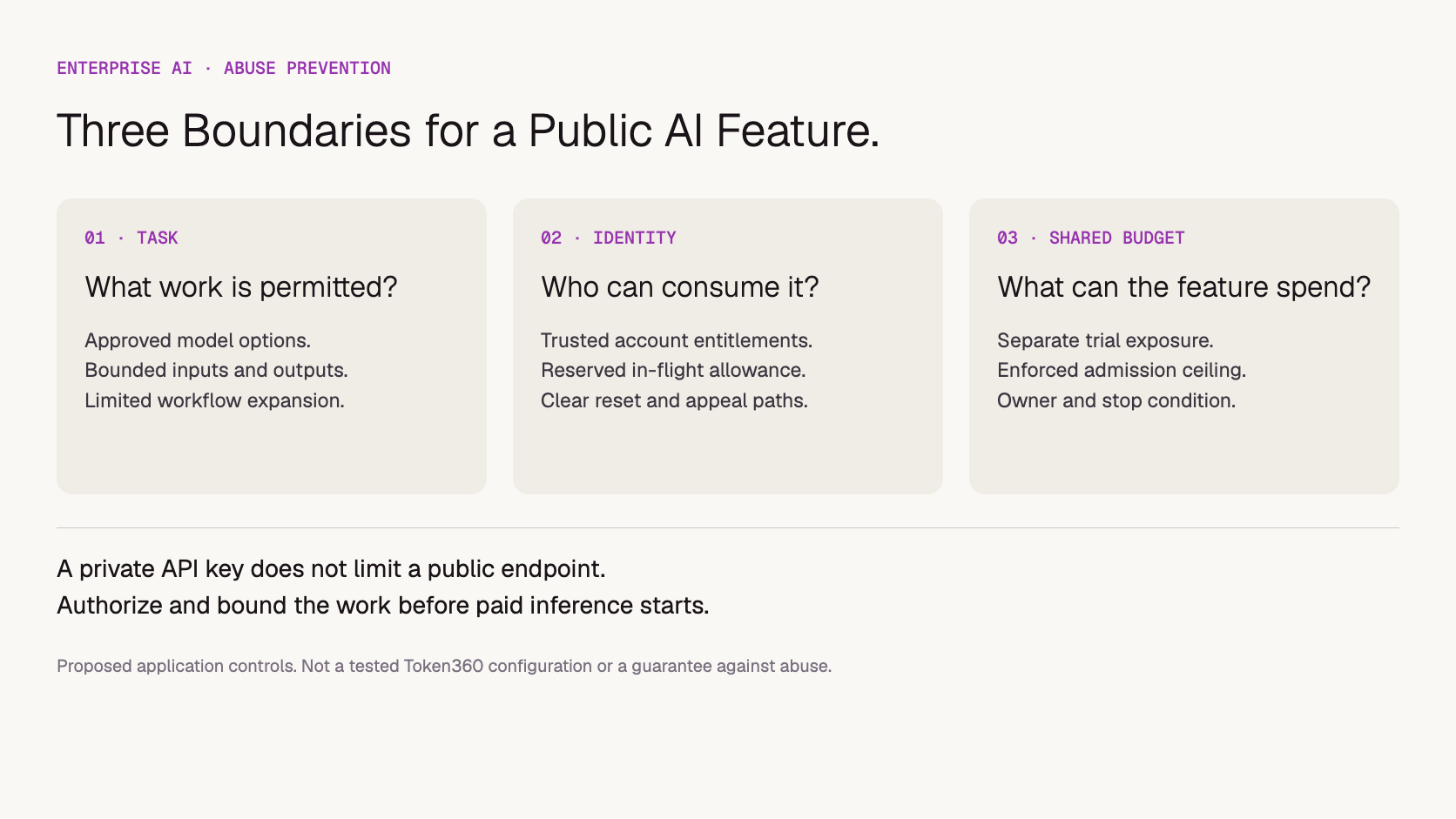
Apply controls at more than one boundary: individual user, customer organization, public feature, and shared infrastructure. Use trusted server-side identity and entitlements where available. IP addresses can contribute a signal, but they should not be the sole definition of a customer, because legitimate users may share networks and abusive users may change them.
For signed-in business customers, an organization allowance can prevent multiple seats from unintentionally multiplying a company-level entitlement. Individual limits can keep one account from exhausting the organization's allowance. Both should reflect the product agreement, rather than silently introducing restrictions that contradict a paid plan.
Anonymous access has a weaker identity boundary. Keep its permitted work small enough that the aggregate exposure is acceptable, and require stronger verification or account review before enabling more expensive actions. A CAPTCHA or verification step can add friction, but it does not establish a complete cost boundary by itself.
Provide an appeal or support route for legitimate users who are blocked. Monitor false positives, including teams behind shared networks and customers with approved batch workloads. A control that stops abuse but makes the intended enterprise use impossible needs adjustment.
Proposed layered policy. No single counter covers every kind of resource exposure.
How do you prevent simultaneous requests from overspending?
Check and reserve the relevant allowance before starting work, using a shared server-side mechanism that handles concurrent submissions consistently. Track pending consumption as well as completed consumption. Otherwise, several requests can all see the same remaining balance and each begin an expensive operation before any usage record is updated.
A conceptual admission sequence is:
Authenticate where required and resolve the actual account and organization.
Validate the permitted task, model options, and maximum work.
Check rate, active-job, and cumulative allowance limits together.
Reserve the applicable allowance and record an internal operation identifier.
Submit the bounded work and reconcile the reservation with the known outcome.
This is a design sequence, not production-ready code or a statement of Token360 behavior. Fixed-cost tasks can use task credits; variable-cost tasks need a defensible estimate or upper bound under the selected provider's semantics. If you cannot bound a task safely, keep it outside an automated free allowance.
A timeout should not automatically return the entire reservation if the provider may still be processing the request. Preserve unknown outcomes and reconcile them. Bound retries under the same operation instead of giving each retry a fresh allowance. For actual generation replay, use the duplicate-generation recovery guide.
What should happen when a limit is reached?
Reject or defer new work with a clear product message and an appropriate next step. Tell the user whether the limit is temporary, account-specific, or feature-wide, and whether existing work continues. Avoid automatic retry loops that keep submitting a request the application has deliberately refused to start.
Offer options that match the reason: wait for a stated reset, reduce the task, obtain approved access, or contact support. Do not invent a reset time for a manual review hold. A paid upgrade may be appropriate for legitimate demand, but suspected credential misuse requires investigation rather than simply a larger allowance.
Separate stopping new work from cancelling existing work. The provider may already have accepted an operation, and a browser disconnect does not prove it stopped. Keep its state visible so users do not submit duplicates in response to an unclear limit message.
The budget alerts and spend limits guide explains the broader distinction between notification and enforcement. Here, the important product decision is what your server does before the next public request becomes a paid operation.
What should you monitor without treating every spike as abuse?
Monitor consumption in relation to the intended product task, not traffic volume alone. Useful signals include unusually costly requests, repeated allowance exhaustion, high in-flight counts, and low completion or acceptance rates. Compare those signals with expected campaigns, customer launches, and approved batch activity before restricting a legitimate customer.
Keep a minimal operational record: account or organization identifier, feature, permitted task class, admission decision, operation identifier, estimated reservation, observed usage, and outcome. Avoid collecting full customer prompts solely to make a cost dashboard more detailed. Access and retention for abuse investigations need their own policy.
Separate provider errors, ordinary customer mistakes, accidental application loops, and suspected deliberate misuse. Each can increase spend, but the appropriate action differs. For example, fixing an internal retry loop is more useful than blocking the customer whose request happened to trigger it.
Test enforcement with synthetic accounts in a controlled environment: simultaneous submissions, a limit reset, a client changing forbidden parameters, a timed-out operation, and a queue of pending jobs. Verify both the refusal and the permitted path. Do not load-test a production provider without an agreed scope.
What belongs to your application, and what belongs to Token360?
Your application decides which end users may initiate paid work and under what entitlement. The inference supplier controls its own account and service boundaries. Coordinate those layers, but do not assume a supplier-level limit identifies your customers or implements the free-trial rules advertised by your product.
Token360's enterprise offering provides model access across text, image, audio, and video and describes tenant-wide key audit and custom pricing. Those capabilities do not establish automatic bot detection, per-visitor trial enforcement, or a managed abuse-prevention system. Confirm any required controls and enforcement semantics for your engagement.
Before launch, agree which application identity maps to which supplier account or key, how quickly usage becomes visible, which controls stop new submissions, and what happens to in-flight jobs. Keep public-demo exposure distinguishable from production customer workloads. The AI feature unit economics guide helps assess whether the permitted trial can support the business model.
Copy the blank public AI feature control worksheet to assign task scope, identity boundary, allowance, concurrency rule, reset behavior, timeout handling, owner, and verification evidence. The worksheet contains no fabricated test results.
No. A lower unit price can reduce the cost of bounded usage, but uncontrolled volume can still consume a budget and affect other customers. Evaluate unit price alongside the maximum permitted work and the controls that enforce it.
Should every user have a separate provider API key?
Not necessarily. The application needs reliable user and organization attribution, but that does not require exposing or issuing a provider credential to every visitor. Choose the supplier-key structure for isolation and operations; enforce product entitlements using trusted application identity.
Can content moderation replace consumption controls?
No. A harmless prompt can still request expensive work or be submitted repeatedly. Content suitability and resource authorization are separate decisions. A permitted topic should not automatically authorize unlimited model calls, outputs, or workflow steps.
Is this a guarantee that the trial cannot be abused?
No. The framework reduces exposure through explicit limits and operational review. Its effectiveness depends on implementation, identity assumptions, provider behavior, and testing. Start with a limited release and revise controls using observed legitimate demand and verified failure cases.
About this guide: Written by Yuki Yu for Token360. The control table, trial example, and admission sequence are editorial proposals rather than a tested Token360 security configuration.
Enterprise AI
API
Bring your next idea to life.
Create a video scene in Creator, or explore models for images, audio, and text to find the right capabilities for your project.



 Guides
 Guides
 Guides