Do You Still Need Engineers With Managed Inference?
Managed inference reduces serving work, but technical ownership remains. Assign application, change, output-review and escalation responsibilities.
Managed inference can reduce model-serving infrastructure work, but your business still needs accountable technical ownership. Someone must maintain the application integration, control access, evaluate changes and decide whether outputs meet business requirements. That person need not be a dedicated inference engineer; the required skills and coverage depend on the workload and the agreed service scope.
For an enterprise buyer, the staffing question begins after the demonstration works: who will look after this feature next month? A supplier may keep an endpoint running while the application uses outdated product data, applies the wrong permissions or accepts an unsuitable answer. Those problems need owners even when the infrastructure is managed.
This is an operating-team planning guide, not a headcount benchmark or a report of a customer deployment. Official sources were checked November 17, 2026. Examples and the downloadable ownership worksheet are proposed planning tools; no staffing savings were measured.
Which engineering work can a managed service remove?
A managed service can take responsibility for specified deployment and infrastructure tasks, reducing work your team would otherwise operate directly. The extent varies by offering. Identify the transferred tasks before estimating staffing changes; “managed” does not establish that the supplier maintains your application or accepts responsibility for its business outcomes.
For example, Hugging Face's Inference Endpoints documentation describes provider-managed provisioning, model deployment and container lifecycle operations. It distinguishes this infrastructure work from building the application. That is a concrete example of a managed scope, not a promise about every inference provider.
Use the inference service-scope guide to establish what you purchase. This article starts with that scope and asks how to staff the responsibilities that remain after launch.
Which responsibilities still need an internal owner?
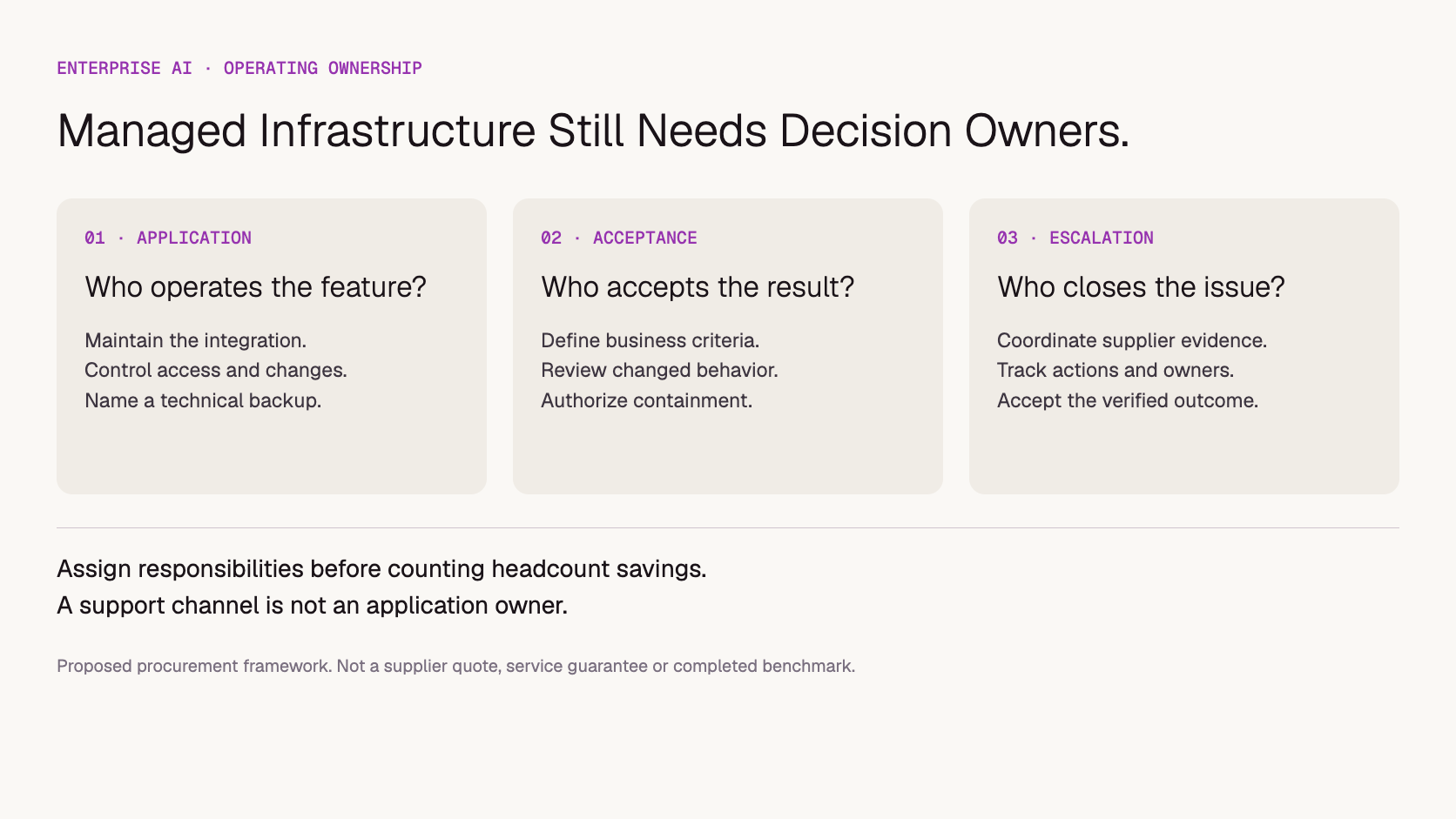
Assign owners for the application, access decisions, business acceptance and supplier coordination. A small team may combine roles, while a larger organization may distribute them. What matters is that each decision has an accountable person, sufficient access and a backup—not that every role appears as a separate job title.
Responsibility
Decision the business retains
Possible owner
Application integration
How requests, responses and failures affect the product
Application engineer
Output acceptance
Whether results are accurate and appropriate for the task
Product or domain owner
Access and data use
Which systems and people may submit which data
Technical owner with security/privacy review
Service changes
Whether a changed model or configuration is acceptable
Technical and business approvers
Supplier coordination
Who opens issues, tracks decisions and escalates
Named service owner
The proposed roles are not a mandatory staffing formula. An existing platform team may own integration and supplier coordination. A business sponsor may own output acceptance with specialist reviewers. Record the actual arrangement, including who acts when the usual owner is unavailable.
AWS's SageMaker security guidance provides a relevant example of shared responsibility: customer responsibilities depend on the service and include considerations such as data sensitivity and company requirements. Managed infrastructure should not be interpreted as transferring all data-use decisions to the provider.
Do you need a specialist machine-learning team?
Not necessarily for every supported model API integration. The team needs the capability to operate the actual workflow, which may be primarily application engineering and domain review. Specialized serving or model expertise becomes more relevant when the arrangement leaves custom runtime, model adaptation or detailed performance work with the customer.
A straightforward internal drafting feature may require an engineer who understands the integration and a reviewer who understands the content. A custom deployment with customer-maintained components can require a different skill set. Do not infer staffing needs solely from company size or from the word “AI.”
Ask the supplier which tasks require customer expertise and what help is included when those tasks arise. If a proposal says “optimization support,” clarify whether it means advice, investigation or hands-on changes. Do not remove a role from the operating plan until the relevant work has an agreed owner.
This is separate from deciding whether to operate the model infrastructure yourself. The API versus self-hosting comparison addresses that architectural choice. Here, the assumption is that some serving work has already been purchased as a service.
Who decides whether a model or configuration change is safe?
The supplier can explain a service change, but your business needs an owner to assess its impact on the application. Identify who reviews the notice, runs representative checks and authorizes the application response. Approval may mean adopting a change, adjusting the workflow or pausing a feature—not necessarily controlling the supplier's release schedule.
Keep a compact set of business-critical examples and their acceptance criteria. These might test required product attributes, a structured output used by another system or handling of a request that should be declined. The owner should know why each case matters, not merely whether a request returns a successful status.
Record the configuration and acceptance decision that were actually reviewed. If a supplier cannot hold a particular version, make that constraint visible in planning. Do not describe rollback as available unless the relevant service and application support it.
The staffing requirement is continuing ownership of these decisions. A launch-only contractor who leaves without handing over the checks and escalation path can leave a managed service attached to an unmanaged application.
Who responds when the endpoint works but the result is wrong?
Separate service availability from task success. A provider may investigate execution issues, while your team must identify whether the application produced an unacceptable business result. Start with evidence and impact rather than assigning fault. Name who can contain the problem, investigate the application and coordinate any supplier escalation.
Consider a hypothetical product-description feature. The endpoint returns valid responses, but descriptions omit required specifications. The business owner defines the unacceptable result. The application owner checks the inputs, prompt and validation logic. The supplier is contacted if the evidence points to behavior requiring its investigation. A successful API response alone does not close the issue.
Decide who may disable automatic publication or route work for human review while the issue is examined. Those are product decisions and need an authorized owner. They should not depend on a supplier support agent knowing your publication rules.
Use the API bug-report guide for the separate task of assembling an escalation packet. The point here is to ensure someone is responsible for acting on the evidence and accepting the resolution.
A proposed ownership framework, not a prescribed team size.
How should a small team arrange coverage?
Combine roles where practical, but make availability and decision authority explicit. A named owner without time, access or backup is not a workable arrangement. Match coverage to the consequence of failure: an internal batch task and a customer-blocking feature can require very different response expectations.
For a low-risk internal workflow, a primary technical owner and a trained backup may use an existing team process. For a customer-facing feature, the company may need a clearer operational handoff and escalation coverage. These are examples to assess, not universal minimum staffing levels.
Before launch, walk through one plausible event: the feature returns unsuitable results while the primary engineer is away. Can the backup find the current configuration, identify the business approver, stop an unsafe downstream action and contact the supplier? Record gaps revealed by the walkthrough instead of assuming a support subscription fills them.
Download the operating-ownership worksheet to assign the primary owner, backup, authority, evidence and escalation route for each recurring responsibility. No headcount assumptions or pre-approved allocations are built into it.
What should be agreed with the supplier before handover?
Agree the boundary between supplier work and customer work, then identify the contacts and evidence needed to cross that boundary. Make sure both sides understand who investigates, who changes what and who accepts the outcome. A support channel is useful, but it is not a substitute for that operating agreement.
Keep initial integration work separate from ongoing operation. The onboarding support guide covers the launch handover. The SLA review guide covers contractual service measures. Neither document determines who approves your application's outputs.
Token360 focuses on enterprise model access across text, image, audio and video. As checked November 17, 2026, its enterprise page invites technical-support and account-management discussions, with several options requiring sales confirmation. Discuss the responsibilities needed for the engagement; do not assume it supplies a replacement engineering team or a universally available managed application service.
Yes, if that person has the skills, capacity and authority to perform them. Record backup coverage and distinguish technical decisions from business approval, even when one person coordinates both.
Can an agency provide the technical ownership?
It can provide agreed work, but your company should retain an accountable relationship owner and business acceptance authority. Document access, handover and coverage so responsibility remains clear when personnel or contracts change.
Does premium support remove the need for internal monitoring?
Not automatically. Confirm what the supplier observes and responds to. Your application may have business failures that are invisible to infrastructure monitoring, such as incorrect downstream actions or incomplete content.
How much engineering time will managed inference save?
This guide cannot provide a universal estimate. List the work being transferred, retained and newly introduced, then compare it with your current operating effort. No staffing reduction should be promised without evidence for that workload.


 Guides
 Guides
 Guides