Editing AI Sound Effects: When Should You Generate Another Take?
Keep, trim or regenerate AI sound effects by checking event count, decay and sync. Hear three original clips from a nine-take Sonilo production test.
By Yuki Yu
A character crosses a room in three slow steps. The generated track gives you seven. Before buying another take, listen to the space between steps three and four. If the third heel strike has time to decay and the first three contacts land with the picture, you may already have the material for the shot.
Editing AI sound effects starts with identifying what the picture needs. Keep a take that fits. Try an edit when the sound you want is present and separable. Generate again when the material itself is wrong or when a clean edit would take longer than finding a better take.
Read first. The original test covers the three prompts, generation settings and results for all nine MP3s. Sonilo Sound Effects API pilot.
What did the editor hear across the nine takes?
The listener accepted one cup take, three rain takes and none of the three footstep takes against their original briefs. All nine were requested as eight-second MP3s. Each cost USD 0.018648 in the October 2026 pilot. The notes came from one listener, who manually timed each generation from submission to visible completion.
Requested cue
Take 1
Take 2
Take 3
First edit decision
One ceramic cup set down
Two contacts
Repeated contacts
Matched
Audition take 3 against the picture
Steady rain on leaves
Steady throughout
Accepted
Accepted
Choose the bed that fits the mix
Three slow footsteps
Seven heard
Nine heard
Ten heard
Test an isolated three-step passage
This is a second look at the same nine files. The observations describe the originals. The suggested cuts are editorial judgments to try on a timeline. No edited cut received a listener score in the pilot. The audio players below contain the original MP3s so you can audition them while reading.
When is an extra footstep easy to cut?
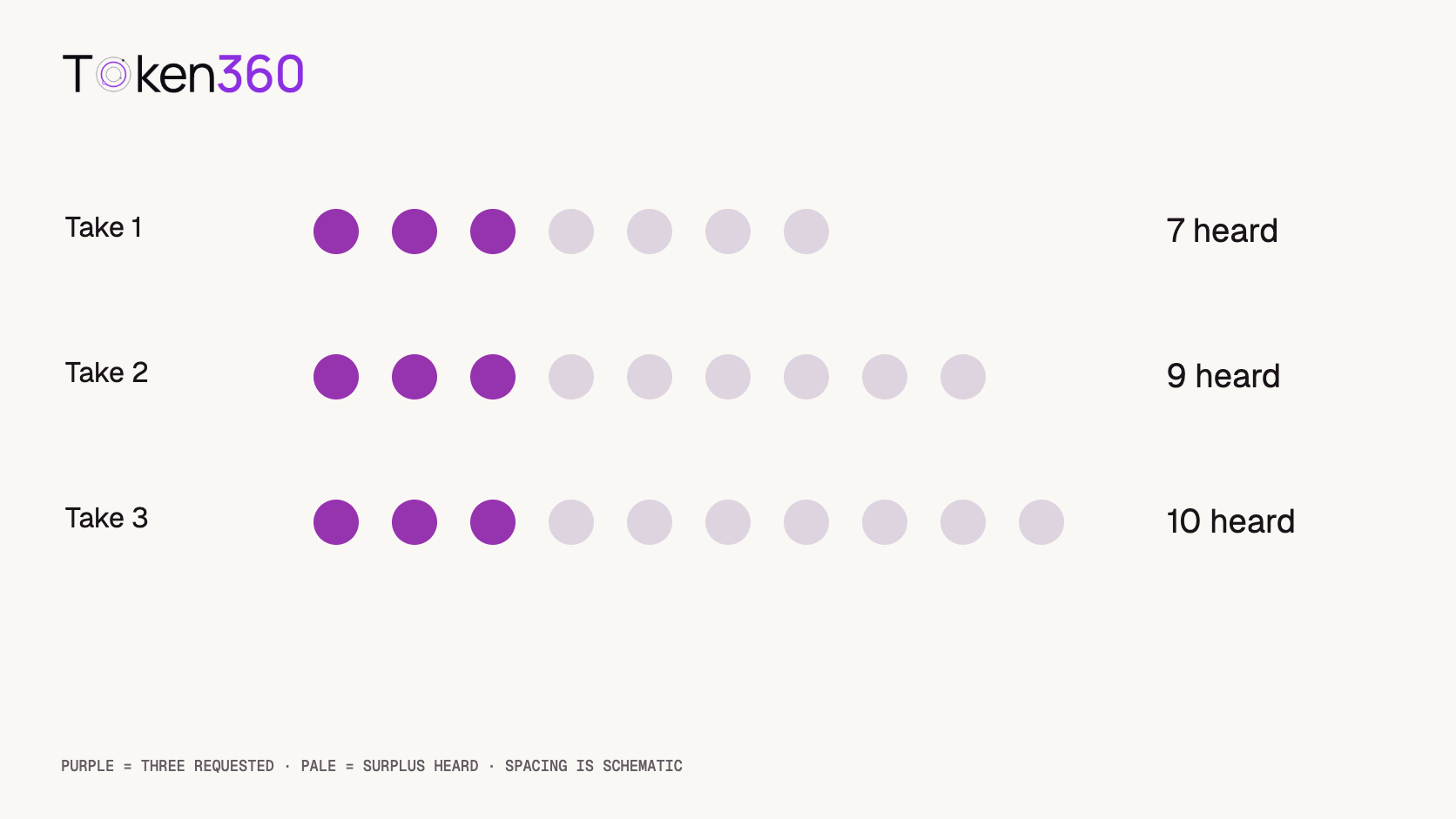
An extra step is easy to remove when the preceding step has finished ringing and the remaining cadence fits the shot. Start with the seven-step take. It has four surplus contacts against the brief. The nine- and ten-step takes have six and seven surplus contacts. The smallest surplus makes a sensible first audition, although a later take may have a cleaner gap.
Listen for the gap. Count three contacts in the recording, then listen only to the end of the third. Can you hear its room sound settle before the next strike? On a second pass, listen for the spacing of the first three contacts. A sequence can have a clean cut point and still sound too quick for the character on screen.
Footsteps, take 1. The listener counted seven contacts. Original audio.
Place the strongest contact on the frame where the shoe takes weight. Play through the shot from a second before the entrance. If the first step lines up but the third arrives while the foot is still in the air, trimming the fourth through seventh steps will fix the count and leave the timing error intact. Try a different three-step passage before moving individual sounds.
A cut through a loud waveform can introduce a click. Audition a nearby zero crossing or apply a short fade at the boundary. Then listen to the tail with the background track present. A fade long enough to hide a click can also soften a heel strike that needs to carry through the mix. Audacity’s guide to fades and edit points.
Each mark represents one contact reported by the listener. Spacing is schematic and does not show measured timing.
How does a single impact change the decision?
For a single impact, preserve the attack and the short decay that identify the object. In the cup brief, the listener wanted one ceramic cup placed on wood. Take 3 already met that description. Start there before spending time rescuing either of the earlier takes.
Cup, take 3. The listener accepted this recording for a single contact.
The double contact in take 1 becomes interesting if its first strike fits the image better. Imagine that the accepted take sounds too heavy for a delicate espresso cup. In that case, isolating a quieter first strike could improve the shot even though the original take missed the count. Listen for where the object stops vibrating. If the second impact overlaps that tail, a hard cut may make the cup sound like a switch.
Keep a short stretch of quiet audio on either side of a promising strike as you move it. Those handles give the editor space to place the transient, shape the decay and adjust the cut when the picture changes. Exporting a tightly cropped hit too early can remove exactly the material that makes the contact sound natural.
Why audition three rain beds if all three passed?
Steady ambience gives the editor a choice of texture. The first take was described as even and uninterrupted, and the other two were also accepted. For an outdoor dialogue scene, audition the beds under the quietest line. Choose the one that leaves the words clear at the level where the garden still feels wet.
Rain on leaves, take 1. The original brief called for steady light rain without thunder, voices or music.
Extending an eight-second bed introduces a new acceptance test. Put two copies end to end, overlap the boundary and listen across several repetitions. An isolated drip near the end can turn into a conspicuous repeating accent. Also listen for a level dip or swell at the join. If a different accepted take gives a quieter seam, changing the source may be quicker than polishing the first loop. Audacity’s clip crossfade reference.
The original listening notes describe each file in isolation. A loop, a dialogue mix and an exterior shot each ask something different of the same recording. Keep the raw-file verdict alongside the verdict for the intended scene so a later editor can tell what was actually reviewed.
What did another generation cost in this pilot?
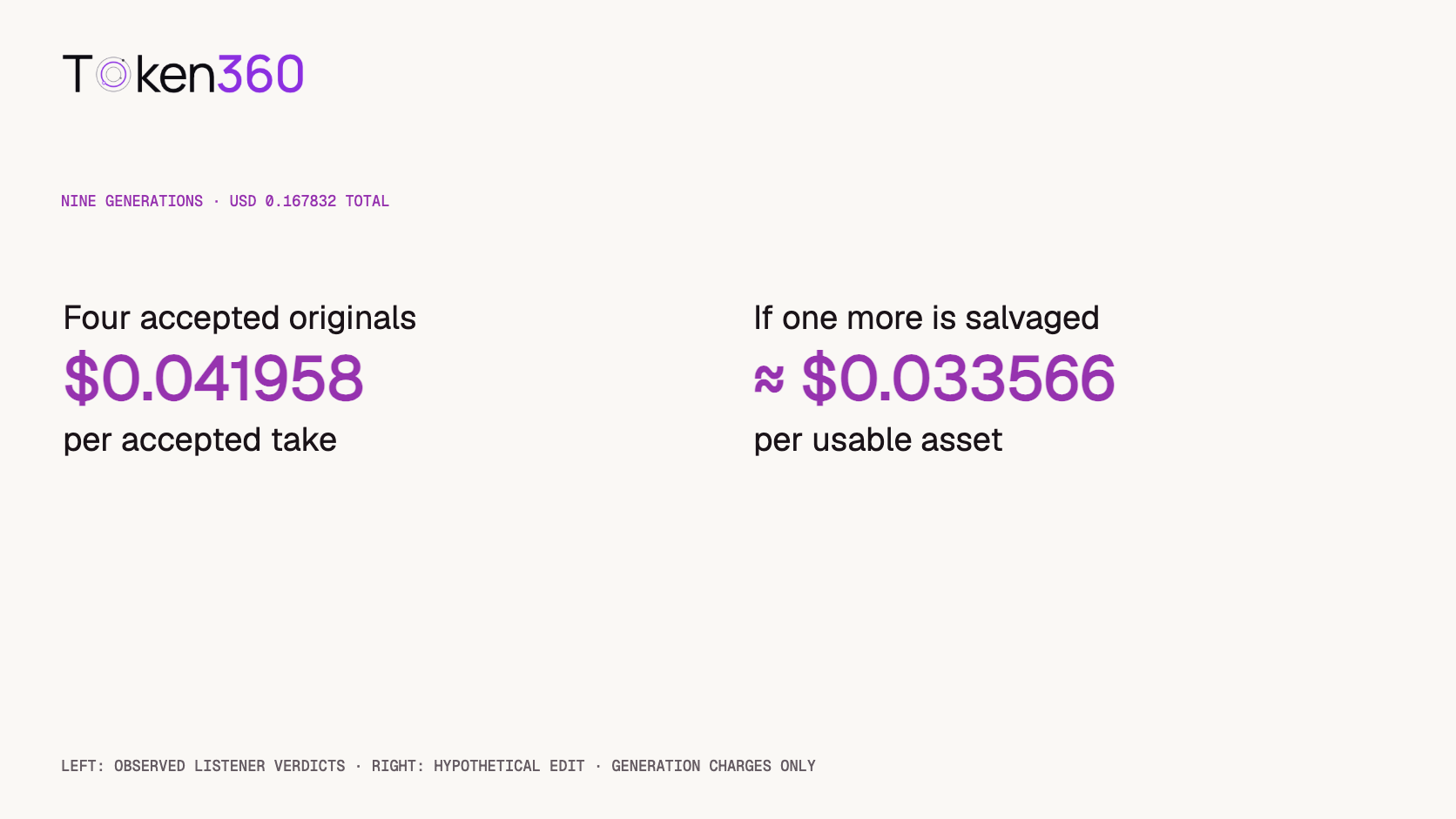
One additional attempt at the observed price would add USD 0.018648 in generation charges. The nine original calls totaled USD 0.167832. Dividing by the four takes accepted against their briefs gives USD 0.041958 per accepted original. This calculation pools three different briefs and excludes labor.
Consider a specific editing decision. If an editor later salvaged one of the five rejected takes, the same generation spend divided by five usable assets would be about USD 0.033566 per asset, before editing costs. That fifth asset is hypothetical. A project that needs only one rain cue may also use just one of the three accepted beds. The denominator should follow what the production can actually deliver.
The manual generation times ranged from 5.57 to 11.08 seconds. The median was 7.42 seconds. Those figures describe how long the tester waited for a result on screen. The editor still has to audition the result, sync it and make a decision. For a deadline, compare the whole time to a reviewed cue on each path. For a budget, include paid editing time alongside generation charges.
What belongs in the handoff to the next editor?
Deliver the original take alongside the selected edit, with the picture version, the cue’s purpose and the remaining review question. A note such as “three heel contacts for the hallway crossing, check the last tail under the door close” gives a mixer a specific listening task.
Record whether the take was accepted as generated, accepted after editing or left unresolved. A single “approved” flag loses that distinction. It can also cause a future editor to spend time reconstructing a successful cut from a source that still contains seven steps. If your team compares generators, preserving both outcomes lets it measure prompt adherence separately from the usefulness of the raw material.
For an additional take, change the instruction that addresses the problem you actually heard. If contacts overlap, ask for clearly separated impacts with a quiet gap after the last step. If the surface sounds wrong, specify the floor and footwear. Keep the accepted scene references available when evaluating the replacement. The Token360 evaluation framework describes how to keep acceptance criteria consistent across runs.
Frequently asked questions
Should I regenerate every clip that misses the event count?
Audition the best passage first. A surplus contact after a natural pause gives you an inexpensive edit to try. Overlapping contacts or an unsuitable walking rhythm make another source more attractive.
Can I count footsteps by looking at waveform peaks?
Use peaks to find possible edit points, then count by ear. A heel and toe can produce multiple peaks within a single perceived footstep. The counts in this article are the original listener’s observations.
Which sample would you try first for a three-step shot?
Start with footsteps take 1. Compare the first three contacts with the visible steps, then audition other passages if the spacing is wrong. The original test recorded no final three-step edit.
Does an eight-second generation require an eight-second edit?
The picture determines the final cue length. A contact can occupy a small part of a shot. Preserve enough of its decay to sound plausible in the room.
How should I price a rescued take?
Record the original generation charge once, then add the time spent editing and reviewing. Count the finished asset when the production can use it. This avoids counting the original and its edited copy as two deliveries.
Can these results predict the next generation?
Three attempts per prompt give an editor concrete examples to audition. Estimating a dependable success rate would require more prompts, more attempts and consistent independent listening criteria.
Read next. If the scene also needs synchronized speech or environmental sound, consider which cues to generate with the picture and which to keep as separate tracks. AI video native audio guide. More production resources are available from Token360.
Editorial revision: November 4, 2026. Test dates and dated source snapshots remain as stated in the article.
Audio
Video Editing
Tutorial
Build faster with one AI API.
Use Token360 to call video, image, audio, and text models with one key and one bill.


 Prompt Library
 Insights
 Insights