How Should Enterprises Choose Multilingual AI Models?
Choose multilingual AI models by language, locale and business task. Check meaning, policy accuracy and review effort before a global rollout.
ENTERPRISE AI · MULTILINGUAL WORKFLOWS
Choose multilingual AI models by testing the business task in each required language and locale, not by counting supported languages. Check meaning, policy decisions, terminology, local formats and escalation behavior separately from fluency. Compare the actual API configuration, review effort and accepted output. A strong result in one language is not approval to launch every language.
This is an enterprise selection framework with hypothetical examples and an unscored test worksheet. It contains no comparative model benchmark, customer results or claim that Token360 has validated every language.
Read first: choosing AI models by use case helps define the task. This article adds the language and locale requirements that a broad model shortlist can miss.
What does “multilingual support” need to mean for your company?
For procurement, multilingual support should mean completing a defined task for a defined audience. Specify the input language, output language, locale, business rules and review requirements. A model that produces fluent sentences may still misunderstand the request, apply the wrong policy or change an important product term.
Consider a customer asking about a return. The useful outcome is not merely a natural-sounding reply in the customer’s language. The answer must interpret the request, use the applicable policy, preserve the relevant dates and explain the correct next step. Evaluate those requirements explicitly.
Requirement
What to specify
What to inspect
Language and locale
Audience, script and regional conventions
Correct language, understandable wording and appropriate formats
Business meaning
Facts and intent that must survive
No changed quantities, negation, eligibility or commitments
Terminology
Approved product names and domain terms
Consistent terms without unwanted translation
Task completion
Required decision, fields or next action
The workflow succeeds, not only the prose
Uncertainty
When to clarify or escalate
No invented policy when information is missing
A language list is a useful discovery filter. It is not a substitute for these acceptance requirements.
How should you shortlist models without relying on an English score?
Use published evaluations to identify candidates, then check whether their languages, tasks and scoring methods resemble your workload. A broad benchmark can inform a shortlist without establishing performance on your company’s terminology or policies. Keep the target-language application test as a separate decision step.
The Cohere Labs Aya evaluation suite distinguishes translated, human-edited and target-language-authored material. Its documentation recommends pairing machine-translated material with human-edited or human-authored subsets. That distinction is useful for buyers: translated English questions alone do not represent every way customers actually ask for help.
For each candidate, record the exact model identifier, API route, configuration and advertised language coverage. Note whether relevant evidence concerns translation, general question answering or the specific task you need. Do not turn a translation score into a claim about correct account handling or document extraction.
Review Token360’s model capability documentation alongside the selected model’s details. Confirm required inputs and parameters instead of assuming that language capability also proves support for scanned documents, speech or a particular output schema.
What should a multilingual test set contain?
Combine equivalent cases across languages with cases written naturally for each audience. The shared cases reveal whether the same business requirement survives a language change. The locally authored cases expose expressions, terminology and situations that a direct translation may miss. Keep a separate set for final confirmation after revisions.
For a support assistant, include ordinary questions, incomplete requests, follow-up corrections and messages that mix a product name in English with another language. Include cases where the correct response is to ask a question or hand the issue to a person. Use permitted, appropriately prepared data rather than copying sensitive customer conversations indiscriminately.
The following are proposed test designs, not observations from model outputs:
Hypothetical case
Business requirement
Failure to look for
A customer corrects an earlier order quantity
Use the corrected quantity in the final response
The answer is fluent but retains the old number
A message mixes local language with an English product name
Understand the request and preserve the product identifier
The name is translated or the request is misclassified
A supplied policy depends on the customer’s market
Use the policy associated with verified market information
The model infers the market only from language
A numeric date is ambiguous
Clarify or use confirmed locale/context
The model silently chooses an unsupported interpretation
A requested exception is absent from the policy
Escalate without inventing authorization
The response politely promises an unsupported exception
Use business-reviewed expected outcomes, not necessarily one exact reference sentence. Different wording can be equally acceptable when the meaning and required action are correct.
How do you separate fluent language from correct decisions?
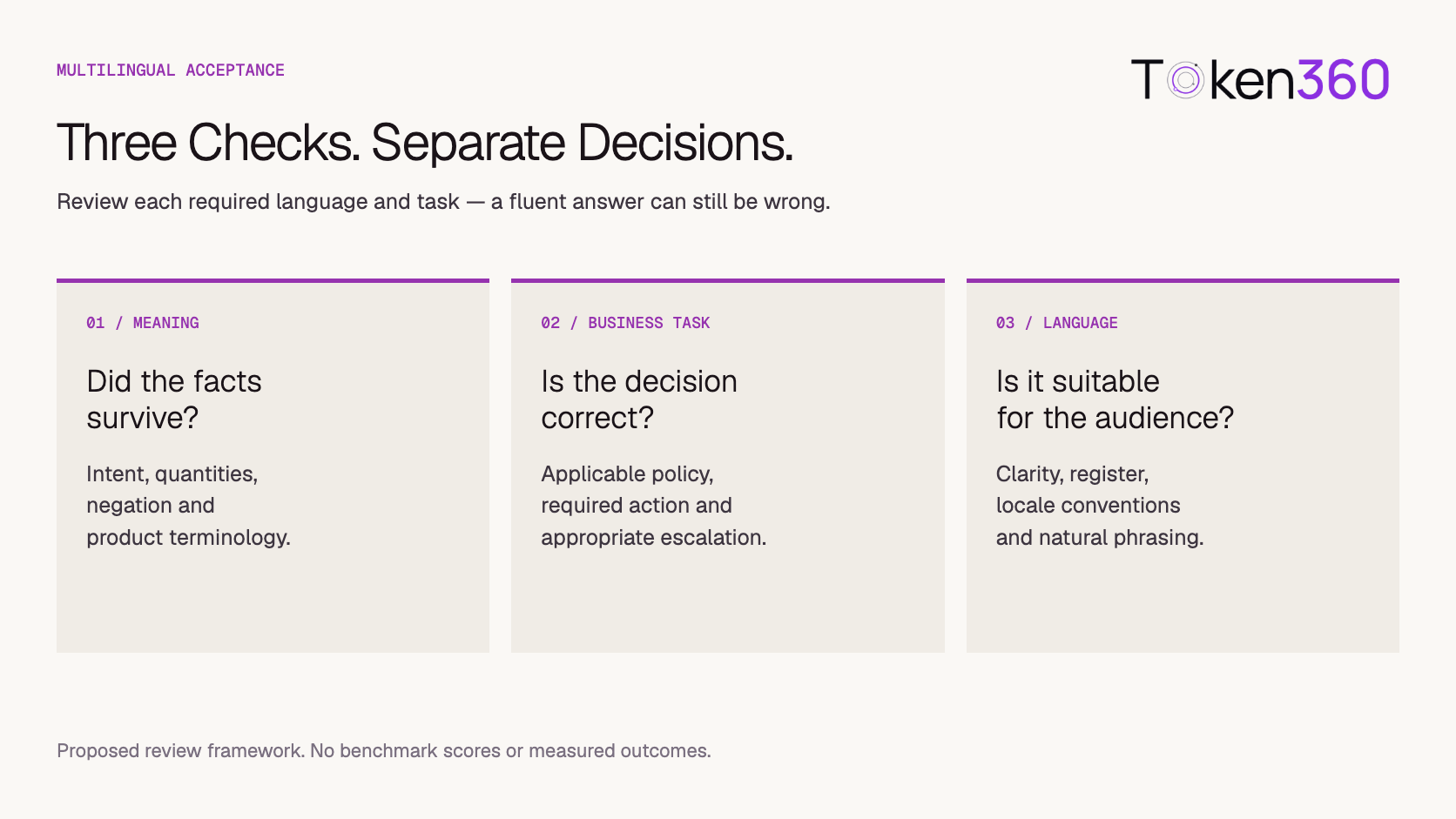
Score language quality and task correctness separately, and define which failures block acceptance. A natural, polite response that changes a deadline or invents eligibility should not pass because its style is good. Have reviewers assess the relevant language and the underlying business rule, with a process for resolving disagreements.
Language reviewers can identify unnatural phrasing, register and terminology problems. A domain owner can verify whether the answer applies the right policy. One person may have both capabilities, but do not assume that a native speaker automatically understands every internal rule or that a policy specialist can judge every language.
For example, a draft might communicate the policy accurately but require a tone edit. Another might sound excellent while granting a refund that the supplied policy does not permit. Record those as different failures. Otherwise a combined score can conceal the mistake that matters most to the business.
Proposed review framework. Good prose cannot compensate for a failed business requirement; no scores shown are test results.
Reviewers should also record whether a failure came from missing source information, misunderstood input or an unsuitable generated answer. Changing the model will not necessarily fix a policy document that never reached it.
Why should language and locale be tested separately?
Language identifies how people communicate; locale affects conventions such as date and number presentation. Neither establishes a customer’s legal market, account location or applicable company policy by itself. Supply authoritative context where the task needs it and avoid making business decisions from language detection alone.
The W3C’s internationalization guide describes locale-aware formatting for dates and numbers. Its examples show why numeric dates can be ambiguous. Where values are structured, use an explicit locale and appropriate application formatting rather than asking a model to improvise every presentation detail.
A hypothetical customer writing Spanish could belong to several different markets. If the returns policy differs by market, retrieve the verified account or order context instead of choosing a policy from the message language. Likewise, preserving a numeric value and displaying it appropriately are separate checks.
Ask the team to identify which values must remain machine-readable and which text is intended for people. This helps distinguish a model error from a formatting or interface problem.
Should you translate everything into one language first?
Translation through an intermediate language is a candidate architecture, not an automatic solution. It adds steps that can change meaning and requires its own evaluation. Compare it with direct multilingual processing using the same cases, expected decisions and review standards before choosing either approach.
In a proposed translation pipeline, the incoming message is translated, the business task is processed and the response is translated back. Inspect each stage when an error occurs. A changed product term in the first translation can affect the final decision even if the last response reads naturally.
Direct processing also needs testing, particularly when source documents and user messages are in different languages. If retrieval supplies the wrong material, a fluent generator may still produce the wrong answer. The separate RAG versus fine-tuning decision guide explains the distinction between access to knowledge and adapted behavior.
No pipeline was tested for this article, and neither is presented as the preferred architecture for every enterprise.
How should cost and response time be compared across languages?
Measure actual usage, elapsed time and review effort for the accepted task in each language. Do not assume that equal word counts or equivalent meanings imply equal API charges. Keep the same task scope and output requirement, and include any additional translation or repair steps in the comparison.
Token360’s billing documentation explains that the billing meter depends on the selected model and that final charges use measured usage and the active pricing rule. Use those records rather than a generic characters-to-tokens estimate when comparing routes.
A shorter answer is not automatically better value if it omits required information. Similarly, a fast first response may still require extensive editing. Record whether the result was accepted as-is, corrected by a reviewer or regenerated. Compare the complete process without inventing a universal price multiplier for any language.
Speech, transcription and generated audio add their own requirements and meters. This article focuses on language-model text workflows; a successful written test does not certify pronunciation, speech recognition or audio quality.
Can one model serve every language in the business?
Possibly, but treat that as a hypothesis to validate. A common model can simplify operations; different candidates may fit particular languages or tasks better. Approve the supported language-and-task combinations explicitly, and keep a defined handling path for combinations that have not passed evaluation.
Report results by language and relevant case type before calculating an overall summary. A high-volume language should not hide a serious problem in another launch market. Show the number and nature of cases reviewed, the remaining failures and what the sample does not establish.
A staged launch might approve reviewed drafts in one language while retaining human handling elsewhere. That is a possible rollout decision, not evidence that automation is ready everywhere. Recheck the relevant cases after material model, prompt, policy or routing changes.
What should you ask Token360 before a multilingual rollout?
Bring a language-and-task brief, not just a request for a model that “supports many languages.” Specify audiences, source languages, required outputs, traffic and acceptance requirements. Confirm the model route and enterprise service scope, while retaining responsibility for validating your own business workflow.
Token360 provides access across text, image, audio and video models and focuses on enterprise procurement. Dedicated capacity, negotiated pricing, contracts and compliance requirements can be scoped to an engagement. Discuss the actual workload through the enterprise offering; model access does not imply a blanket guarantee of equal quality in every language.
The multilingual acceptance worksheet provides fields for locale, task, expected behavior, configuration, reviewer, result and usage evidence. It is a blank planning tool, not a scored model comparison. Learn more about the company through About Token360.
Case ID,Language,Locale,Task,Source language,Expected behavior,Model and route,Configuration,Reviewer,Meaning result,Business result,Language result,Usage and charge evidence,Elapsed time,Review effort,Decision
,,,,,,,,,,,,,,,
Frequently asked questions
Is a translated English test set enough?
No single test set establishes complete coverage. Translated cases are useful for checking equivalent requirements, but add locally authored examples and realistic mixed-language inputs. Have qualified reviewers check that the test itself preserves the intended meaning.
Can another AI model do all the language evaluation?
It can assist with triage, but should not be the only acceptance authority without validation against qualified human review. A model-generated score does not prove that company policy, subtle meaning or local terminology is correct.
Should every grammatical error fail a model?
Define severity according to the task. A minor style edit and a changed business commitment are different issues. Customer-facing copy may have stricter language requirements than an internal draft, but factual and policy errors still need explicit treatment.
Does multilingual text support include voice support?
No. Verify the required audio capabilities separately, including supported inputs, speech recognition or generation behavior and the appropriate quality checks. Written-language results cannot establish performance on accents, pronunciation or noisy recordings.
What if we cannot review a required language?
Treat acceptance evidence as incomplete. Obtain qualified review, narrow the launch scope or keep a human-assisted process. Do not describe an unreviewed language as production-validated because the output looks plausible.
Read next: the AI model evaluation framework covers broader evaluation design and decision records. Replace local draft links with verified published URLs before publication.
Evidence boundary: this framework draws on official documentation and a primary multilingual evaluation resource. It reports no newly generated samples, language ranking, success rate or measured savings.
Enterprise AI
API
Bring your next idea to life.
Create a video scene in Creator, or explore models for images, audio, and text to find the right capabilities for your project.



 Guides
 Guides
 Guides