Chat memory depends on how history and preferences are stored and supplied. Check continuity, retention, access and cost before buying an API.
ENTERPRISE AI · CHAT MEMORY
A chat API does not automatically remember every previous conversation. Continuity depends on how the service and your application supply conversation state. Some endpoints require the application to send prior messages; others offer server-managed state. Remembering preferences across separate chats is another feature that needs explicit storage, access rules and update behavior.
For an enterprise assistant, “remember” might mean resuming yesterday’s draft, recognizing a customer’s preferred language or recalling a decision from another project. These are different product requirements. Buying access to a conversational model does not settle where those records live, how long they remain available or which user can reuse them.
This is a procurement framework, not a tested memory benchmark. Provider documentation was reviewed on November 17, 2026. The checks below are proposed acceptance tests; this article does not claim that a particular Token360 route includes persistent memory.
What do businesses mean by chat memory?
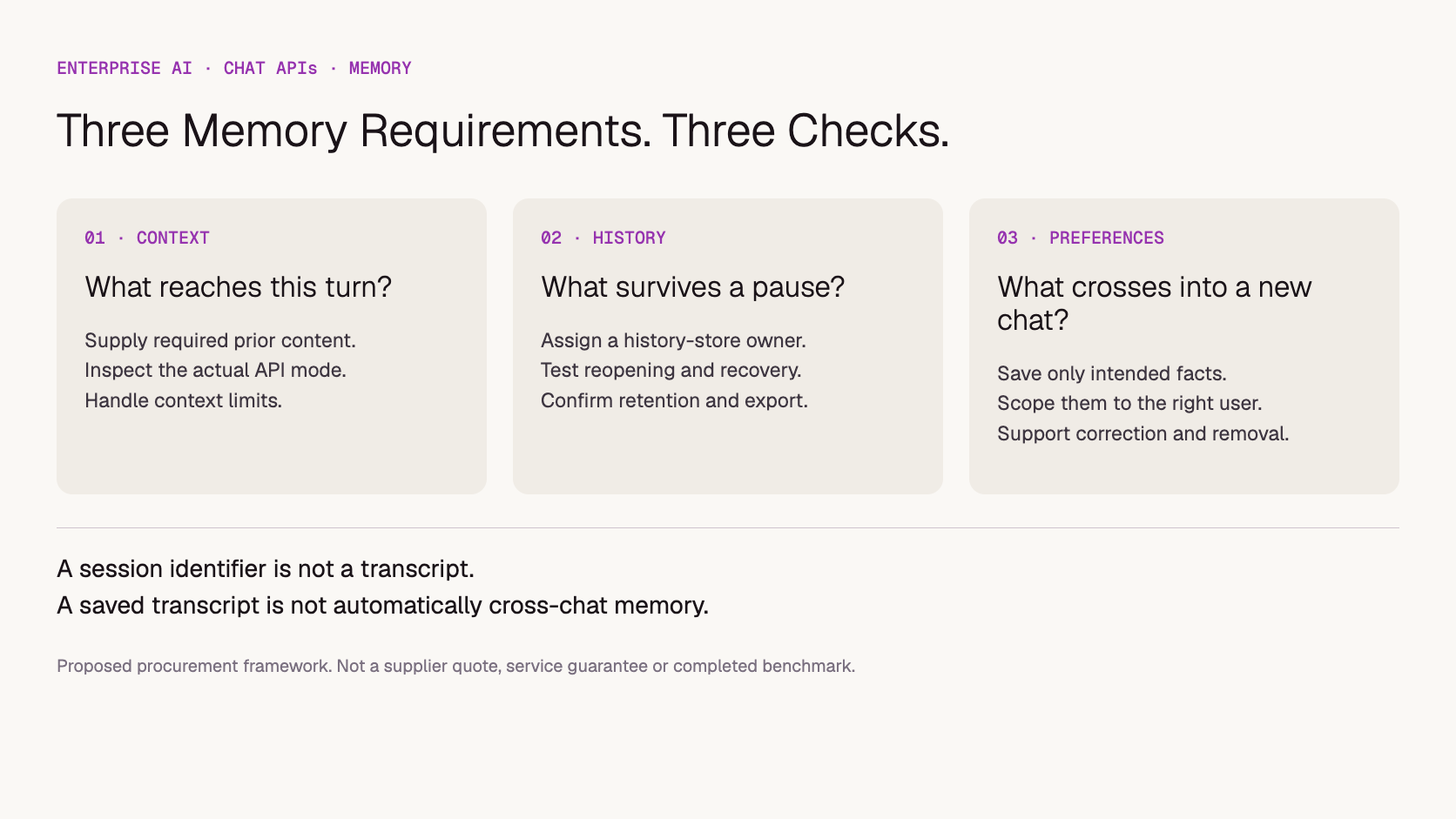
Separate the current request’s context, the stored transcript of one conversation and information intentionally reused across conversations. A system may provide one without the others. Write the expected user behavior for each: continue a turn, reopen an old thread or apply an approved preference in a new chat.
Requirement
Example
What must be confirmed
Within-conversation context
“Make that title shorter” refers to the preceding answer
The required prior content reaches the next model call
Saved conversation history
A user resumes a draft after reopening the app
The transcript can be stored, retrieved and authorized
Cross-conversation preferences
A new chat uses an approved language preference
The preference is intentionally saved and supplied
Current business records
The assistant knows the latest order status
The authorized source is queried or refreshed
A conversation about an old order is not a substitute for a current order record. Likewise, keeping a transcript does not establish that every word of it will be included in every future request.
Who supplies history to the next API call?
The answer depends on the endpoint and mode in use. In a stateless pattern, the application sends the conversation content needed for the next response. In a stateful pattern, the service can retain conversation state and accept a continuation reference. Confirm the actual route, supported protocol and expiration behavior before relying on either design.
Anthropic’s Messages documentation describes stateless conversation requests as well as a beta message-thread option with server-held state. That distinction matters more than a blanket statement that all chat APIs either have memory or do not. Availability and lifecycle must be checked for the feature you actually buy.
An SDK helper can make the client code look conversational while assembling history behind the scenes. The Google GenAI Python chat implementation, for example, combines its maintained history with the next user input. Ask the technical owner to explain where the state is held and what happens after the application process restarts. A successful second turn in a demo does not establish durable history across devices or sessions.
Does a session ID preserve the conversation?
An identifier only has the meaning the service gives it. A routing identifier, a stored-thread reference and an application conversation ID may serve different purposes. Do not assume that sending the same value restores earlier messages. Check which component uses it and what content that component can retrieve.
The Token360 session-affinity guide addresses route continuity across turns. This article addresses the separate procurement requirement of storing and restoring conversation content. The application still needs a defined strategy for supplying the context required by its chosen protocol.
For example, a customer may expect to resume a purchasing discussion after a lunch break. Specify that behavior directly, then verify the transcript and any required state remain available. Do not infer the answer from a stable model name, account key or session identifier.
Can the assistant remember preferences across new chats?
Only when the application or service deliberately makes that information available. Cross-chat memory needs a policy for what is saved, whose preference it is and when it should apply. It should not be inferred from a product’s ability to continue one conversation or from a large context window.
A proposed design might store “preferred response language: English” in a user profile, while keeping a project’s shipping requirements within that project. The assistant should not apply one customer’s temporary project instruction to all future customers or treat a tentative suggestion as an approved company rule.
Decide whether users can inspect, correct and remove saved preferences. Record their source and scope so an application can distinguish a direct instruction from a model-generated summary. If a preference is superseded, the update should reach every place from which future requests retrieve it.
Does a larger context window solve memory?
A larger window can allow more information in a request, but it does not by itself provide durable storage, access controls or cross-chat retrieval. Stored history and active model context are different resources. Confirm how your implementation chooses what to include when a conversation becomes long.
The long-context model guide covers window-size selection. For memory procurement, ask what happens to older messages: are they omitted, summarized, retrieved selectively or rejected when limits are reached? Each choice can change what the assistant has available to answer.
If summaries are used, test whether they preserve decisions and exceptions that matter to the task. The context-compression review addresses that failure mode. An old message remaining visible in the interface does not establish that its contents are in the model’s current input.
Proposed ownership framework for buying and implementing conversational continuity.
What retention and deletion questions should procurement ask?
Ask which records exist, where they are held and how each can be accessed, exported and deleted. Include application transcripts, provider-held state and derived memories or summaries. Removing a conversation from the interface should not be assumed to remove every underlying record or every fact previously extracted from it.
Ownership: which team operates the history store and handles user requests?
Scope: are records separated by user, customer, workspace and project as required?
Lifecycle: what expires automatically, and what requires an explicit deletion operation?
Derived state: can an old summary or preference reintroduce a deleted or corrected fact?
Portability: what can be exported if the model or provider changes?
Distinguish storage needed to continue a conversation from provider retention for other purposes and from model training. They are separate questions with separate terms. Confirm the actual agreement and implementation rather than treating “stateless,” “memory” or “delete chat” as a complete data-handling description.
How should you test whether continuity works?
Test the user behaviors your product promises, including recovery after a pause and isolation between accounts. Record what context was made available as well as the answer. Otherwise, a missed fact might be attributed to the model when the application never restored it, or an accidental shared state might go unnoticed.
Proposed check
Expected behavior to define
Evidence to retain
Resume a conversation after closing the app
Continue with the required prior decisions
Restored thread and sanitized request/state reference
Open a new chat
Apply only intentionally shared preferences
Profile scope and supplied context
Switch between two test users
Keep their history and preferences separate
User-to-record authorization checks
Correct a saved preference
Use the replacement rather than the old value
Stored update and subsequent behavior
Reach the planned conversation length
Preserve required facts or disclose limits
Context-selection or summarization behavior
Use synthetic test details where possible. A successful small test is evidence for that scenario, not proof of unlimited memory or complete isolation. Repeat the relevant checks after changes to state handling, model routes or the history store.
Download the chat-memory evaluation worksheet. It is a blank acceptance plan, not a record of tests completed against Token360.
Scenario ID,Expected behavior,Synthetic user,Conversation scope,Model and route,State mode,Storage owner,Pause duration,Context restored,Preference scope correct,Correction applied,Access isolated,Observed output,Usage and cost,Reviewer,Decision,Notes
What costs and responsibilities should the quote include?
Separate inference charges from conversation storage, retrieval, context management and application development. Sending a short new message does not necessarily mean the model processes only that message: earlier context may also be included. Ask how history and any caching affect actual usage, rather than estimating costs from the newest user turn alone.
For Token360, specify whether you need ordinary multi-turn requests, supported provider-held state or an application-managed history solution. Token360 provides enterprise access across text, image, audio and video models; that does not automatically include a complete customer-memory product. Confirm capabilities for the chosen model and route.
Use the model catalog to identify candidates and discuss the required behavior through enterprise procurement. Include pause duration, conversation length, identity boundaries and retention needs. The About page provides company context.
If the chat product also requests generated clips, the asynchronous chat-to-video workflow explains how the conversation connects to a longer-running job and its delivered asset.
What other chat-memory questions matter?
Does remembering a message mean the model learned from it?
No. Supplying a saved message as context is different from changing model weights. Confirm provider data-use terms separately; visible conversational continuity does not prove training occurred.
Will changing the model preserve memory?
Not automatically. Application-owned text may be reusable, but provider-specific continuation state or tool records may need different handling. Test the transition before promising seamless continuity.
Does deleting the browser tab erase the chat?
It depends on where records are stored. Closing a tab is not a reliable description of server-side retention or deletion behavior.
Should every old conversation be included in each request?
Not by default. Select information relevant and authorized for the current task. Including unrelated history increases processing and can introduce outdated or conflicting instructions.
Enterprise AI
API
Bring your next idea to life.
Create a video scene in Creator, or explore models for images, audio, and text to find the right capabilities for your project.


 Guides
 Guides
 Guides