An LLM API does not automatically include web search. Check tool execution, sources, freshness and charges before buying for current-information tasks.
An LLM API does not automatically include live web search. Some services expose a search tool, some return search results for your application to process, and others only generate from the information already available to the model or supplied in the request. Confirm the exact endpoint, enabled tools, returned evidence and billing before buying for current-information tasks.
A business may want to compare current vendor offerings, check a public product announcement or draft an account brief from recent sources. A model can write a convincing answer to those questions without establishing that it searched. The procurement requirement is access to suitable evidence, not simply fluent text that sounds up to date.
This is a capability-selection framework, not a web-search benchmark or a claim that every Token360 model can browse. Public documentation was reviewed on November 17, 2026. The example checks below are proposed acceptance tests, not completed experiments.
What are you buying when an API offers web search?
You may be buying retrieval alone or a workflow that retrieves information and writes an answer. Those are different deliverables. A search API can return ranked pages and snippets without composing a response; a search-enabled model service can combine retrieval with generation. Ask which output your application receives and which processing steps remain your responsibility.
For example, Perplexity’s Search API documentation distinguishes structured web results from an LLM-generated answer with citations. Its Agent API web-search documentation describes adding a search tool that the model can choose to call. These examples illustrate different service boundaries, not interchangeable guarantees across API providers.
Capability
Typical deliverable
What the buyer must confirm
Model generation without retrieval
An answer using supplied context and model knowledge
Whether current evidence is supplied elsewhere
Web search API
Ranked results, URLs and available extracted content
Who reads, selects and synthesizes the results
Model with a web-search tool
An answer plus supported tool and source information
When search runs and how evidence is returned
Internal knowledge retrieval
Material from connected company sources
Source freshness, permissions and retrieval scope
Internal company retrieval is a separate purchase decision. The RAG versus fine-tuning guide explains that boundary. Public search should not be assumed to know your private contracts, inventory or account-specific terms.
Does enabling a search tool mean every answer is searched?
Not necessarily. A service may allow the model to decide whether a tool is needed, and a compatible request format does not establish that the tool ran. For workflows requiring fresh evidence, verify the provider’s control options and inspect the actual execution information rather than relying on the answer’s wording.
Google’s search-grounding documentation describes enabling a search tool and the model deciding whether search can improve the answer. It also describes returning search-related steps and citation information. The practical requirement is to preserve the relevant evidence through your integration instead of reducing the response to plain text.
Ask the supplier to demonstrate a request through the same endpoint and account configuration that production will use. A consumer chat interface, an upstream demo and a third-party API route can expose different tools. “The model supports search” is incomplete until the proposed route and request support it too.
Does live search guarantee the latest or correct answer?
No. Retrieval during a request does not guarantee that every relevant page is indexed, accessible or current, or that the answer interprets it correctly. Define the freshness and source requirements for the business task. Distinguish when a page was retrieved from when its information became effective, and check whether a newer authoritative source supersedes it.
A hypothetical procurement question about a vendor’s current plan can surface an old announcement, a reseller page and a newer official pricing page. A recent retrieval timestamp on the old announcement does not make its terms current. The evaluator should check which source supports the specific claim and whether its scope matches the question.
Do not equate “no result found” with “the event never happened” or “the feature does not exist.” It may mean that the required evidence was not retrieved. Decide how the application should express that limitation. For stale internal files rather than public information, use the separate company-information freshness framework.
What should a sourced answer return to your application?
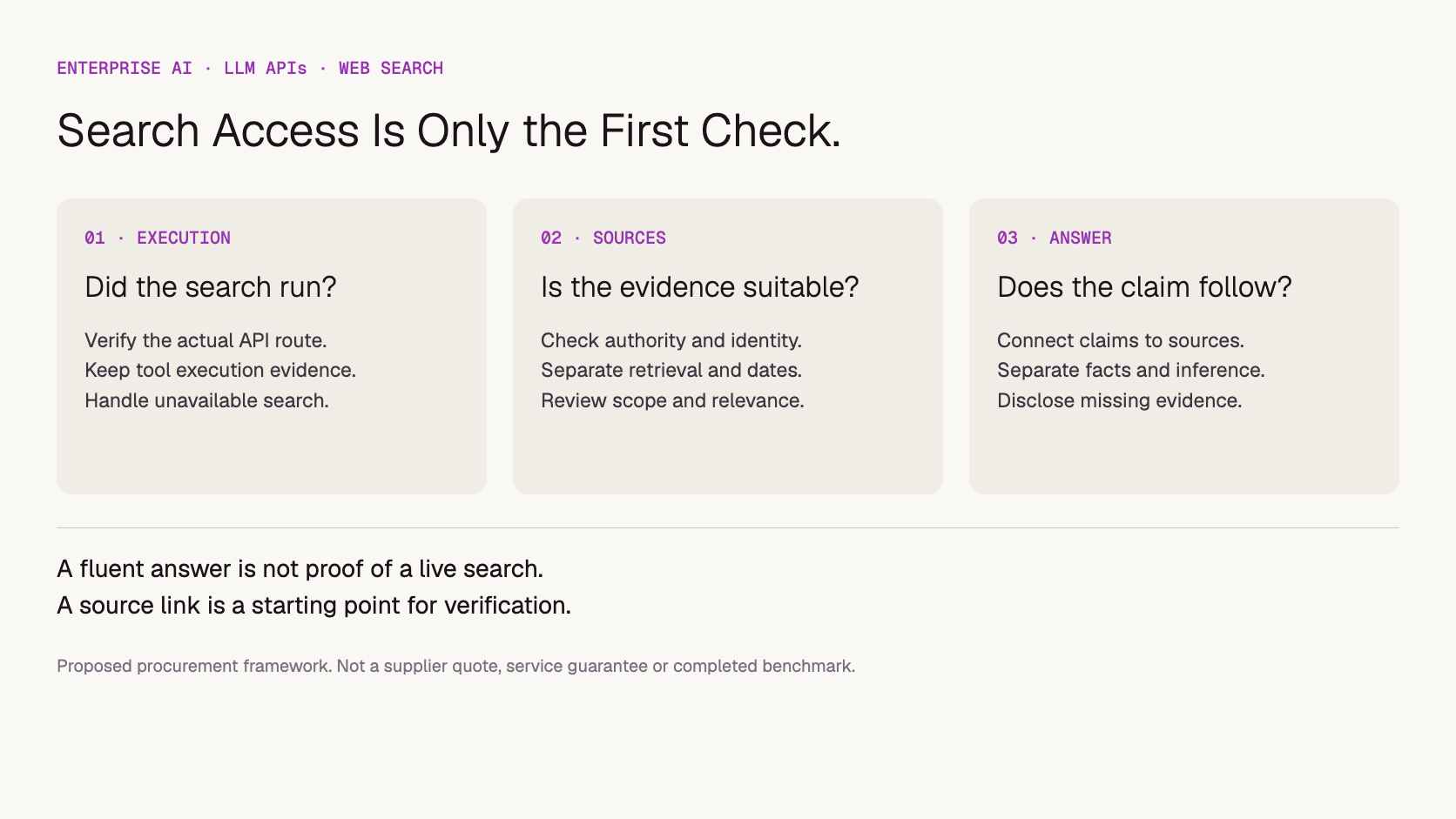
A useful evidence trail should let your application connect a material claim to an identifiable source and preserve enough context to review it. Ask which URLs, titles, excerpts, citation mappings and retrieval details are available. A list of links at the bottom is not sufficient evidence that each important statement follows from those sources.
For each proposed check, open the cited page and verify the claim. Confirm that the source refers to the right company, product version, region and date. Separate what the source states from the model’s inference. A page can be authoritative while still failing to support the exact statement attached to it.
Agree how citations survive streaming, storage and display in your application. Follow the selected provider’s attribution and display requirements. Preserve source metadata where permitted, but do not assume permission to retain or republish entire retrieved pages merely because an API returned them.
Proposed acceptance framework for buying current-information capability.
How should an enterprise test a search-enabled API?
Choose representative public-information questions with independently checkable answers, then evaluate retrieval, interpretation and failure behavior separately. Include an ambiguous query and a question without enough accessible evidence. A service that can acknowledge missing evidence may be more suitable for the workflow than one that always supplies a confident answer.
Proposed test
Evidence to inspect
Acceptance question
A recent official product announcement
Execution record and official source
Did the response use the relevant announcement?
Two businesses with similar names
Domains and entity details
Did it research the intended business?
Old and new terms available online
Publication and effective dates
Did it distinguish current terms from historical ones?
A fact unavailable in accessible sources
Answer qualification and escalation behavior
Did it avoid inventing a resolution?
A search timeout or unavailable tool
Error and application fallback
Did it disclose the loss of current evidence?
Record end-to-end time and actual charges alongside source checks. Keep the evaluation questions, expected evidence and review rules consistent across candidates. A single successful question establishes only that example, not coverage of the whole public web.
Download the web-search evaluation worksheet to record execution evidence, cited sources, freshness, supported claims and fallback behavior. It is a blank test plan; no supplier has been scored in this article.
What costs and data flows should the quote cover?
Ask whether the quote includes model usage, search calls and any additional retrieval or extraction operations. Also identify which organizations receive search queries and retrieved content. A public-information task can still contain confidential input if a user includes customer names, account details or an unpublished plan in the question.
Google’s Gemini pricing documentation treats grounding as a priced capability with model-specific conditions. Do not apply an ordinary token quote to a search workflow without confirming the applicable charges. One user question may trigger more than one search, so record actual usage rather than assuming one question equals one billed tool call.
For integration, agree what happens when the search budget, time limit or source access fails. The application can return a clearly limited draft or request human review; it should not silently present an unsupported answer as freshly checked. Keep query minimization, retention and applicable provider terms in the procurement discussion.
What should you confirm with Token360?
Ask Token360 whether the exact model route supports the required search capability, how it is enabled and what evidence and charges it returns. Token360’s enterprise model access across text, image, audio and video does not itself establish live browsing support. Treat search as a capability to verify for the proposed implementation.
Use the model catalog to identify candidates, then take the public-information use case and evidence requirements to enterprise procurement. If search must be supplied by a separate service, identify who integrates and operates that step. The About page provides company context; this article does not certify a particular search integration.
What other questions do buyers ask?
Can I just tell the model to search in the prompt?
A request in natural language does not create a missing tool. Confirm that retrieval is available, enabled and actually used when the workflow requires it.
Does pasting a URL mean the API reads the page?
Not automatically. URL retrieval must be supported by the service or performed by your application. A model recognizing a familiar URL is not evidence that it fetched the current page.
Is a citation enough to trust the answer?
No. Check that the source supports the associated claim and has the right scope and date. Citations enable review; they do not replace it.
Do all business requests need web search?
No. Rewriting supplied text or summarizing a provided document may not need external retrieval. Enable it where outside evidence is necessary, and evaluate its added cost, time and data exposure for that task.
Question ID,Question,Expected source,Expected date or scope,Model and route,Tools enabled,Search executed evidence,Returned source URLs,Source supports claim,Freshness checked,Missing evidence disclosed,Failure behavior,End-to-end seconds,Usage units,Actual charge,Currency,Reviewer,Decision,Notes
Enterprise AI
API
Bring your next idea to life.
Create a video scene in Creator, or explore models for images, audio, and text to find the right capabilities for your project.



 Guides
 Guides
 Guides