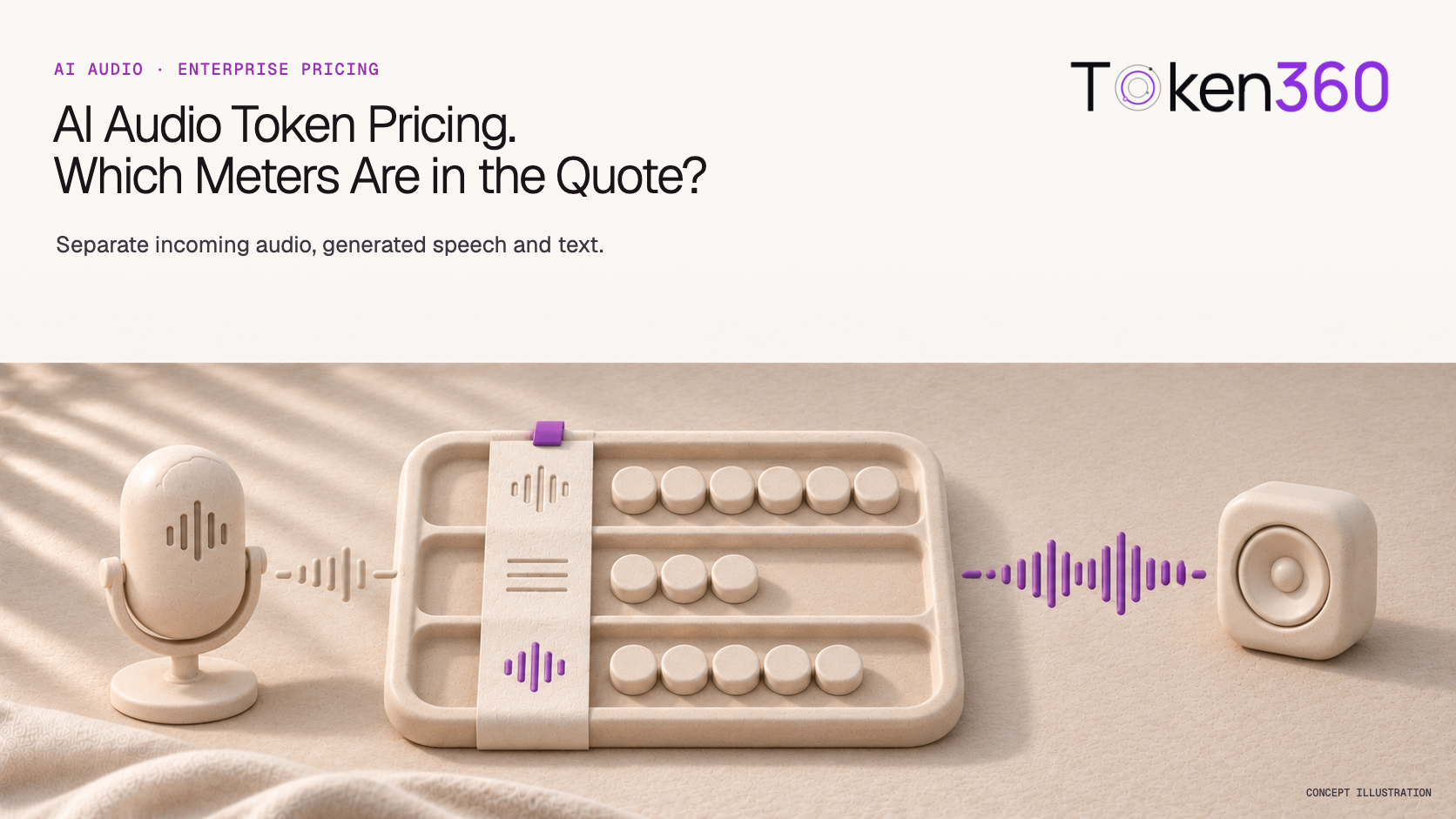
Compare AI audio token pricing by separating audio input, audio output and any text or cached-input charges. Apply each rate to the corresponding billable quantity for the same conversation workload. A single “price per million tokens” or “cost per minute” is incomplete unless the quote explains which direction, modality and processing it covers.
An enterprise evaluating an audio-capable assistant may send recorded speech, include text instructions and receive a spoken answer. The finance team needs to understand that combination before accepting a quote. This article concerns model usage metered in audio tokens; it does not assume that every voice service uses token billing.
For scripted narration and revision costs, use comparing text-to-speech API pricing. For recognizing recordings, channel treatment and transcript features, use comparing speech-to-text API pricing. Here, the purchasing question is how separate modality and direction meters combine into one audio-model bill.
Which prices belong in an audio-token quote?
Request a rate for every billable component the chosen configuration can produce: audio input, audio output, text input, text output and separately priced cached input where applicable. Confirm whether the quoted quantities overlap. Do not multiply a total token count by one rate when its component tokens have different prices.
For a concrete public example, the OpenAI GPT-Audio model page, checked November 22, 2026, lists separate text and audio input/output rates. That rate-card structure demonstrates why modality matters. It does not establish that the same model, endpoint, rates or billing breakdown are available through Token360.
Build a component-level quote, using only meters that actually apply.
| Component | Quantity to request | Question the quote must answer |
|---|
| Audio input | Billable input audio tokens | Does the reported quantity include earlier audio processed again? |
| Audio output | Billable generated audio tokens | Does billing track generated output or only output played to the user? |
| Text input | Billable text-input tokens | Which instructions, history and other text are included? |
| Text output | Separately charged text-output tokens, if any | Is accompanying text separately billed or included in another component? |
| Cached input | Eligible cached quantities by modality | Are these a subset of reported input, and which rate applies? |
| Other operations | Actual units for separately charged operations | Are transcription, tools or session-duration charges additional? |
This is a set of questions, not a universal billing schema. A supplier may use a duration-based voice service or a different combination of meters. Mark a component “not applicable” only after confirming the selected offer, rather than turning an absent field into a zero-cost assumption.
How do you calculate the audio-model usage subtotal?
Multiply each non-overlapping billable quantity by its own rate, adjust for the quoted unit and add the resulting charges. Treat cached and uncached input as separate quantities when their rates differ. Add other applicable fees afterward, keeping the model-usage subtotal distinct from the cost of the complete application.
Token usage subtotal = Σ (billable tokens in component ÷ quoted token unit × component rate). If the rate is per million tokens, the quoted unit is 1,000,000. Apply documented rounding or minimum-charge rules where relevant.
The following numbers are fictional arithmetic, not market prices, Token360 quotes or measured usage. Assume no cache discount, minimum charge, rounding adjustment or additional operations.
Illustrative monthly workload: separate quantities produce separate charges.
| Component | Billable tokens | Invented price per million | Calculated charge |
|---|
| Audio input | 2,000,000 | $10 | $20 |
| Audio output | 1,000,000 | $20 | $20 |
| Text input | 500,000 | $2 | $1 |
| Text output | 100,000 | $8 | $0.80 |
| Total model usage | 3,600,000 | No single applicable rate | $41.80 |
|---|
Multiplying all 3.6 million tokens by the fictional $10 audio-input rate would give $36, which understates this example. Multiplying everything by the $20 output rate would also be wrong. The error comes from applying one meter's price to other components.
When comparing two models, keep the business workload and acceptance requirements consistent, but obtain each model's own usage quantities. Identical recordings and requested answers do not justify assuming identical token counts across models. Preserve the quoted rate and its effective date alongside the usage record.
Can an audio-token price be converted to a per-minute price?
A per-minute conversion is useful only when it names the model, direction and documented or measured token-to-time relationship. Keep incoming and generated audio separate, and state which other charges are excluded. A derived audio-minute rate is not automatically the cost of a minute of conversation or a completed customer call.
Use tokens per audio minute × price per token only for the specific component whose conversion is established. OpenAI's Realtime cost documentation describes different token-to-time relationships for user audio and assistant audio. Those rules belong to the documented service; they are not a universal conversion for all audio models.
Distinguish three denominators before presenting a budget:
- Input audio minutes: the incoming audio duration under the selected counting rule.
- Output audio minutes: the generated speech duration under that rule.
- Elapsed conversation minutes: wall-clock time from the defined start to end, potentially including pauses and waiting.
For example, a hypothetical ten-minute interaction could contain four minutes of user speech, three minutes of generated speech and three minutes of waiting. It is not automatically ten billable minutes of input plus ten of output. Nor does the seven minutes of speech alone establish the entire bill: text, history and any session-based charges still need their own treatment.
If finance needs a per-conversation-minute forecast, divide the complete modeled charge by explicitly defined elapsed minutes and label it a workload estimate. Do not present it as the supplier's tariff. Recalculate when the speaking mix, response length or session design changes.
Why can later turns cost more than the new audio alone?
Check what the service processes on each response, including retained conversation history and instructions. A new spoken turn may not be the only input counted. Cache eligibility, history management and auxiliary processing can alter the bill, so a short single-turn demo cannot establish the cost of a longer conversation.
The OpenAI Realtime cost guide describes prior conversation items becoming input to later responses, with caching potentially reducing eligible input cost. This is a documented example of why history matters, not a claim that every provider retains, reprocesses or discounts history identically.
Ask the supplier to explain one early response and one later response from the same representative conversation. Identify new audio, carried-forward history, any text instructions and cache treatment. If cached tokens are already included in total input, subtract the eligible cached subset before applying the uncached rate; do not bill both the total and its subset again.
For interrupted replies, confirm how the actual service treats output already generated. The time a user hears is a different observation from what the backend produced. Likewise, ask whether optional input transcription or tool calls add charges rather than assuming they are included in the audio rate.
Collect the authoritative final usage or settlement record once for each billable operation. Determine whether streaming updates are cumulative or incremental before adding them together. For the broader history behavior, see whether an AI API remembers previous messages; for cache mechanics, see when prompt caching lowers API costs.
What should you ask Token360 to include in the quote?
Send Token360 the intended audio interaction, expected volume and representative conversation patterns. Request confirmation of the available model and access method before asking for modality-specific rates. The quote should identify the actual billing units, history and cache treatment, any additional charges and the evidence used to reconcile a representative request.
Token360 provides enterprise model access across text, image, audio and video. Its enterprise quotes are tiered: higher usage receives lower quoted rates. It does not charge a separate service fee. These facts do not establish that every audio model uses tokens, that all usage categories share a discount, or that a particular live speech-to-speech interface is available.
Token360's billing documentation, checked November 22, 2026, says the selected model's pricing rules and final measured usage determine charges. It also distinguishes an upstream public price from the Token360 route price. Use the confirmed route and active quotation, not another provider's public rate card, for the purchase estimate.
Use the worksheet template at the end of this article to record each component, its rate unit, quantity source and overlap rules. Include the following in an enterprise inquiry:
- The required interaction: audio in, audio out, text accompanying either, and whether live exchange is necessary.
- The requested model or capability, supported transport and expected concurrency, without assuming availability.
- Monthly conversation count, duration distribution, typical turn count and estimated input/output speaking mix.
- Separate modality and direction rates, cache rules, eligible enterprise tiers and any minimums or additional meters.
- A worked estimate and a plan to reconcile representative short and long conversations against final charges.
Keep the estimate separate from testing evidence. This article reports no audio-generation tests or measured cost advantage. A proposed validation should check that the output meets the business requirement and that recorded usage explains the bill; it should not accept a cheap but unusable conversation as a good purchase.
For a complete phone-agent budget, use what a voice API includes in an AI phone agent. This article's subtotal stops at the confirmed model and related metered operations. Telephony, application infrastructure and human operations belong in separately identified budget lines when applicable.
Worksheet template
Model / route,Component,Rate,Rate unit,Billable quantity,Quantity source,Included in another total?,Cache treatment,Rate effective date,Confirmed / unresolved
,Audio input,,,,,,,,Unconfirmed
,Audio output,,,,,,,,Unconfirmed
,Text input,,,,,,,,Unconfirmed
,Text output,,,,,,,,Unconfirmed
,Cached audio input if priced,,,,,,,,Unconfirmed
,Cached text input if priced,,,,,,,,Unconfirmed
,Additional operation if applicable,,,,,,,,Unconfirmed


 Guides
 Guides
 Guides