AI APIs for Game Studios: From Concepts to Usable Assets
Use AI APIs in game production with clear asset briefs, style checks and engine validation. Measure accepted assets, not just generated candidates.
INDUSTRY USE CASES · GAME DEVELOPMENT
AI APIs for game studios can support concept exploration, draft dialogue, temporary sound and other development assets. Their value depends on what survives selection, editing and integration into a playable build. Define an asset's job before generating it, then evaluate visual or audio quality alongside consistency, technical fit and the work needed to use it.
For game producers, art leads and studio tooling teams, a folder full of attractive outputs is an intermediate result. The production question is whether those outputs help the team answer a design question or deliver an asset that works in the game. Token360 can provide text, image, audio and video model access; the studio still owns art direction, integration and release decisions.
Read first: Choose AI models by business use case. This article focuses on assets generated during development. A live AI character that responds to players is a separate product and operating problem.
Which game-production tasks are suitable for AI APIs?
Start with tasks that have a bounded purpose and a clear reviewer: exploring an environment mood, drafting alternative item descriptions, trying a sound direction or preparing a storyboard. Keep exploratory outputs separate from approved production files. A candidate can be useful for discussion without being suitable to ship.
For a hypothetical puzzle game, the team might explore how a collectible should look and sound. Image candidates help compare silhouettes; short audio candidates help establish whether collecting it feels delicate or forceful. Neither task requires the team to commit to a final asset before testing the interaction.
Choose the question the asset must answer. “Generate more beautiful crystals” encourages an endless gallery. “Compare silhouettes that remain distinguishable from background rocks at gameplay scale” gives the art lead a decision. The API workflow should support that decision, not make output quantity its success metric.
Why separate concept, placeholder and production assets?
These assets serve different purposes and need different approval standards. A concept explores direction, a placeholder enables a test, and a production asset must meet the requirements of the intended build. Label the state explicitly so a convenient temporary file does not become an accidental release asset.
Asset state
Purpose
What acceptance means
Concept
Compare a creative direction
Helps the team make a design decision
Placeholder
Test an interaction or sequence
Works well enough for the specified test, with limitations recorded
Production candidate
Prepare a potentially shippable asset
Meets style, technical and usage requirements after review
Integrated asset
Function in a target build
Passes the relevant in-game checks and release approval
A detailed concept image may suggest a collectible design but lack a usable silhouette or transparent edge. A temporary sound may establish timing while being unsuitable for repeated playback. Preserve the useful creative result without pretending the remaining production work has disappeared.
Give each file an owner and intended destination. If a placeholder is retained, record the decision that promotes it and the checks it passed. Renaming a folder from “draft” to “final” does not establish that the asset is ready.
What belongs in a game-asset brief?
Define the asset's gameplay role, visual or audio constraints, technical target and acceptance criteria before generating candidates. Include approved references where the model supports them, but distinguish references from required outputs. A style reference does not specify dimensions, animation states or how the asset should respond inside the game.
For the puzzle collectible, a useful brief could specify its importance relative to background objects, expected screen size, allowed palette, viewing angle and whether it needs multiple states. The audio brief should identify the event being signaled and what other sounds may play at the same time.
Record what is fixed and what is open to exploration. The art director may allow different surface treatments while requiring a recognizable shape. The designer may need a short readable event cue while leaving the timbre open. This reduces the chance that a visually impressive output changes a requirement the rest of the game depends on.
Do not treat reference similarity as proof of readiness. A candidate can resemble the approved style and still be hard to read at actual gameplay size. Include the in-game viewing context in the review, even when the generation request itself cannot express every requirement.
How do studios keep a generated asset set coherent?
Review related assets together against a shared art or sound direction, rather than approving each file in isolation. Use a small accepted reference set and record the differences that matter. Consistency includes scale, perspective, contrast and functional meaning, not simply repeating the same style words in every prompt.
A collection of individually attractive icons can fail as a set if each uses a different light direction or level of detail. A pickup cue can sound good alone but become confusing if it resembles the damage cue. Evaluate the relationship between assets, not only their standalone quality.
Approve a limited direction set before expanding variants. If the direction changes, identify the affected asset family instead of mixing old and new versions throughout the project. Keep the generation recipe and subsequent edits linked to the accepted file so the team can understand how it was produced.
For narrative drafts, maintain approved names, world facts and terminology separately from exploratory text. A language model should not silently invent a new rule of the game world merely to complete an item description. Route contradictions back to the narrative owner.
What makes a generated image usable in the engine?
Check the exported file and its behavior after import, not only the image preview. The required dimensions, transparency, pivot, scale and other settings depend on the asset's role and engine workflow. A model output is a source file; integration determines whether it behaves as the intended game asset.
For example, Unity's Sprite import reference distinguishes sprite extraction mode, pixels per unit, pivot and alpha settings. These settings illustrate why “the image looks correct” and “the sprite works correctly in the scene” are different checks. Follow the documentation for the engine version actually used by the project.
Test an icon at its real display size, inspect transparent edges against the intended background, and check whether placement remains stable when swapping states. If an asset will be animated, a plausible contact sheet does not establish consistent frame alignment. That needs its own inspection and playback test.
Some candidates will be cheaper to redraw or edit than to regenerate repeatedly. Record whether rejection came from the concept, the exported file or import configuration. Those are different problems and should lead to different actions.
How should generated audio and video be evaluated?
Evaluate sound and motion in the context where they will be used. Check timing, repeated playback, interference with other content and consistency with the intended event. A clean standalone clip can still fail as an in-game cue, loop or sequence once it is combined with player actions and other assets.
For the collectible sound, test consecutive pickups and overlap with ambience. Does the start feel late? Does the tail build up unpleasantly? Does the cue remain distinguishable? The appropriate answer comes from playback in context, not from the file's existence or duration alone.
Generated music can help explore mood, while production may still require editing and arrangement. Use the sound-effects editing guide for the separate task of preparing individual clips. This article's focus is deciding whether an asset works within the game's production flow.
Video models may support storyboards or visual exploration. Keep concept footage distinct from actual gameplay captures, and do not present a generated sequence as proof that the game implements that scene. Approved marketing and the shipped experience should remain aligned.
What records should follow an asset into a build?
Keep a stable asset identifier linked to its brief, source references, generation configuration, manual edits and approval state. Record the build or destination where it is used. This makes it easier to replace temporary content, explain revisions and prepare accurate information about the content that actually ships.
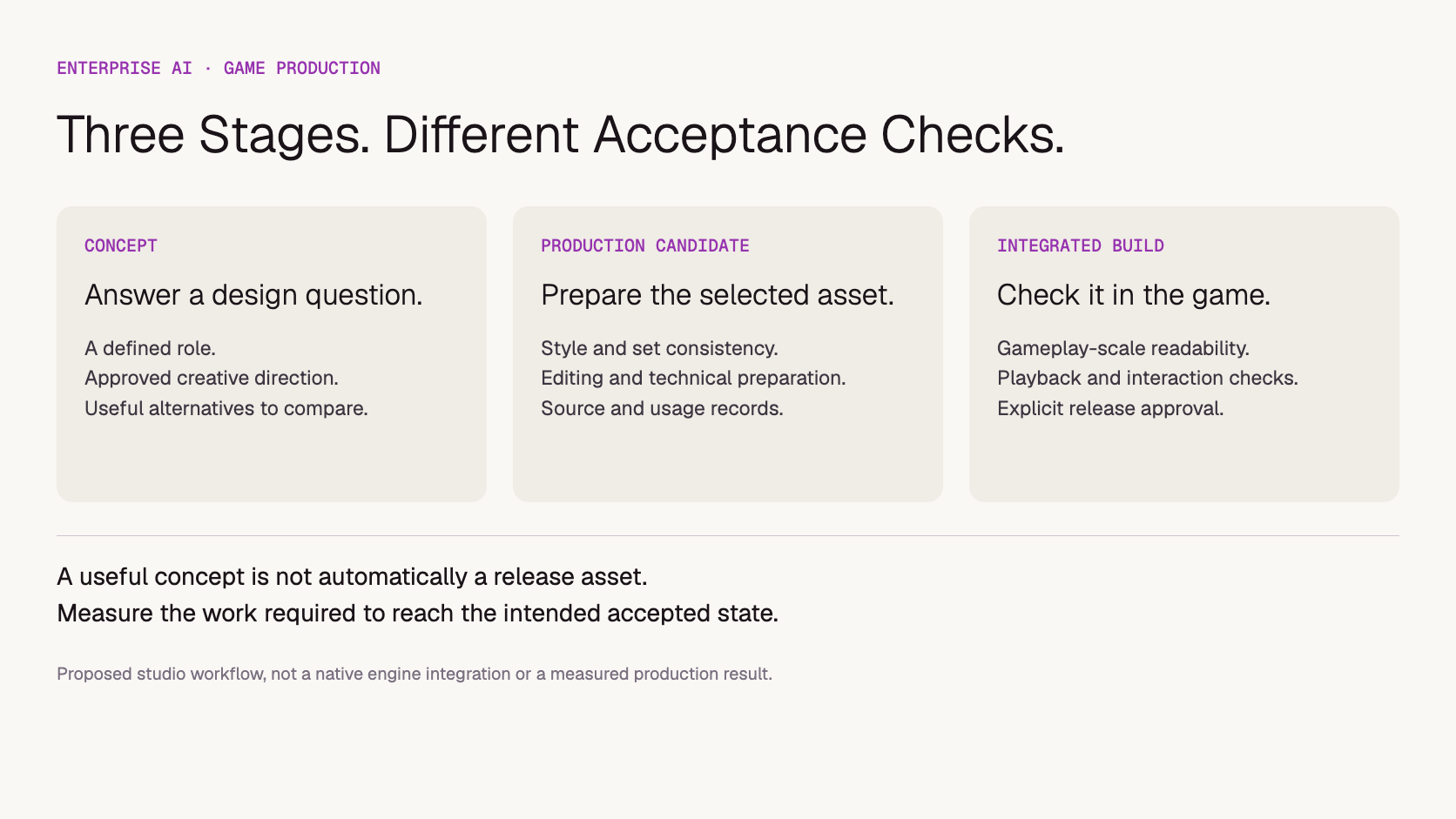
Proposed studio workflow. Acceptance changes as an asset moves from a creative experiment into a playable build.
Use the game asset acceptance register as a blank planning template. It includes separate fields for exploratory status, technical checks, in-game review and release approval. Store those relationships in the team's existing asset-management process if that is more practical than maintaining a separate sheet.
As checked November 11, 2026, Steamworks' Content Survey distinguishes pre-generated content that ships with the game from content generated while it runs. Its AI section focuses on player-consumed content rather than general efficiency tools. Review the current survey for the actual release; this is not a blanket approval for any generated asset.
Confirm the applicable permissions for source materials and intended asset use separately. A provenance record helps the team investigate a question; it does not by itself establish rights or distribution eligibility.
How should studios measure the value of an API workflow?
Measure the work needed to reach the intended accepted state, including generation, selection, editing and integration. Compare like-for-like tasks. A concept chosen for a mood discussion and an asset approved for release are different outcomes, so combining them into one “assets generated” number obscures the production result.
For a pilot, select one asset family and define the target build and acceptance checks in advance. Track candidate count, review time, correction work and integration failures. Keep inference spend separate from labor and tooling cost before evaluating the total.
A workflow might improve concept exploration without reducing final production work. That can still be useful if the team values faster design decisions, but report it accurately. Do not turn an observed improvement at one stage into a claim that the entire game-production cycle is faster.
Include rejected candidates and the reasons they failed. They reveal whether the bottleneck is direction, consistency, file preparation or in-engine behavior. This article proposes an evaluation method; it contains no measured studio savings or acceptance-rate benchmark.
Where does Token360 fit in a game studio's stack?
Token360 can supply text, image, audio and video model access for a studio's production tooling. The studio still needs asset editing, engine integration and release review. Choose model capabilities by asset task, then scope expected volume and enterprise requirements around the actual production workload.
As checked November 11, 2026, Token360's enterprise page describes multimodal access, custom enterprise pricing and tenant-wide key audit. Higher throughput is a contact-sales item; priority support and SLAs are marked coming soon. Confirm the terms required for the project. No native Unity integration, asset pipeline or storefront approval is claimed here.
For development-time generation, the studio can review outputs before putting them in a build. Live generation during play adds different requirements for response time, service availability, player inputs and ongoing usage cost. Treat that as a separate scope rather than assuming a successful offline asset pilot validates a runtime feature.
Frequently asked questions
Can an AI API generate game-ready assets?
It can produce candidates, some of which may become usable after review and preparation. “Game-ready” depends on the asset's role, technical requirements and behavior in the target build. Verify those conditions rather than relying on a preview.
Should a studio use one model for all asset types?
Not necessarily. Text, imagery, audio and video require different evaluations. A shared access layer can simplify model access, but it does not remove the need to test each task and check how the outputs work together.
Are generated placeholders safe to leave in the release?
Only after an explicit production and release review. Confirm technical fit, intended use and applicable requirements. Placeholder status should not disappear merely because the file remained in the project long enough.
Does an API workflow replace artists or sound designers?
This workflow assigns them direction, selection, correction and integration decisions. Whether it changes staffing or workload depends on the production context; no replacement or labor-saving outcome is established by access to generation alone.
What is a useful first test?
Choose a small asset family with a clear role, such as collectible icons and their event cues. Evaluate them together in the intended scene. Record what required manual work and which candidates were rejected before expanding the workflow.
Evidence scope: editorial production analysis using Unity, Steamworks and Token360 documentation checked November 11, 2026. The puzzle-game example is hypothetical. No engine test, studio deployment, cost saving or player outcome is claimed.
Enterprise AI
API
Bring your next idea to life.
Create a video scene in Creator, or explore models for images, audio, and text to find the right capabilities for your project.


 Guides
 Guides
 Guides