What Documents Do We Need to Approve an AI API Vendor?
Build an AI API vendor approval pack with commercial, security and data evidence. Assign reviewers and record scope, gaps and decisions.
ENTERPRISE AI · VENDOR APPROVAL
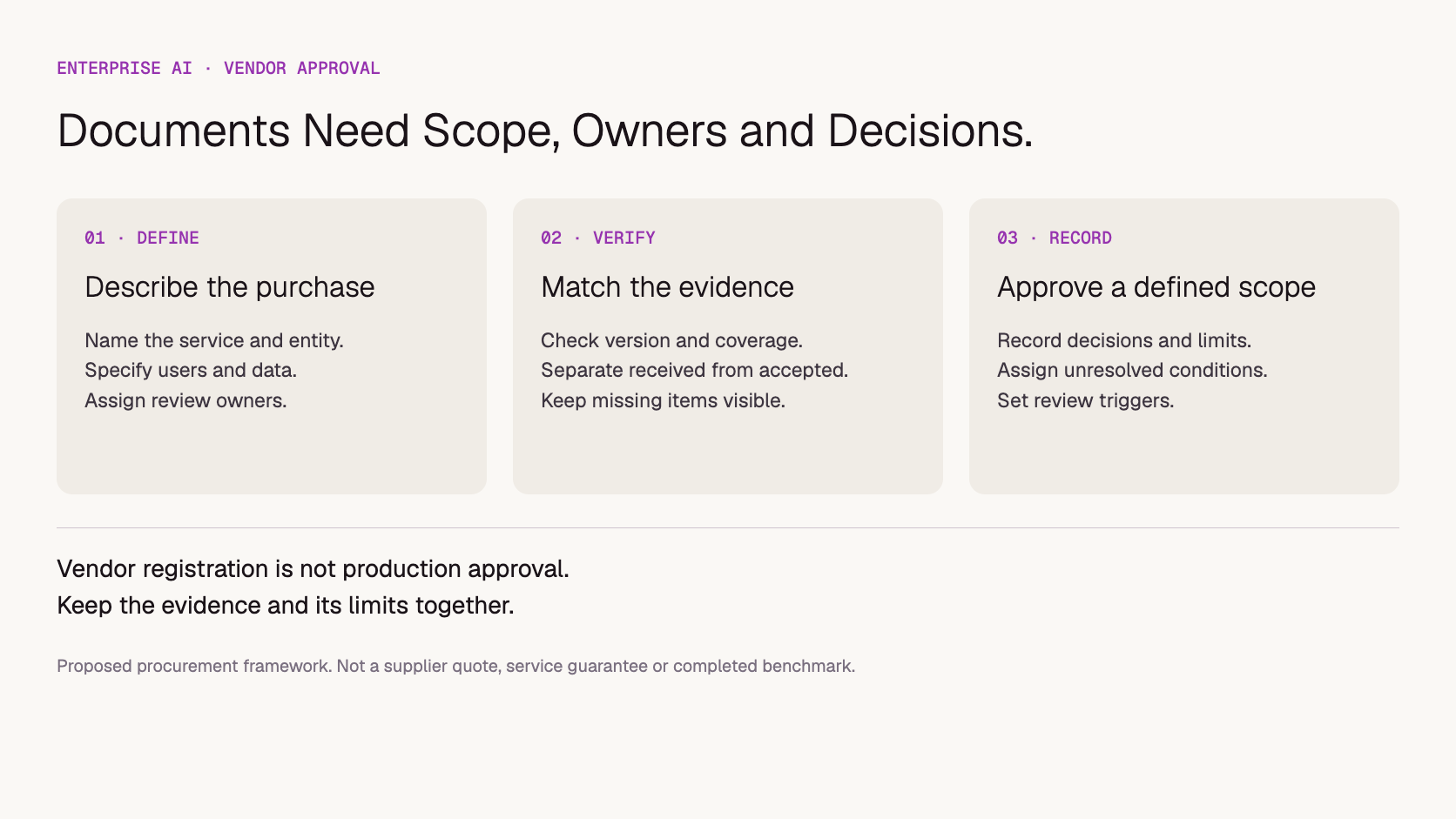
Build an AI API vendor approval pack around the intended service, contracting entity and data flow. Collect commercial documents, applicable terms, privacy and security evidence, and an operating-scope record. Assign each item to a reviewer. A document is useful only when its coverage matches the service your company plans to buy.
A procurement team can register a supplier while security still has questions about customer data. Engineering can complete a test call before legal approves the proposed use. Treat these as separate decisions, with a shared evidence register, rather than assuming one approval settles the others.
This is a proposed buyer-side documentation framework, not a report of a completed customer review or a statement that every listed document is available from Token360. Official sources were checked November 17, 2026. Your company's requirements determine which items are mandatory.
What should go into the vendor approval pack?
Start with a short service description and four evidence groups: supplier identity, commercial scope, data and security, and operations. Request documents against actual requirements instead of sending an undifferentiated questionnaire. Record unavailable items explicitly; an empty folder should not be mistaken for evidence that a requirement is satisfied.
Evidence group
Documents or records to request
Decision owner
Supplier identity
Legal entity, registered address, contracting contact and relevant tax or payment forms
Procurement and finance
Commercial scope
Quote or order form, billing units, payment terms and applicable service terms
Budget owner and legal
Data and security
Privacy and retention policies, processing agreement where required, security evidence and relevant processing parties
Privacy and security reviewers
Operations
Supported service scope, support contacts, access responsibilities and any agreed service commitments
Technical and service owners
This table is a starting point, not a universal statutory checklist. Tax documents depend on jurisdiction and transaction structure. A low-risk evaluation with synthetic data may need a different review from a customer-facing system processing confidential records. Let the designated reviewers set the evidence threshold.
Why does the exact buying scope come first?
Approval attaches to a defined use, not to a provider name in isolation. Record who will use the API, which model services are in scope, what data will be submitted and where outputs go. Otherwise, a satisfactory answer about one workload can be incorrectly reused for a materially different deployment.
A useful scope page names the buying entity, business owner, application, environment, model or model family, expected data classes and intended users. Include whether access is internal or embedded in a customer-facing product. Identify any routing choices or third-party services that require clarification.
For example, approval for public product descriptions does not automatically cover uploading support tickets containing personal information. The supplier may remain the same while the processing risk changes. Mark the later use as a scope change requiring review, rather than silently expanding the original approval.
The broader AI model access purchase checklist helps define the buying decision. This pack preserves the documents and decisions needed to approve that specific purchase.
How should reviewers distinguish a policy from contractual evidence?
Record the type, date, coverage and contractual status of each source. A marketing page describes an offer; a policy describes published practices; a signed agreement may establish obligations for the engagement. Do not assume these documents have equal authority or that one automatically overrides another.
Have legal identify the applicable agreement and order of precedence. If a sales statement appears broader than the written terms, request clarification before relying on it. Preserve the accepted version or dated reference in your procurement system so later reviewers can see what was evaluated.
Token360's published terms identify Super Individual LLC as the contracting party and distinguish the platform from third-party offerings with separate provider terms. Those are relevant starting points for entity and terms review, not proof that a particular enterprise use has been approved.
For any supplier, a security report should be checked for the covered entity, system, period and exceptions. A badge alone does not answer those questions. Do not request sensitive audit materials through a public upload form; use the supplier's approved review process, including an NDA where needed.
Which data questions need supporting documents?
Ask where customer data travels, why it is retained, who can process it and how deletion is handled. Match each answer to the intended models and access route. Platform-level statements may not resolve every downstream provider condition, so unresolved coverage should remain visible to the privacy reviewer.
Read the privacy policy and retention policy as separate documents. Ask which provisions apply to request content, operational records and generated assets in the proposed service. Do not infer zero retention or a particular processing location from the existence of a privacy page.
If your organization requires a data processing agreement, a subprocessor record or specific security evidence, request it and confirm its scope. “Requested” and “approved” are different register statuses. If the supplier cannot provide an item, the reviewer should decide whether an alternative is acceptable, the workload must change, or procurement should stop.
How can one evidence register prevent repeated questions?
Keep a single register that links each requirement to a source and an accountable decision. It should distinguish evidence received from evidence accepted. This prevents teams from repeatedly asking the same question while still allowing security, finance and legal to reach different conclusions within their respective responsibilities.
Register field
What to record
Requirement and owner
The question, why it matters and the reviewer responsible
Evidence and version
Document name, date, controlled location and relevant section
Coverage
Entity, service, models, environment and data classes covered
Status
Requested, received, clarification needed, accepted or declined
Decision and follow-up
Accepted limitation, responsible approver and review trigger
An illustrative entry might read: “Retention for proposed customer-support workload; privacy owner; published policy received; downstream coverage clarification pending.” That is more useful than a green check beside “Privacy policy.” It identifies the unfinished decision without asserting that the vendor has failed it.
A proposed review sequence, not an assurance certification.
When is the pack ready for a purchasing decision?
The pack is ready when required reviewers can identify the approved scope, supporting evidence and unresolved exceptions. Completeness does not mean every imaginable document has been collected. It means mandatory requirements have decisions, material gaps have owners, and the budget holder knows what the organization is authorizing.
Keep supplier registration, permission to spend and permission to launch production separately visible. A purchase order may be issued for an evaluation while production processing remains unapproved. If approval is conditional, record the condition and who can confirm it has been met.
Once buying approval is settled, use the separate API onboarding support guide to define implementation responsibilities. Procurement evidence does not replace configuration testing or operational handover.
What should buyers request from Token360?
Send the proposed workload and your required evidence list together. Ask which documents are public, which can be supplied privately and which commitments need to be agreed for the engagement. Avoid treating the availability of enterprise discussions as proof that every certification, contractual term or operating requirement is already included.
The Token360 enterprise page describes multi-modal model access, usage-based pricing discussions and technical support. Some service options remain contact-sales or roadmap items. Confirm the current deliverable rather than copying a roadmap item into an approved supplier record. Background on the business is available on the About page.
It can organize responses, but reviewers should request supporting evidence for material claims. Check that answers apply to the entity and service being purchased, and record exceptions rather than accepting every answer as unconditional.
Do all documents need to be public?
No. Some evidence may be available only through a controlled review. Record access restrictions and the authorized reviewer; do not redistribute confidential materials merely to make a procurement folder easier to share.
Does vendor registration authorize production use?
Not by itself. Registration may establish payment and supplier identity. Your organization must separately determine whether the use, data processing and operational setup are approved.
When should the approval pack be reviewed again?
Use material changes as triggers: a new data class, customer-facing use, a different model route, an updated agreement or expired evidence. Define the responsible owner and any periodic review requirement within your own process.
Enterprise AI
API
Bring your next idea to life.
Create a video scene in Creator, or explore models for images, audio, and text to find the right capabilities for your project.


 Guides
 Guides
 Guides