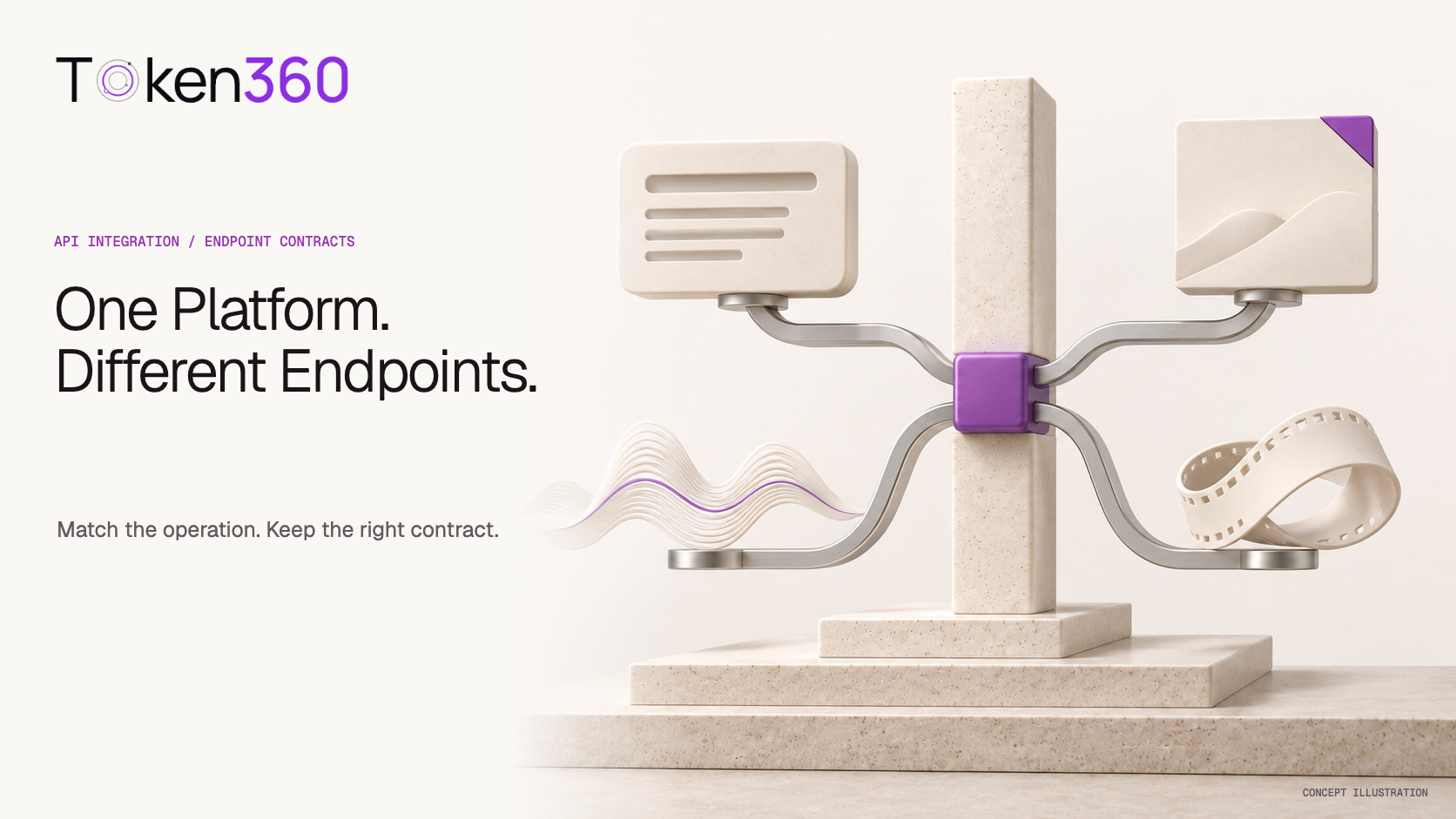
A unified AI API can expose different endpoints. Match text, image, audio and video tasks to the right Token360 operation and response contract.
API INTEGRATION · DOCUMENTATION ANALYSIS
By Yuki Yu · Reviewed November 6, 2026
No. A unified AI API can provide access to text, image, audio and video models while keeping different endpoints for different operations. For Token360, choose the operation and the selected model’s supported protocol before building the request. One integration relationship does not mean one universal request body or one response parser.
This article answers a specific implementation question: where should an application send each task? It is a documentation-based decision guide, not an inference benchmark. The examples below are proposed integration checks; no latency, cost savings or model-quality results are claimed.
Start with the result the application needs, then match the documented API. A written answer, a generated image and a video job are different results even when each starts with a text prompt. The following map is a starting point; the selected model must support the chosen endpoint.
Intended operation
Token360 API path
Selection note
Chat or multimodal chat
POST /v1/chat/completions
Check model support.
Responses-style application
POST /v1/responses
Use the matching protocol.
Messages-style application
POST /v1/messages
Supported models only.
Generate an image
POST /v1/images/generations
Model-specific inputs.
Generate a video
POST /v1/videos
Asynchronous resource.
Speech or transcription
/v1/audio/*
Select the documented operation, not the literal wildcard.
Why is “multimodal” not enough to choose an endpoint?
“Multimodal” describes the kinds of information a model can handle, but does not specify what your application wants it to do. Reading an image and creating an image involve the same media category with different output requirements. Write the desired output explicitly before selecting an API or copying an example.
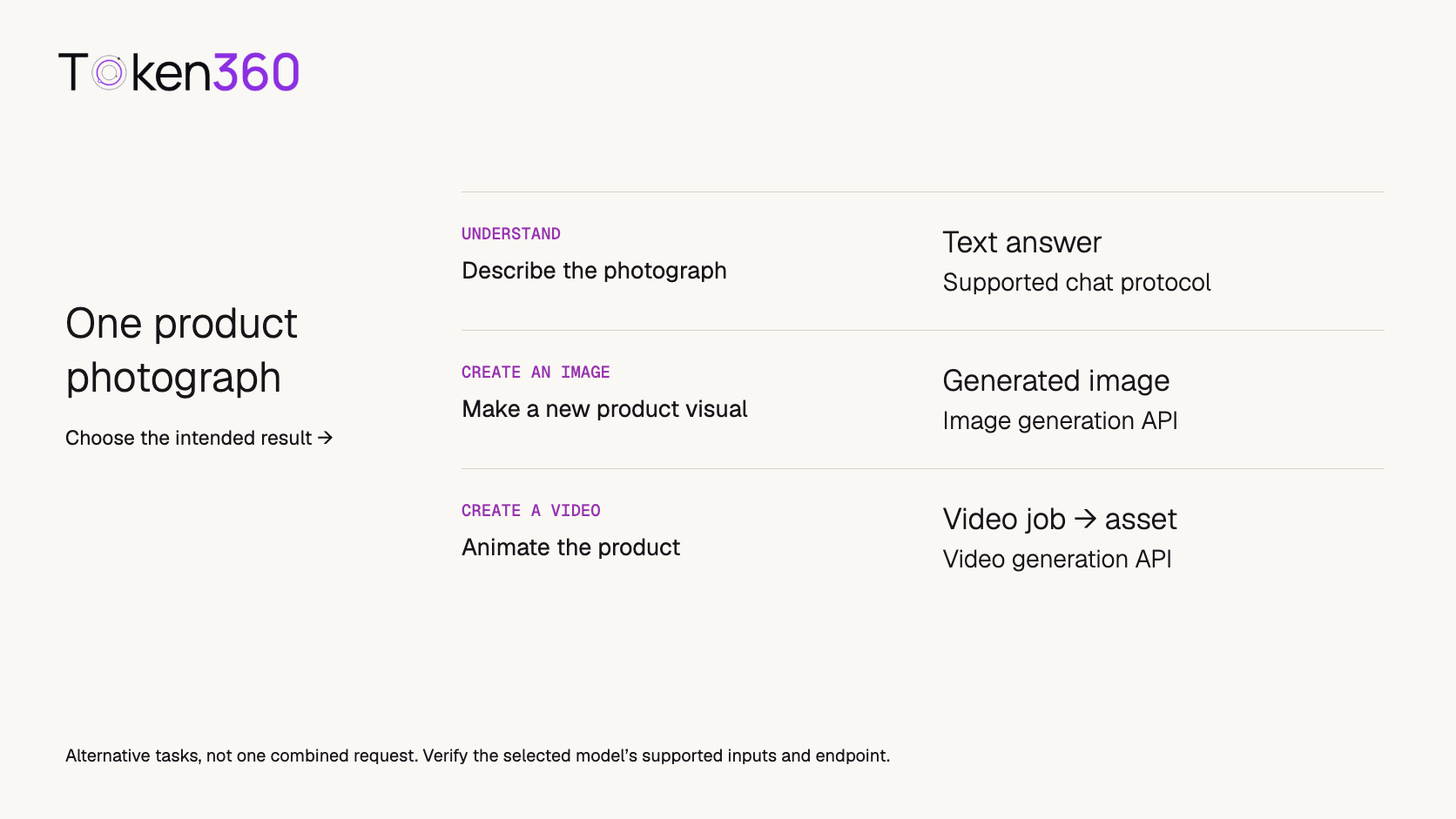
Consider a product photograph. “Describe the damage in this photo” asks for analysis. “Create a new studio photograph of this product” asks for image generation. “Animate this product rotating” asks for video generation. Putting all three requests under a UI button named “AI image” hides distinctions the backend still needs to preserve.
The same issue occurs with audio: a transcript, spoken narration and a piece of music are not interchangeable deliverables. A procurement requirement saying “supports audio” is incomplete for integration planning. Specify the input asset and required result, then check that exact operation in the catalog.
This distinction is not unique to Token360. OpenRouter’s multimodal overview also distinguishes multimodal inputs, image and video generation, and dedicated speech and transcription interfaces. Its documentation illustrates why a platform’s breadth does not establish a single universal endpoint. Do not transplant another platform’s paths into Token360 requests.
One source asset can serve different tasks. These are alternative operation choices, not three outputs from one request.
What is the difference between a base URL and an endpoint?
The base URL identifies the API root used by a client. An endpoint adds the operation-specific resource path; raw HTTP also needs the correct method. Keeping those concepts separate prevents a configuration value for the entire client from accidentally becoming a URL for just one operation.
OpenAI-compatible client base URL:
https://api.token360.ai/v1

Complete raw HTTP chat URL:
https://api.token360.ai/v1/chat/completions
Token360’s base URL guidance says not to add /chat/completions to the SDK’s base_url, because the SDK supplies that resource path. The HTTP example above is an address illustration, not a complete authenticated request.
For an integration ticket, record these separately: client/library, base URL, HTTP method and path, public model ID, and required response type. That makes a review much more useful than a screenshot saying “the API URL is configured.” It also lets a colleague see which assumption changed when a new task is added.
Can the same model use Chat Completions, Responses and Messages?
Do not infer endpoint support from a model name or provider family. Select an advertised model-and-endpoint combination, then parse the contract for that endpoint. Supporting one conversational interface does not automatically establish support for another, even when the interfaces can all return human-readable text.
Token360’s protocol compatibility documentation makes the endpoint the boundary for the client-facing response contract. Chat Completions, Responses and Messages have distinct JSON and streaming conventions. Upstream routing does not turn them into the same payload.
A practical review question is: “Which parser owns this response?” If the answer is “the code that extracts a chat message,” check whether the new operation actually returns a chat message. A media-job response or a Responses-style output item should not be silently treated as an empty chat answer.
Keep this check separate from model quality. A valid response shape tells you the application can interpret the result. It does not tell you whether the answer is accurate or whether a generated asset meets a creative brief.
What should an enterprise team document before adding another modality?
Create a small operation record for each task, rather than assuming a successful text integration covers every other workload. The record should state the expected result, chosen interface, accepted input and completion condition. This is an implementation review artifact, not evidence that a model has already passed production testing.
Record
Example question to resolve
Why it matters
Operation and result
Are we describing the photo or generating a new asset?
Prevents selecting by media label alone.
Model and interface
Does this public model explicitly support this path?
Connects catalog selection to the actual call.
Input representation
Is the reference supplied as a URL, upload or another supported representation?
Prevents copying incompatible inputs between models.
Completion condition
Does the first response contain the final deliverable or identify ongoing work?
Defines when the application can display a result.
Consumer
Which component parses and validates the returned result?
Assigns responsibility for the response contract.
Acceptance evidence
What minimal request and saved result demonstrate this exact path?
Keeps a demonstration tied to a specific operation.
Token360’s capability documentation identifies the model page and public schema as the source for supported input/output modalities, parameters and limits. Use that record when filling in the worksheet; do not infer capabilities from a familiar vendor name.
For example, an enterprise team adding product-video generation to an existing description service should create a new operation record. The existing service may already have authentication and operational ownership, but its “display the answer” condition does not establish when a video is ready. This is a proposed review scenario, not a customer case study.
How should you verify the selection without overbuilding?
Start with the smallest valid request for the chosen operation, then add the features your application needs. Keep the original request and a sanitized response with the model ID and endpoint. A basic smoke test checks integration wiring; a production acceptance test must also check the actual output requirements.
Use three separate checks. First, does the request reach the intended operation with accepted inputs? Second, does your application recognize completion and extract the result? Third, does that result satisfy the task? A successful first check should not be reported as all three passing.
For a proposed image-description test, the result should be readable text about the supplied image. For a proposed image-generation test, the consumer should obtain and validate the generated image. For video, the consumer must distinguish job acceptance from a completed usable asset. These are test definitions, not results measured for this article.
If a call fails, preserve the failure as evidence and use Token360’s troubleshooting guidance. Do not keep swapping endpoint names until one returns a success code and call that a compatibility test. Confirm why the successful combination is the supported one.
Frequently asked questions
Does one API key mean every request has the same body?
No. Authentication and the operation contract are separate concerns. A key does not make image inputs, chat messages and audio uploads interchangeable. Use the documented request shape for the chosen model and operation.
Can I send every text prompt to a chat endpoint?
A text prompt can request many different outputs. Select the endpoint for the intended operation, not just the fact that the input is text. Asking for a generated video is different from asking for a written video script.
Will native parameters make an unsupported endpoint work?
Do not use native parameters as an endpoint-discovery mechanism. Follow the selected model’s instructions for request mapping, and consult the native-parameter guidance before changing the body format. Endpoint selection and vendor-specific fields are separate decisions.
Does a successful Playground result validate my application integration?
It can show a useful model result, but your application still needs to demonstrate its own request, response parsing and completion handling. Record what was actually tested rather than treating a UI demonstration as evidence for an untested SDK path.
Read next: use Token360’s Quickstart for the first call, then check the selected model’s schema. If your procurement scope spans several modalities, discuss that scope through Token360’s enterprise team; commercial scope does not replace operation-level integration validation.
Developer Guide
API
Bring your next idea to life.
Create a video scene in Creator, or explore models for images, audio, and text to find the right capabilities for your project.


 Guides
 Guides
 Guides