Evaluate Token360 alongside your current AI API supplier. Define eligible workloads, verify capacity and agree terms before assigning production work.
ENTERPRISE PROCUREMENT · SECOND SUPPLIER · BLOG 177
By Yuki Yu · Sources checked November 6, 2026
You can evaluate Token360 as a second AI API supplier without planning a full migration. Start with a defined workload that both your organization and the supplier can support. Confirm compatibility, data approval, commercial terms and capacity before assigning production work. A second account alone does not establish emergency coverage or an independent supply path.
The useful starting question is not “How quickly can we replace everything?” It is “Which specific work would we want Token360 to handle while our existing supplier stays in place?” That work might be a new application, an approved task category or an additional modality. The right scope depends on the reason for adding a supplier.
This article answers a potential enterprise buying question using public documentation and an illustrative allocation example. It does not report a customer deployment, a measured resilience improvement or a guaranteed commercial offer. Technical migration and automatic fallback require their own implementation decisions.
What role would a second AI API supplier actually play?
A second supplier needs an explicit role: serving an ongoing workload, remaining qualified for future use, or participating in a separately designed recovery process. These arrangements require different evidence and commercial commitments. Decide which one you are buying before treating an additional API account as an operational capability.
Arrangement
What it means
What it does not establish
Active second supplier
Handles a defined share or category of normal work
Ability to take over every other workload
Qualified standby supplier
Has completed an agreed review for possible activation
Reserved capacity, current test results or instant activation
Automatic fallback route
Application logic attempts another approved route under defined conditions
Permission to resend any data or repeat an uncertain operation
For example, a team seeking another route for product-description drafts might need an active second source. A team seeking continuity during an outage needs a more demanding coverage discussion. The first arrangement can be useful without claiming to deliver the second.
Write down the buying objective in one sentence. “Give our new catalog-writing service an additional approved supplier” is a scope. “Remove all AI dependency risk” is not a testable acceptance condition.
Can we keep the existing supplier and assign only new work?
Coexistence can begin with complete, separately assignable tasks while existing workloads remain with their current supplier. Choose a boundary that an application owner can enforce and a reviewer can recognize. Confirm that your existing commercial commitments and internal approvals permit the arrangement; do not assume that technical feasibility settles the purchasing decision.
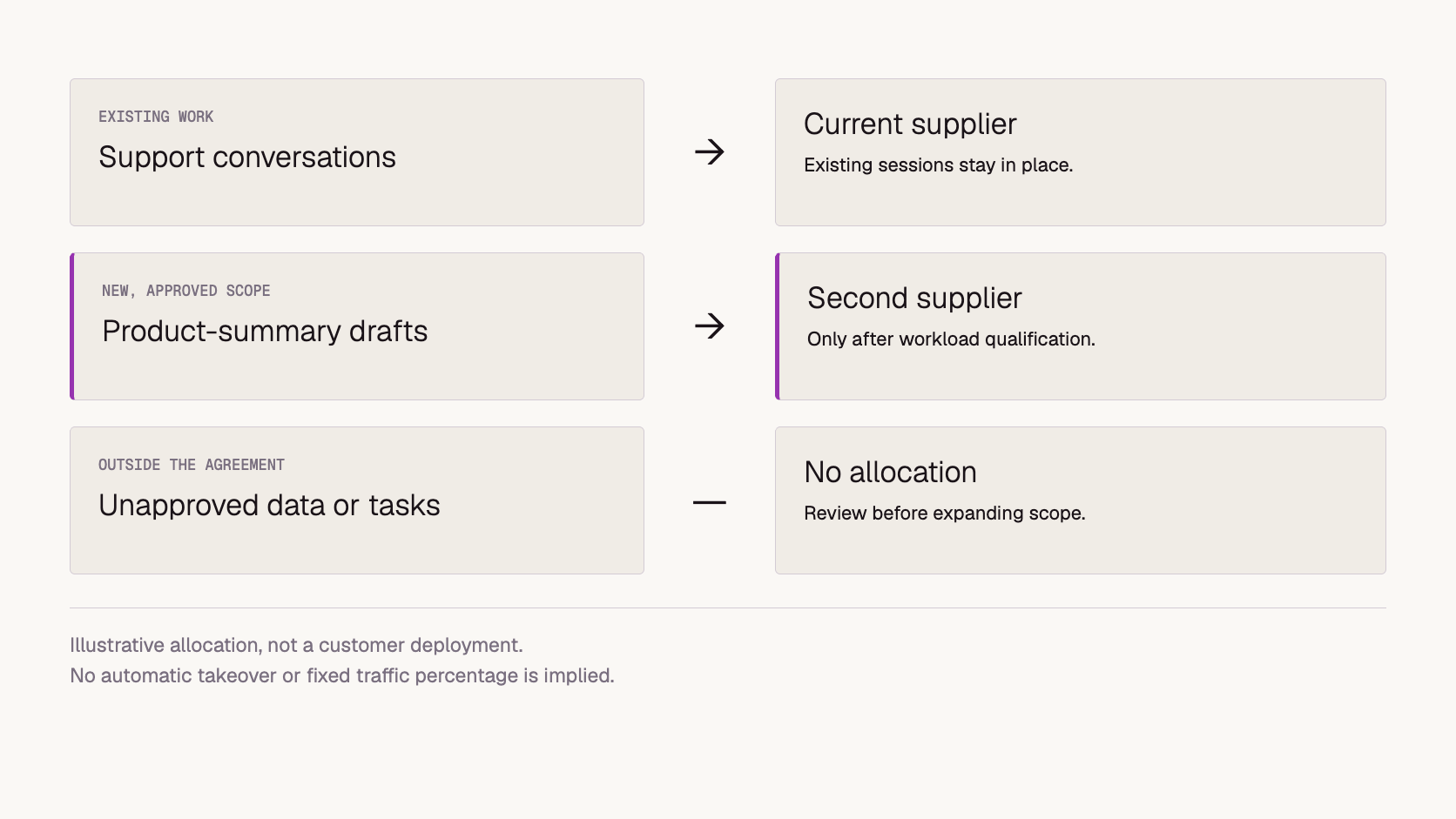
Consider this constructed example: a retailer keeps its existing support assistant with Supplier A and evaluates Token360 for new product-summary drafts from approved catalog fields. Each draft has its own input, acceptance check and task identifier. The example is a proposed allocation, not evidence that a particular model has passed the retailer’s requirements.
Work
Initial assignment
Boundary to preserve
Existing support conversations
Remain with Supplier A
No automatic transfer of conversation state or customer records
New product-summary drafts
Candidate Token360 workload, after approval
Only approved source fields; agreed output checks before use
Already submitted media jobs
Remain with the submitting service
No duplicate submission merely because another supplier exists
Work outside the approved scope
Excluded until reviewed
No implied permission to expand by changing a routing rule
This boundary also makes a pause manageable: stop assigning new eligible tasks to the second supplier and reconcile its outstanding work. It does not require moving every existing session back and forth. Avoid an arbitrary traffic percentage when the real separation is by task type, data class or application.
Illustrative scope, not a customer deployment or a recommendation for a fixed traffic split.
Does using two suppliers give us independent capacity?
Two commercial relationships do not prove two independent sources of inference capacity. If supply diversification is the objective, establish which dependency you want to diversify and what evidence supports that distinction. Different billing entities or API URLs alone cannot show whether the underlying service paths share an important dependency.
Token360’s routing documentation distinguishes public model identifiers from upstream deployments and describes eligibility-based route selection. Therefore, listing a model in two catalogs is not enough to establish the independence you need. This is an inference about the evidence required, not a claim about any particular pair of suppliers.
Ask a narrow question: “For this approved model and workload, what supply dependency is different from our current route, and what remains shared or unconfirmed?” A useful answer might define the service boundary that the supplier can substantiate. If details cannot be established, record independence as unverified rather than converting uncertainty into an uptime claim.
A complementary modality is a different case. Adding video generation alongside an existing text service can broaden capability, but it does not provide a substitute for text inference during an outage. Keep capability expansion and continuity coverage separate in the business case.
What needs to be confirmed before we allocate production work?
Qualify the exact workload, not the supplier’s entire catalog. The approval should connect a specific model configuration and data scope to acceptable outputs, operating conditions and named owners. A successful sample demonstrates that sample’s result; it does not establish sustained capacity, universal compatibility or permission to process a different class of data.
Token360 directs users to each model’s public schema for supported inputs, outputs and parameters. Use that model-capability reference to describe the candidate assignment precisely. Its protocol compatibility documentation also makes clear that a shared endpoint contract does not mean every model supports every optional feature.
The following record is a suggested buyer-side review tool, not Token360’s default onboarding policy:
Scope item
Evidence to record
Reason to hold the allocation
Task and data boundary
Included inputs, excluded fields, approval owner
Production data has not been approved for this supplier
Test conditions and separately confirmed service limits
Expected load exceeds the validated or agreed scope
Ownership and support
Who assigns tasks, pauses work and handles escalation
No accountable owner or usable escalation path
Commercial basis
Eligible usage, charges, commitments and applicable period
The new allocation conflicts with the approved budget or terms
Copy the
Copy second-supplier-scope.csv:
scope_item,proposed_assignment,excluded_work,evidence_reference,owner,review_trigger,supplier_confirmation
Buying objective,,,,,,
Normal workload,,,,,,
Data approval,,,,,,
Model/configuration,,,,,,
Output acceptance,,,,,,
Normal demand and timing,,,,,,
Optional incident coverage,,,,,,
Capacity and limits,,,,,,
Upstream independence if required,,,,,,
Price and commitments,,,,,,
Activation and pause authority,,,,,,
Last exercise and refresh conditions,,,,,,
to record these decisions and their evidence. Leave unanswered items open. A blank capacity field should not silently become “same as our current provider.”
How do we keep a second supplier ready over time?
Readiness needs an owner and a refresh rule. Record when the approved workload was last exercised and what changes invalidate that evidence. An active allocation can expose operational issues during normal work; an unused integration needs deliberate checks. Neither pattern establishes future emergency capacity without an additional service commitment.
Relevant changes include a model replacement, different input types, new data restrictions, expired credentials or a material increase in expected load. Set the review cadence around the workload’s consequences and change rate, rather than copying an arbitrary schedule. Re-run the affected checks when the scope changes.
Jacob Gabrielson’s AWS article, Avoiding fallback in distributed systems (December 5, 2019), explains why rarely exercised fallback paths can introduce risk. It is not an AI supplier benchmark. The applicable lesson here is narrower: do not rely on an integration simply because someone once connected it successfully.
If the intended role includes incident coverage, document who can activate it, which work is eligible and what happens when capacity is insufficient. Keep activation approval separate from the routing implementation. A standby supplier may be useful even when activation requires a coordinated operational step.
What should we ask Token360 to quote?
Ask for the portion of work you expect Token360 to serve, plus any separately required standby or expansion arrangement. Distinguish normal usage from possible incident demand and identify which requirements are essential. A discussion about enterprise capacity, price or support is not a substitute for confirming the applicable scope in the actual offer.
Token360’s company-confirmed enterprise positioning covers text, image, audio and video procurement, with pricing, dedicated capacity, contracts and compliance requirements scoped to the engagement. As checked on November 6, 2026, its public enterprise page advertises custom pricing but still places some support and scale items in a roadmap/contact-sales section. Do not treat all enterprise requirements as included self-service features.
The limits documentation lists multiple constraints, including concurrency, token throughput, account budgets and upstream capacity. Ask which limits apply to your proposed allocation. Being able to send a request does not establish that the same throughput is reserved for a later incident.
We plan to retain our current supplier for [existing workload] and evaluate Token360 for [defined new workload]. The approved inputs are [data scope], using [model/configuration]. Normal demand is [measured volume and timing]. We also want to discuss [additional coverage, or none]. Please confirm eligible capacity, pricing, commitments, support scope and any requirements that cannot currently be met.
This is an original inquiry template with empty fields, not a quotation or a customer request. Check whether moving usage affects an existing minimum commitment. A lower unit rate on newly allocated work can still leave the buyer paying for unused committed volume elsewhere; compare the combined arrangement before assuming savings.
When is adding another supplier not worth it?
A second supplier is not automatically the right purchase. Pause when the intended workload cannot be separated, the required capability is unverified, or the organization cannot maintain two operational relationships. The decision should weigh the specific benefit against integration, review and ongoing ownership costs, without assigning an invented financial value to hypothetical outages.
For a small stable workload, a second contract and another set of controls may add more work than useful flexibility. For a distinct new application, the boundary may be easier to justify. If independence is essential but unverified, changing the supplier count does not resolve the central requirement.
A defensible decision can be “approved for these tasks,” “standby subject to these conditions,” or “not suitable yet.” None requires a promise to migrate everything later.
Frequently asked questions
Do we need to move all our AI usage to Token360?
A full migration is not a prerequisite to evaluating a second-supplier arrangement. Define the proposed workload and confirm the purchasing and operating terms. This article does not promise an offer with no minimum usage or commitment.
Can we use the same model with both suppliers?
Potentially, if both services support the required configuration. Check versions, parameters and behavior. A shared model label alone does not prove identical outputs, feature support or independent upstream capacity.
Should every request be sent to both suppliers?
No. The allocation discussed here assigns work deliberately to one service. Sending the same task to two services is a separate design with additional processing, data-handling and cost consequences. It is not required for dual sourcing.
Can Token360 take over immediately during an outage?
Do not assume that. Coverage depends on the approved workload, actual capacity, application behavior and any agreed activation conditions. A working API key or a successful test does not establish immediate takeover capability.
Do we need a new test for this procurement discussion?
You can start the discussion with a workload brief. Production approval needs evidence for the actual proposed assignment. No new performance results are claimed in this article, and no supplier arrangement should be marked validated solely from reading it.
Read next: use the model-capability guide to define the eligible assignment, then bring that scope to Token360’s enterprise team. If continuity is the goal, include the additional demand and activation conditions explicitly.
Developer Guide
API
Bring your next idea to life.
Create a video scene in Creator, or explore models for images, audio, and text to find the right capabilities for your project.


 Guides
 Guides
 Guides