Why Does an AI SDK Retry One API Call Multiple Times?
SDK and application retries can multiply HTTP attempts. Learn how to identify the retry owner, bound the operation and verify client behavior.
CLIENT ENGINEERING · RETRY OWNERSHIP · BLOG 174
By Yuki Yu · Documentation checked November 6, 2026
One SDK method call can produce several HTTP attempts because the client library may retry selected failures automatically. If an application wrapper also retries, the attempts can multiply. Before changing models or increasing timeouts, identify which layer owns retries and count the requests actually sent—not just calls to your application function.
OpenRouter’s FAQ addresses SDK compatibility. Compatibility is a starting point for integration, but it does not make client behavior disappear. A library’s retries still need to be understood when it is used against a compatible gateway.
This article examines client-side retry ownership for synchronous AI requests, including applications connecting to Token360. The attempt counts below are a constructed calculation, not live Token360 measurements. No paid inference was run, and no billing multiplier or production failure rate is inferred.
Read first: Token360’s limits, timeouts and retries guide distinguishes temporary failures from conditions that require a different action. This article focuses on the additional retries a client stack may introduce.
What is the difference between a call and an attempt?
A call is the operation your code asks a library to perform. An attempt is an individual transmission made while trying to complete it. One call may succeed immediately, retry before succeeding, or fail after exhausting its budget. Count those events separately so an application log does not hide network activity.
Unit
Example in an integration
What it does not prove
User operation
Generate a draft summary once
That only one network request followed
Application invocation
Your wrapper calls the SDK
That the SDK sends only one attempt
HTTP attempt
The client transmits a request
That inference started or was charged
Returned result
The wrapper returns text or an error
That earlier attempts had no effect
A line such as “starting summary” at the top of a function is useful for user-operation tracking. It is not sufficient evidence of how many requests left the process. Conversely, three transport events are not automatically three completed model generations. Preserve both observations rather than collapsing them into one request count.
Which retries can an AI SDK perform automatically?
Automatic behavior depends on the SDK, version and configuration, including the kind of error received. Inspect the library actually running in your deployment rather than assuming every compatible client behaves the same. A configurable default is not an application policy, and a package upgrade can change the behavior you need to verify.
As checked on November 6, 2026, the official OpenAI Python SDK documentation describes two automatic retries for selected connection failures and HTTP 408, 409, 429 and server errors. It exposes max_retries to change that behavior. This is a statement about that client library, not a promise that Token360 retries every such response or that another SDK shares the default.
Record the installed package version and effective configuration alongside your deployment. Include overrides on individual calls, shared client factories and framework wrappers. Looking only at the client constructor can miss a per-call override or an outer retry decorator.
How can two retry layers turn one operation into nine attempts?
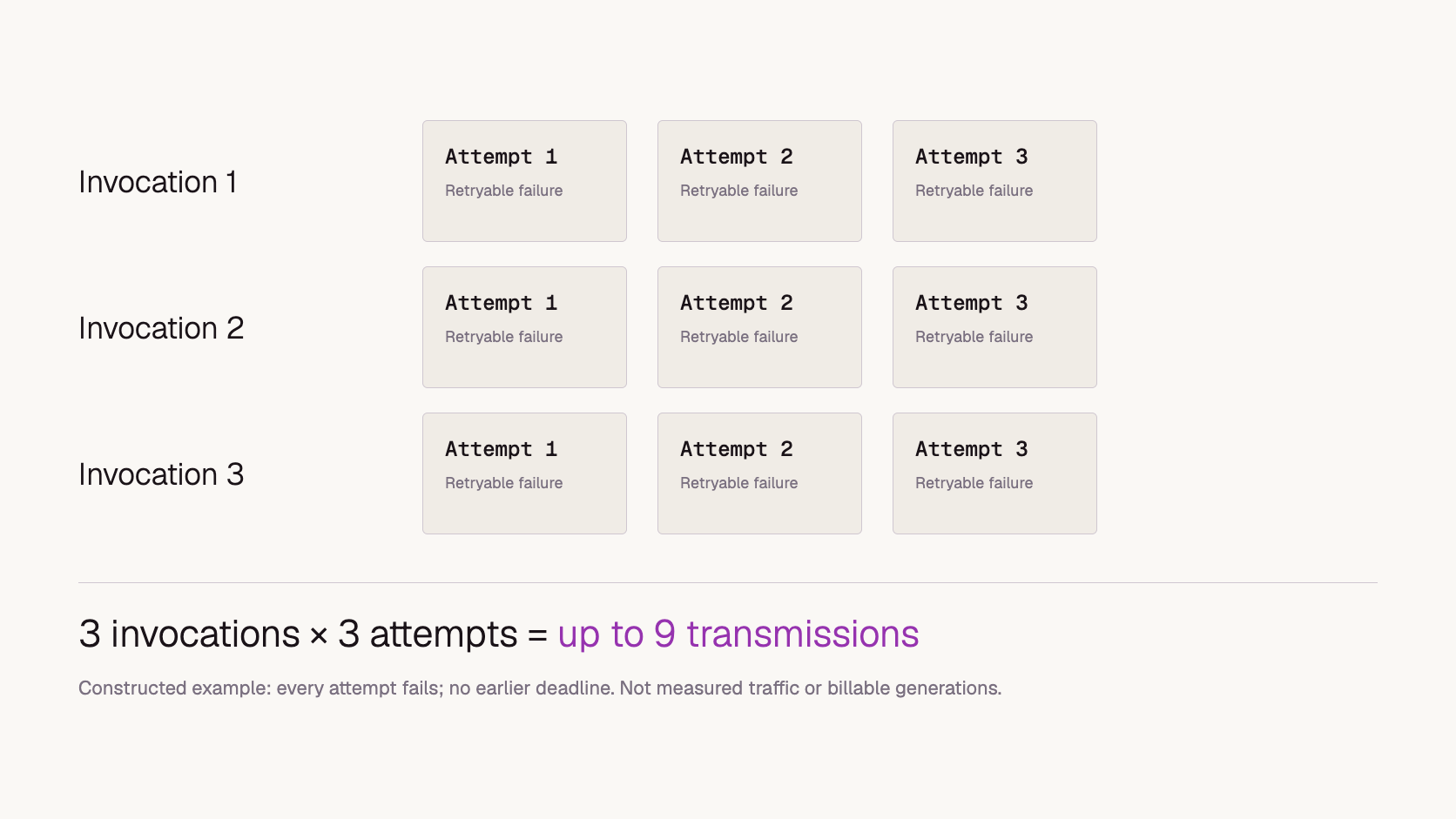
Nested retry budgets multiply when every outer invocation starts a fresh inner budget and every attempt keeps failing in a retryable way. In a constructed example, three application invocations with three SDK attempts each permit nine transmissions. This is an upper bound under the stated conditions, not the number every request will produce.
Here, “two retries” means the initial attempt plus two additional attempts. The outer wrapper permits two retries too. Assume a replayable request body, persistent retryable failures, no successful early exit and no earlier total deadline. Count only client transmissions; do not add hypothetical internal provider attempts.
Constructed policy
Maximum application invocations
Maximum attempts per invocation
Calculated client attempts
No retries at either layer
1
1
1
SDK has two retries; wrapper has none
1
3
3
Wrapper has two retries; SDK has none
3
1
3
Both have two retries
3
3
9
The last row is (1 + 2) × (1 + 2) = 9. It is original scenario arithmetic, not a benchmark. A success, non-retryable error, cancellation or exhausted deadline can stop the sequence earlier. A transport event may also fail before reaching the server.
Constructed worst-case client trace. All attempts fail in a retryable way; no earlier deadline stops the operation.
The general amplification risk is also explained in AWS’s discussion of retries and backoff. Its guidance favors a deliberate retry point rather than independent retries at every layer. For an AI integration, the practical question is which component can make the complete stop-or-retry decision.
Which layer should own the retry decision?
Choose a retry owner that can see the operation’s remaining time, error meaning and duplication risk. A simple client may use a bounded SDK policy. A workflow that must inspect account conditions or reconcile uncertain submissions may need application-level control. Either way, inventory other layers and avoid silently giving each a fresh budget.
There are two distinct decisions: whether another attempt is appropriate, and how long to wait before it. Backoff changes spacing; it does not decide whether the operation is safe or useful to repeat. A slower loop can still repeatedly submit work that should have stopped.
Token360’s error-handling documentation, checked November 6, 2026, directs clients to inspect the error body: temporary capacity and spend or balance restrictions can require different actions. If your application needs that distinction before any retry, confirm the SDK will not already repeat the request before returning the exception.
For the OpenAI Python client, the following configuration fragment disables SDK-managed retries. It does not send a request, implement a replacement policy or disable retries elsewhere:
import os
from openai import OpenAI

client = OpenAI(
    api_key=os.environ["TOKEN360_API_KEY"],
    base_url=os.environ["TOKEN360_BASE_URL"],
    max_retries=0,
)
Use the documented base URL for your chosen Token360 API. Do not copy a model endpoint into a base-URL setting without checking the client’s path construction. This fragment follows the documented SDK option; it was not executed as a live integration test. If you disable retries, explicitly decide how your application will expose or handle transient failures.
Does a timeout limit the whole operation?
Not necessarily. A transport timeout, an SDK retry policy and a user-facing deadline can govern different intervals. Establish a total operation budget independently of individual attempt settings. Otherwise, repeated attempts and waiting periods can keep the application busy after the user has stopped waiting or the workflow no longer needs the result.
Use a monotonic clock to track elapsed operation time in your application design. Before another attempt, check the remaining budget, the planned delay and whether there is still enough time for useful work. A fixed attempt limit alone does not bound every workload to an acceptable user experience.
Consider a constructed schedule with three attempts that each take four seconds and two intervening waits of one and two seconds. The schedule totals fifteen seconds before application overhead. That arithmetic illustrates why “four seconds per attempt” and “four seconds for the operation” are different policies; it is not a measurement or a claim about a particular timeout implementation.
Token360’s guidance also notes that a client timeout does not establish that upstream work never started. Stopping the wait and cancelling remote work are different events. Do not turn an uncertain outcome into a fresh submission merely because a local timer expired.
How do you verify retry behavior without generating paid work?
Test your actual client stack against a controlled mock endpoint or transport that records attempts and returns scripted responses. Keep real credentials and production URLs out of that test. It can establish what your client does under those simulated conditions, but cannot establish a provider’s execution, billing or cancellation behavior.
The following is a proposed acceptance plan, not a completed experiment. Use the same SDK version and wrapper configuration you deploy. For each scenario, record the expected attempt ceiling before running it, then compare observed transmissions and final application behavior.
Mock scenario
Observation to collect
Question it answers
Immediate success
Transmission count and returned result
Does the normal path send once?
Temporary error, then success
Attempts, delays and retry owner
Which layer repeats the operation?
Persistent retryable error
Final count and elapsed budget
Do nested policies exceed the intended cap?
A documented terminal error
Whether the request is repeated
Does the client stop at the correct layer?
Budget expires before next attempt
Whether another transmission starts
Is the total deadline enforced?
Use an application operation ID to group the trace and a local attempt number for each observed transmission. Add timestamps, SDK version, effective retry settings and the final exception or result. Preserve a service request ID when returned, but do not invent one for a connection that never receives a response.
Record metadata without logging authorization headers, full prompts or private file URLs. If framework-level logs cannot reveal each attempt, test a supported transport hook in isolation. Document what the instrumentation observes: a hook callback is not automatically proof of upstream execution.
What should a Token360 production rollout verify?
A rollout should verify effective retry settings in the deployed process, not only a code sample. Review the SDK, application wrapper, job worker and intermediary policies together. Set an owner for the total deadline and record which events are observable, so production support can separate one user operation from its underlying attempts.
Start with a client configuration review: package version, per-call overrides, worker redelivery behavior and any proxy retry rules. Then run the controlled acceptance cases. Only after that should you validate the approved model and endpoint using authorized production or staging requests, under a bounded test budget.
Use Token360’s model capability checklist to verify the actual request contract. A retry policy cannot fix an unsupported parameter, wrong model ID or incompatible operation. Keep capability validation separate from the transport test so a configuration error does not masquerade as transient instability.
The useful rollout artifact is a short, reviewable policy: who may retry, which errors qualify, how many attempts are allowed, when the operation stops and what happens when its outcome is unknown. This is an application design recommendation, not a claim about hidden Token360 routing or provider internals.
Frequently asked questions
Does max_retries=0 guarantee only one request everywhere?
No. It disables retries managed by that SDK configuration. Your wrapper, worker or another component may still repeat the operation. Verify the complete path you control.
Do nine HTTP attempts mean nine charges?
No. Transmission count does not establish whether inference ran or was billed. Reconcile available request records and actual usage under the service’s billing rules; do not multiply a model’s price by the client count.
Is exponential backoff enough to prevent retry amplification?
No. Backoff spaces attempts out. Independent nested budgets can still multiply the total. Bound the operation and make ownership explicit.
Does disabling retries make an integration more reliable?
Not by itself. It can expose failures sooner and simplify diagnosis, but transient errors may then reach users. Choose and test a bounded policy appropriate to the operation rather than treating one setting as a universal fix.



 Guides
 Guides
 Guides