Kling and Seedance Action Order: A Six-Take Review
Review six Kling and Seedance clips for cup release and one bell press. Separate observed order, known failures and unresolved acceptance checks.
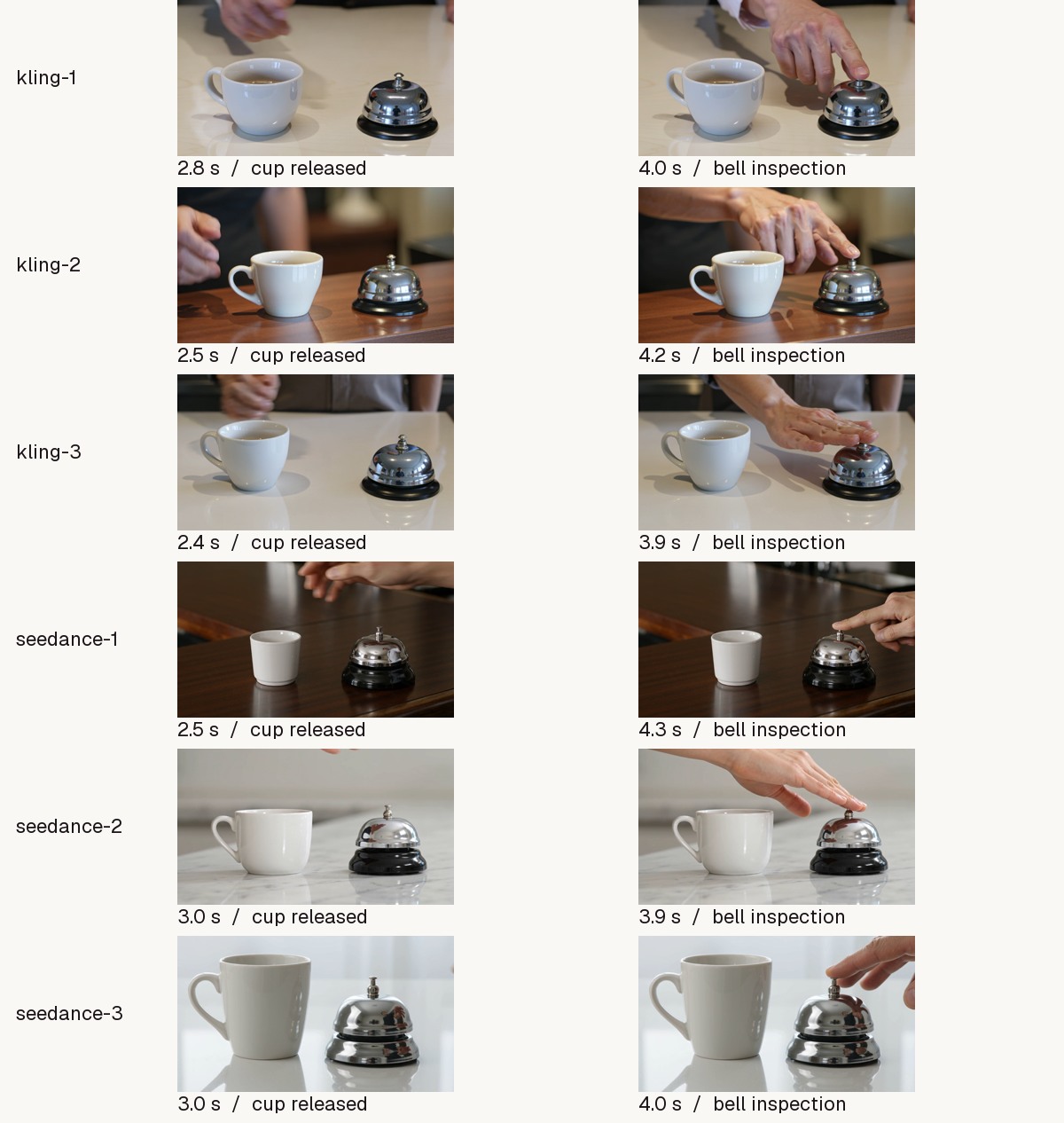
All six clips place the cup on the counter before the hand reaches toward the bell. They differ at the last few millimeters: one bell visibly bounces through repeated presses, while another fingertip reaches the button with almost no discernible travel. For a product demo that calls for one press, showing the hand arrive is only half the test.
The tester confirmed that kling-1 through kling-3 used Kling 3.0 Omni and seedance-1 through seedance-3 used Seedance 2.0. The tester confirmed that both groups were generated in Token360 Playground. All six exports have one 1280 × 720 video track, run approximately 5.04 seconds and contain no audio track. We reviewed the visible motion at 0.1-second intervals. Times below identify representative frames on that grid.
What exactly should the hand do?
One continuous locked-off shot of a counter. A hand holds a white cup above the left side. A silver service bell sits on the right. First the hand sets the cup down and fully releases it. Then the same hand moves right and presses the bell plunger once. Keep the cup, hand and bell in view throughout. No cuts.
What counts as a successful take?
Mark A at the first frame where the cup rests on the counter and the fingers have let go. Mark B at the first frame where the bell plunger visibly moves down under the same hand. A strict pass needs both events in that order, one press and continuous visibility in one shot. A hand hovering over the bell earns no press. If the plunger is hidden, record “unverifiable” and keep that take in the denominator. A bell sound alone cannot settle the question.
Record A and B in seconds using each file’s own frame timestamps. Beside the counts, show one pair of event frames per take so readers can inspect ambiguous hand contact. If both models finish all three takes, compare the visible motion and omissions without treating six clips as a general ranking.
Where did the second action break down?
File label
Cup free by
Inspect bell at
What the frames show
Kling 3.0 Omni · take 1
2.8 s
4.0 s
One sustained depression and release. The cup enters partly outside the opening frame.
Kling 3.0 Omni · take 2
2.5 s
4.2 s
Finger settles on the plunger. Small downward travel is visible; it stays in contact through the end.
Kling 3.0 Omni · take 3
2.4 s
3.9 s
Plunger moves down under a nearly flat hand and returns. The cup enters after the opening frame.
Seedance 2.0 · take 1
2.5 s
4.3 s
Finger taps the top more than once; plunger travel is shallow. A single press is unconfirmed.
Seedance 2.0 · take 2
3.0 s
3.9 s
First visible compression rebounds, followed by another around 4.2 s. Multiple presses.
Seedance 2.0 · take 3
3.0 s
4.0 s
Finger overlaps the top, but the exposed stem shows little measurable travel. Depression is unclear.
Each pair shows a free-standing cup and a later view of the bell. These are inspection times. Watch the originals to check repeats and rebounds.
A conservative acceptance ledger for the six takes
The existing review supports observations about order, but a strict pass also requires one visible press and continuous visibility. The ledger below separates a known failure from an unresolved count. It does not turn the 0.1-second inspection grid into a full-frame certification or a model ranking.
Take
Sequence observation
Strict brief status from available review
Kling 1
Cup released before bell contact
Fail on continuous visibility: cup partly outside the opening frame
Kling 2
Release followed by small plunger travel
Unverifiable as a full pass until adjacent frames confirm one press
Kling 3
Release followed by depression and return
Fail on continuous visibility: cup enters after the opening frame
Seedance 1
Release before repeated fingertip contacts
Unverifiable press count; shallow travel does not establish one press
Seedance 2
Release before two visible compressions
Fail: repeated presses
Seedance 3
Release before fingertip overlap
Unverifiable depression
This is a conservative classification of the recorded observations, not a newly executed frame-by-frame test. A confirmed defect is sufficient to reject a take for this exact brief; an unresolved take is not automatically a failure by the model. The tester confirms both groups were generated in Token360 Playground. Exact seeds and effective settings were not retained. Before commissioning more clips, inspect the original frames around the bell events for takes 2, 4 and 6. If the mechanism remains hidden, use a closer view for the follow-up instead of simply increasing the attempt count.
Watch all six original takes
Kling 3.0 Omni · take 1 · One sustained depression and release. The cup enters partly outside the opening frame.Kling 3.0 Omni · take 2 · Finger settles on the plunger. Small downward travel is visible; it stays in contact through the end.Kling 3.0 Omni · take 3 · Plunger moves down under a nearly flat hand and returns. The cup enters after the opening frame.Seedance 2.0 · take 1 · Finger taps the top more than once; plunger travel is shallow. A single press is unconfirmed.Seedance 2.0 · take 2 · First visible compression rebounds, followed by another around 4.2 s. Multiple presses.Seedance 2.0 · take 3 · Finger overlaps the top, but the exposed stem shows little measurable travel. Depression is unclear.
For an editor, the strongest evidence is a visible gap, a downward stroke and a rebound. The second Seedance 2.0 take makes the mechanism easy to inspect but repeats the action. The third shows how a convincing reach can leave the mechanism ambiguous. Those differences are enough to choose an edit for this shot. Three takes per group give little evidence about performance on other scenes.
For an independent check of container duration and track information, inspect each original with FFprobe.
How precisely can these clips establish action order?
The 0.1-second inspection grid locates useful review moments, but it does not identify an exact onset or exclude a brief extra press between samples. For a final acceptance decision, replay each full clip and inspect adjacent decoded frames around release and contact using their presentation timestamps.
Keep three outcomes separate: the event is visible, the event visibly violates the brief, or the view is too ambiguous to judge. A hidden plunger must not become a successful press simply because the hand reaches the bell. Likewise, release followed by several presses satisfies ordering but fails the requested count.
What can a team conclude before choosing a model?
These files support choosing among the six available takes and identifying which action needs revision. They do not establish that one model is generally better at sequential actions. Token360 Playground was confirmed as the platform, but effective settings and seeds were not retained, and each group contains only three exports.
A follow-up should record the serving platform and exact configuration, use matched input and duration where supported, and predeclare what counts as one visible press. Keep the complete set of attempts, including errors and ambiguous results. If the bell mechanism cannot be judged at the chosen framing, simplify the view before increasing the number of samples.
Frequently asked questions
Can the bell ring before the cup is released?
That take completes the actions in reverse or overlapping order and fails the sequence requirement. Note which events were visible so a reader can distinguish a timing error from a missing action.
Should failed generations be replaced?
Record a platform error separately from a completed clip that misses the brief. Keep every completed take. Disclose any replacement for a request that returned no playable file.


 Prompt Library
 Insights
 Insights