Consider a reranking API when your search already retrieves useful documents but places them below less useful results. Test whether reordering those same candidates improves what users see or what an answering model receives. Buy only if the improvement justifies the added cost, delay and data-processing scope for your workload.
This is an enterprise purchasing guide, not a benchmark. Token360 reranking models, endpoints and compatibility with the cited services have not been verified for this article.
Which search problem can a reranking API address?
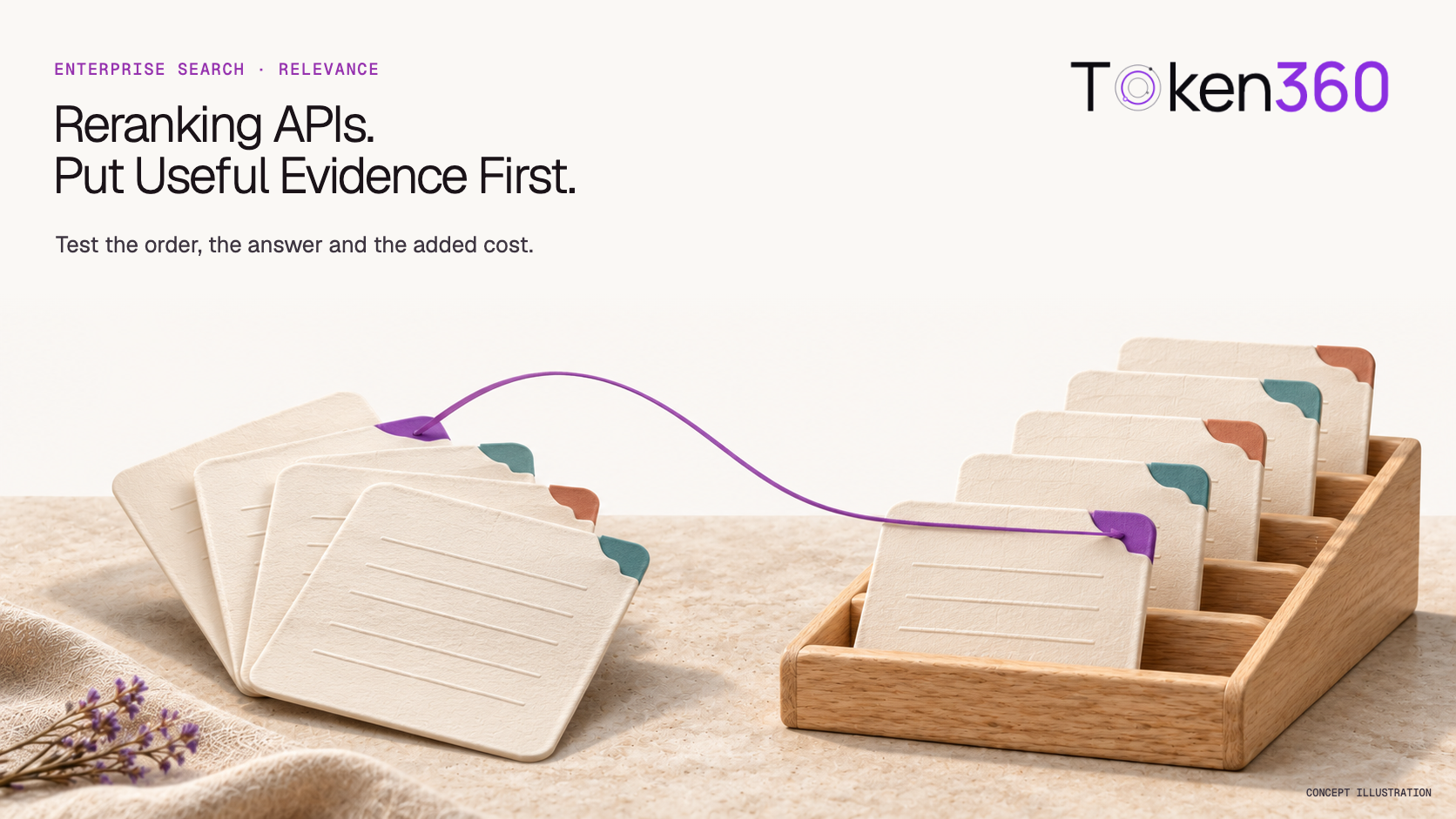
Reranking addresses the order of an existing candidate list. It is worth testing when the required evidence is present but does not reach the results shown to users or supplied to an answering model. It cannot recover a missing document simply by reordering a list that never contained that document.
Imagine a support assistant answering a question about a product's return policy. Search retrieves the current policy, an older policy and a promotional page. The current policy is present, but the application selects other material first. That is a plausible ranking problem. If the current policy was never retrieved, investigate coverage, access, freshness or retrieval before buying a second model.
Diagnose the failure before adding another model
| What the review finds | What to investigate first | Role for reranking |
|---|
| Relevant evidence is present but too low | Candidate ordering. | A direct pilot candidate. |
|---|
| Relevant evidence is absent | Source coverage and retrieval. | Cannot reorder an absent result into the list. |
|---|
| Only outdated documents are available | Content freshness and version rules. | Relevance alone does not establish that a document is current. |
|---|
| The answer is wrong despite suitable evidence | Answer generation and use of evidence. | A different ordering might help, but is not a demonstrated fix. |
|---|
| Restricted documents reach the wrong user | Access-control enforcement. | A relevance model is not an authorization system. |
|---|
These are diagnostic examples, not observations from Token360 customer deployments. The broader RAG versus fine-tuning guide covers which overall approach fits a business problem. This article focuses on whether to purchase a ranking stage inside an existing search workflow.
What does a reranking API return?
A typical reranking API receives a query and candidate texts, then returns their relevance order, often with scores and identifiers. It does not inherently search your entire knowledge base or write the final answer. Specify what text it evaluates and how its returned positions map back to your original documents.
As reviewed November 23, 2026, Cohere's Rerank reference describes a query-plus-text-list input and ordered relevance results. It also documents a limit on the number of returned results and truncation of long documents. Those interface details illustrate questions to ask; they do not establish Token360 support.
Ask whether the service sees full documents, selected passages, titles or other fields. A passage containing the answer may be lost during preparation or truncation. Include sufficiently representative inputs in the pilot rather than comparing a model that sees the full policy with one that receives only its title.
A relevance score is not a business approval, a proof of factual correctness or an access decision. Do not copy a score threshold from one model to another without validation. Decide what the application should do when all candidates are unsuitable, such as run another search or decline to answer, instead of treating the first-ranked item as necessarily sufficient.
This is also separate from replacing an embedding model. Reordering retrieved text does not by itself require a new vector index. If the procurement includes an embedding change as well, assess that change independently using the embeddings index migration guide.
How should an enterprise compare rerankers before buying?
Start with the same queries and candidate lists for every comparison, and have domain reviewers identify which results are useful. Compare the original ordering with the reordered lists under the same display or context limit. Then test the complete application separately, because a better document order does not automatically produce a better answer.
Use approved queries representative of the workload: customer terminology, exact product identifiers, ambiguous wording and the languages the business serves. Include queries with no suitable answer and cases where nearly identical documents differ in an important condition. Keep a held-out set for final evaluation after configuration choices are made.
- Freeze the comparison inputs. Save the query, candidate identifiers, document versions and text actually submitted.
- Label useful evidence. Record which candidates answer the question and which are merely related. Let qualified reviewers resolve disagreements.
- Inspect the selected results. Check whether required evidence reaches the limited set shown to the user or passed to the answering model.
- Test the complete answer path. Keep the answer model and prompt fixed when comparing ordering changes. Review factual support and citations as separate outcomes.
- Record regressions and failures. Keep queries that became worse, timeouts and no-answer cases in the record.
A useful summary is the share of evaluated queries whose selected results contain the required evidence. Report it separately from answer correctness, and state how many queries were evaluated and how they were selected. This article provides no measured improvement or target pass rate.
Use the blank reranking evaluation sheet template at the end of this article. It records baseline and new evidence selection, answer review, added delay and charges. It contains no supplier scores.
Also inspect result mapping. Pinecone's SDK documentation explains that a returned item's index refers to its position in the submitted list. If an application associates a new rank with the wrong document, the integration can invalidate an otherwise useful ordering. Preserve stable source identifiers through the test.
When is the extra cost and delay worth paying?
Pay for reranking when a representative pilot shows a worthwhile improvement within your application's cost and response-time budget. Measure the added stage and the whole request. Reduced context sent to an answering model may offset some expense, but savings and faster overall responses must be demonstrated rather than assumed.
Ask what the quote meters: requests, evaluated documents, document length, tokens or another unit. Supply candidate-count and length distributions, not just monthly user questions. One user question may trigger multiple searches or ranking calls. Returning fewer results does not necessarily mean that fewer candidates were evaluated or billed.
Compare the baseline application's charges with the complete proposed path, including reranking, retries and any changed answer-generation usage. If the new ordering allows a smaller context, verify that necessary evidence still survives. A lower context bill is not useful if the resulting answer loses an important exception.
Test ordinary and peak conditions. Review slow requests and failures as well as typical response time, and agree what happens when reranking is unavailable. Returning the original search order might be acceptable for one use case but inappropriate for another; the fallback should be an explicit product decision.
The Pinecone overview describes reranking as a second model applied after retrieval, with a relevance-versus-latency tradeoff. That supports measuring the added work, not a prediction of Token360 performance or a guarantee that every workload benefits.
What data and integration requirements belong in the purchase?
Identify the query and document content sent to the ranking service, then verify that the proposed processing arrangement is approved for those inputs. Preserve access rules, document identifiers and version information throughout the workflow. Purchasing a reranking endpoint does not automatically provide a knowledge-base connector, permission system or complete enterprise search application.
Apply the application's permission rules before exposing candidates to an external service. A document that is semantically relevant may still be inappropriate for that user or that processing destination. Ask about retention, logging, training use and processing locations for the actual service arrangement; do not infer these from another model on the same platform.
Specify supported input languages and field formats, document-length handling, candidate limits and expected output mapping. Where an endpoint supports additional features such as returning passages, verify the exact model version and output schema. A feature appearing in one provider's documentation is not evidence of cross-provider compatibility.
Agree who builds the connection to your search system and who maintains the evaluation set. Keep a versioned baseline so model changes can be checked against the same business questions. The purchase should include a clear method for recognizing a regression, rather than assuming that every newer model is an improvement.
What should you ask Token360 before requesting a quote?
Ask Token360 whether an eligible reranking model and endpoint are available for your search workload. Provide example queries, candidate texts, languages and operating requirements, then request documentation and an evaluation route. Treat model availability, scoring behavior, framework compatibility and data controls as unconfirmed until verified for the proposed service.
Token360 focuses on enterprise model access across text, image, audio and video. Text-model access does not establish a dedicated reranking API or support for the Cohere or Pinecone interfaces discussed here. No Token360 reranking endpoint was verified for this article.
Company-confirmed enterprise quotes use usage tiers: higher usage receives lower quoted rates, with no separate service fee. A usable reranking quote still depends on confirmed availability, the model and billing unit. This article asserts no volume bands, rate, capacity commitment or latency guarantee.
Our search retrieves [candidate types and typical counts] for [business questions and languages]. We need to improve which evidence reaches [users or the answering model]. Please confirm an eligible reranking service, length handling, output mapping, data terms and evaluation access, then quote for [usage and peak demand]. Identify unsupported or unverified requirements.
Discuss that brief with the enterprise team. If the required evidence is missing from the candidate list, fix that first. If it is present but poorly ordered, a controlled pilot can establish whether another model is a justified purchase.
Evidence boundary: official documentation reviewed November 23, 2026. This article proposes a procurement evaluation, not a first-party benchmark or a claim of verified Token360 reranking capabilities.
Worksheet template
Query ID,Query/language,Candidate set/version,Text preparation,Required evidence IDs,Selection limit,Baseline evidence selected,Model/version/settings,New evidence selected,Answer review with fixed generator,Regression/no-answer outcome,Reranking elapsed time,Full request elapsed time,Observed charges/unit,Failure/fallback,Reviewer,Decision
,,,,,,,,,,,,,,,,
About the author
Yuki Yu is Marketing Manager at Token360.


 Guides
 Guides
 Guides