Mono Compatibility for Video: What Survives the Stereo Fold-Down?
Hear three stereo and mono comparisons from original AI audio. Measure what changes in a fold-down and check whether each cue still works with the picture.
By Yuki Yu
A music cue sits comfortably under a product demonstration on headphones. Switch the mix to mono and the cue takes a step back, even though its fader has stayed still. Do you turn it up, change its stereo processing, or keep the mix? Start by finding out which part changed. A whole-track level reading and a few seconds of listening can lead to different, equally useful answers.
Mono compatibility describes how well a stereo mix preserves the sounds a viewer needs when its two channels are combined. We folded three existing Token360 audio excerpts to mono with equal weights. The first six seconds of one music bed lost 1.90 dB of average signal level. A rain bed and a cup impact each changed by less than 0.01 dB. You can audition all three comparisons below.
Read first. The original sound-effects pilot explains why the listener accepted the rain and single-impact cup recordings for their briefs. Sonilo sound-effects pilot and original samples.
What happens when two audio channels become one?
In an equal-weight fold-down, the editor takes the left and right samples at each instant, adds them and divides by two. A sound present at the same level and polarity on both sides retains its sample value. A sound present on only one side contributes half its original sample value to the mono channel. Equal and opposite values sum to zero. Audacity’s explanation of stereo-to-mono mixing.
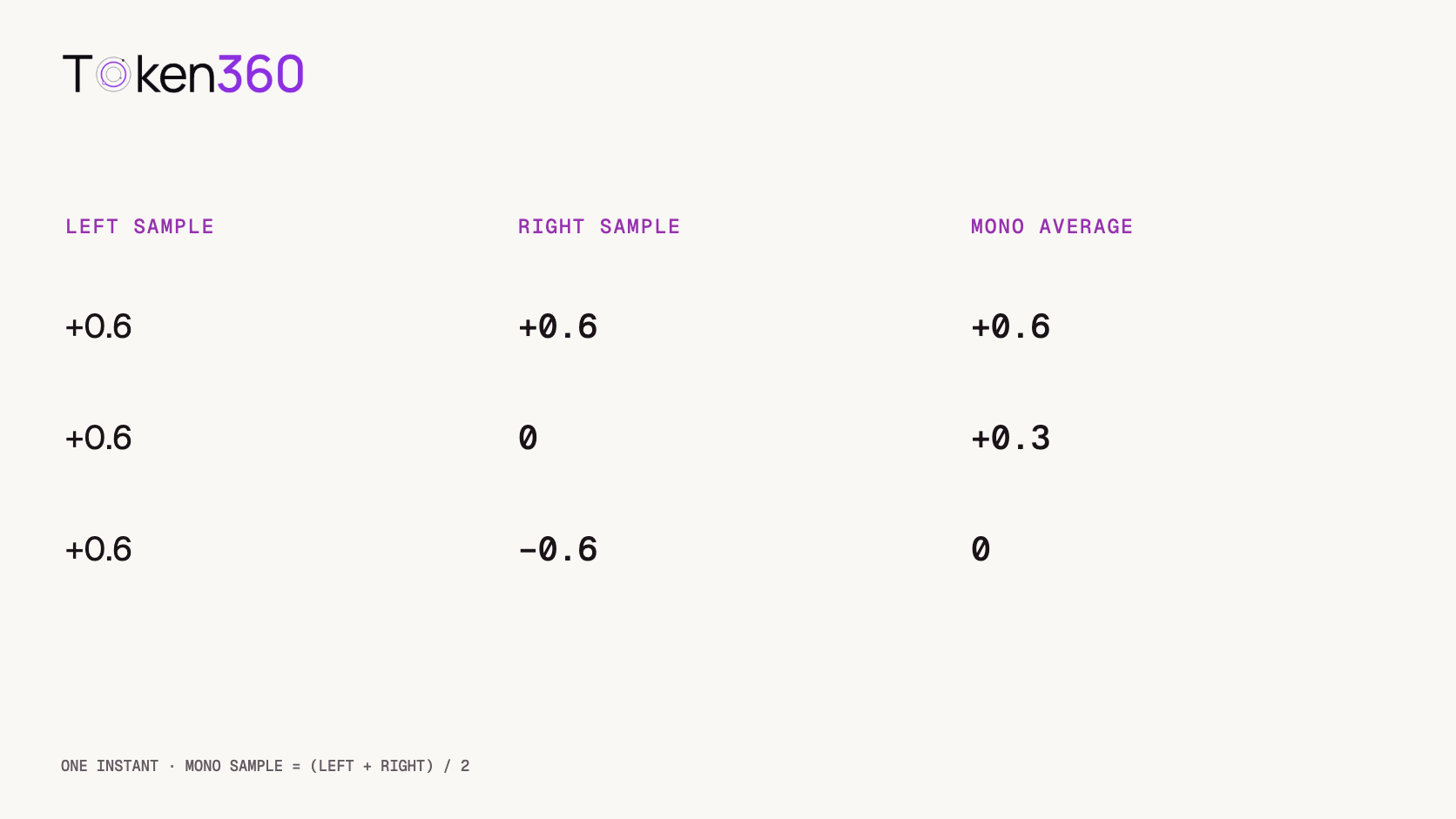
Think of one instant at which the left channel reads 0.6 on a normalized digital scale. With 0.6 on the right, the average is 0.6. With silence on the right, it is 0.3. With −0.6 on the right, it is zero. A recording contains many such instants. Different instruments, reflections and effects can add differently throughout the track. That is why a single gain change may restore the apparent strength of one part while leaving another hard to hear.
How did we make the listening comparisons?
We used the opening six seconds of three existing Sonilo MP3s, decoded at 44.1 kHz. Each A player preserves the source channels. Each B player sends the arithmetic average to both channels. This keeps the playback file layout identical while changing the signal that reaches each side.
All six excerpts use 16-bit PCM and the same ten-millisecond fades at their boundaries. We applied no loudness matching. The measurements use the decoded samples immediately before those export fades and quantization. For the stereo reference, we averaged squared sample values across both channels and across the six seconds. For the fold-down, we performed the same calculation on the averaged signal. The change in dB is ten times the base-ten logarithm of the ratio of those mean-square values.
Use headphones or a stereo playback system for the first pass. Set a comfortable volume for each pair, then leave it fixed while switching between A and B. The source files vary substantially in level, so turn the volume back down before moving from the quiet effects to the music. If your playback chain already sums both channels, the two players may sound alike. That is useful information about the listening setup.
Garden rain · first six seconds
A · Stereo
B · Mono
Cup on wood · first six seconds
A · Stereo
B · Mono
Explainer music · first six seconds
A · Stereo
B · Mono
What did the fold-down change in each excerpt?
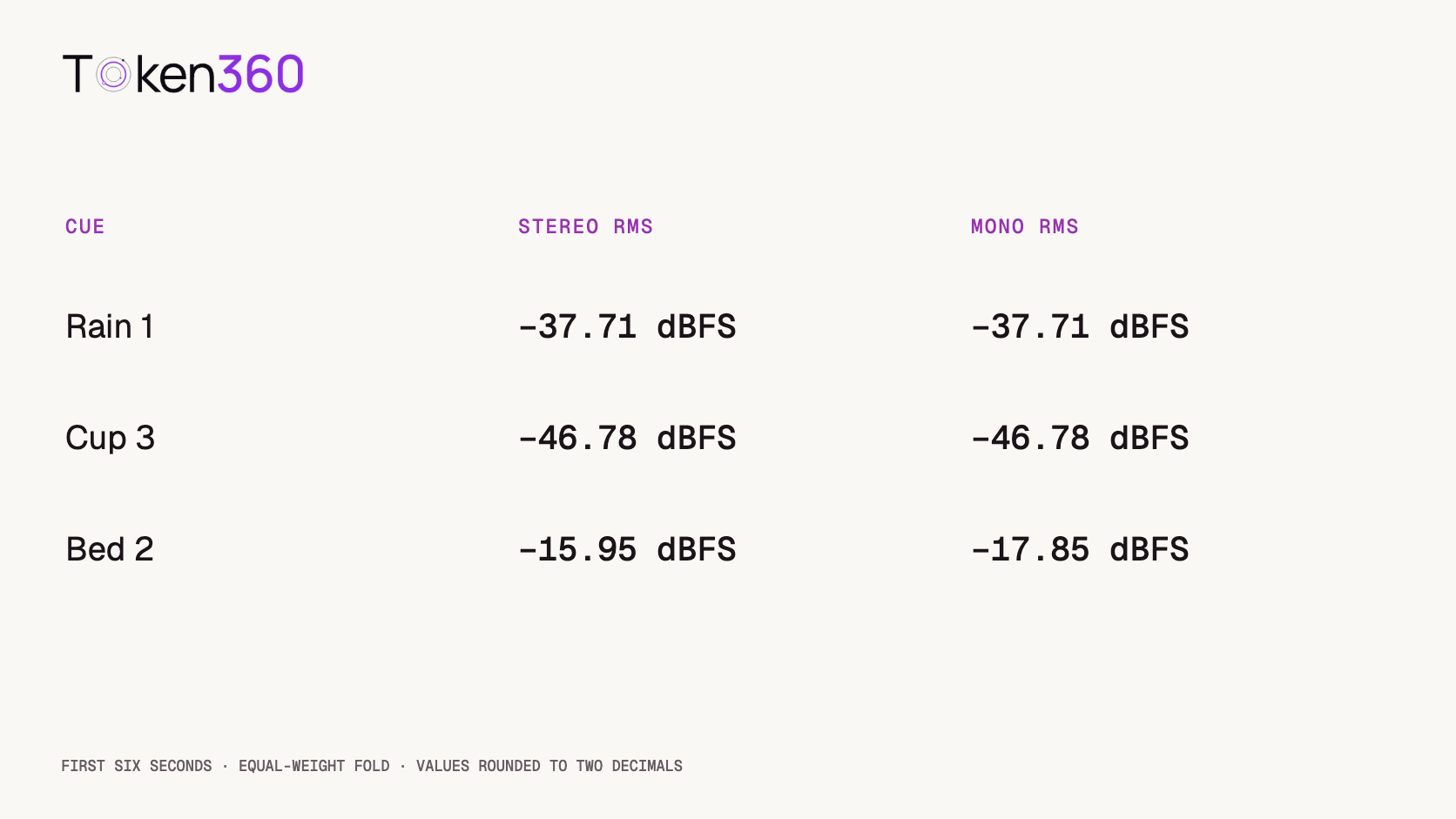
The music bed had the largest measured change. Bed 2 moved from −15.95 dBFS RMS across its stereo channels to −17.85 dBFS RMS after the fold. In the rain and cup excerpts the stereo and mono readings were identical when rounded to two decimal places.
First six seconds
Stereo reference
Mono fold
Level decrease
Garden rain, take 1
−37.71 dBFS
−37.71 dBFS
<0.01 dB
Cup on wood, take 3
−46.78 dBFS
−46.78 dBFS
<0.01 dB
Explainer bed, take 2
−15.95 dBFS
−17.85 dBFS
1.90 dB
The cup reading illustrates a limit of a six-second average. A single impact takes up only a small part of the window. Quiet time on either side reduces the overall RMS reading even when the contact itself is audible. To decide whether the cup will register in a shot, play the impact against the picture and listen to the leading edge and decay. Comparing its average with six seconds of sustained music would answer a different question.
The music figure also has a practical limit. It tells you that averaging the channels reduced the excerpt’s overall energy. It cannot identify a particular instrument as the cause or tell you that viewers will prefer a louder bed. The prior listening notes described Bed 2 as more pop-like than another accepted take. That observation concerned arrangement. This follow-up isolates a channel-mixing operation on a short excerpt. Original music briefs and listening notes.
Which change matters enough to revise a mix?
Revise when a sound loses the role the picture gives it. For a close-up of a ceramic cup, the viewer should hear a contact at the moment the cup meets the table. For a rainy garden behind dialogue, the listener may only need enough texture to recognize the location. Those cues can have different acceptance criteria even within one short video.
Take a product name spoken over a swelling music bed. Listen once in stereo and once in mono with the voice present. If the name remains clear and the bed is slightly quieter, an editor might keep the mix. If a short musical accent marking the product reveal disappears in mono, mark that exact time and solo the relevant track. Raising the entire music stem to repair one accent may make the preceding sentence harder to follow.
After recording the original difference, optionally match the playback levels for a second pass. This helps you ask a narrower question. With the overall level closer, does the cue retain its attack, texture and balance? Label that pass separately. A level-matched comparison can help diagnose a tonal change, while the original comparison preserves the level difference a listener may encounter.
What does a phone listening check add?
A phone check lets you hear the delivered mix through a particular device, player and playback setting. A digital mono fold lets you isolate the effect of combining channels. Keep both observations if the video will be reviewed on phones. The file comparisons here simulate only the digital fold.
For a repeatable device check, use the same exported scene, physical device, orientation and volume setting. Set it where a viewer would normally hold it and play the cut from a few seconds before the cue. Ask a colleague to describe what happened. “I heard the cup land before the title appeared” is more actionable than “the audio is fine.” If the digital fold is clear and the device playback loses the cue, the next investigation can focus on the playback path and the mix around that moment.
What should the mixer receive after review?
Send the scene time, playback condition, intended cue and observed change. A note such as “At 00:06, the reveal accent fades into the bed on the mono check, but the voice remains clear” gives the mixer a bounded problem. Include both reference exports if somebody else needs to reproduce it.
Keep a copy of the stereo master, the fold rule and the exact excerpt used for comparison. If a picture revision moves the reveal into another musical phrase, run the check on that version. For generated footage with an attached soundtrack, also record which sounds can be adjusted independently. A separate impact track gives the mixer more choices than a single file containing speech, music and effects together.
Frequently asked questions
Does a phone always play a video in mono?
Playback depends on the device, output path and settings. Test the delivery setup you care about. A controlled mono file is a repeatable way to isolate channel summation.
Can I use just the left channel for the mono check?
Soloing the left channel tells you what that channel contains. To reproduce this comparison, average left and right at equal weight so material on either side contributes.
Why did the rain barely change?
For this excerpt, averaging the channels preserved almost all of the measured signal energy. This result applies to those six seconds. A different rain recording or a different section can behave differently.
Is 1.90 dB a failure threshold?
It is the measured change for one music excerpt. Set your review criterion around the cue’s job in the finished scene, then document what changes on playback.
Should I normalize both files before listening?
Keep the original gain for the first pass so the comparison includes the level change. A second, level-matched audition can help you concentrate on the balance of sounds within the cue.
Is RMS the same as program loudness?
RMS here describes unweighted sample energy over a fixed window. Check the delivery specification separately if you need a program loudness measurement for publication.
Read next. For scenes where speech, effects and picture are generated together, identify the audible event that needs to survive the final mix. AI video native audio guide. More production resources from Token360.
Editorial revision: November 4, 2026. Test dates and dated source snapshots remain as stated in the article.
Web listening copies use MP3 encoding at 320 kbps. The reported measurements were made on the original WAV excerpts before web encoding.
Audio
Video Editing
Tutorial
Build faster with one AI API.
Use Token360 to call video, image, audio, and text models with one key and one bill.


 Prompt Library
 Insights
 Insights