Compare LLM APIs and recommendation engines for product selection, ranking and explanations. Define the data, controls and evaluation your business needs.
ENTERPRISE AI · PRODUCT RECOMMENDATIONS
An LLM API can help interpret a shopper’s request, compare eligible products and explain a shortlist. It does not automatically supply the catalog, behavioral learning, ranking evaluation or business controls of a recommendation system. Buy for the job you need: selecting relevant items, supporting a shopping conversation, or combining both.
“Recommend three products” looks simple in a demo. In production, the same request raises harder questions: Are those products available? Are they suitable for this customer? Why were they ranked above alternatives? Did the recommendations improve the shopping experience, or just sound convincing?
For an enterprise buying model access, the decision is not whether an LLM can name products. It is which parts of the recommendation workflow the purchase actually covers.
What does a recommendation engine do beyond generating text?
A recommendation engine selects or orders items for a particular context using an explicit objective and available signals. Depending on the system, these can include product attributes, recent behavior and past interactions. A language model can participate in that process, but a fluent response alone does not demonstrate useful ranking.
For example, Amazon Personalize documents recipes that score items using user interactions and metadata, with supported real-time personalization responding to recent activity. Those are specific service capabilities, not properties that should be assumed for every model endpoint. See the Amazon Personalize recommendation documentation, reviewed November 18, 2026.
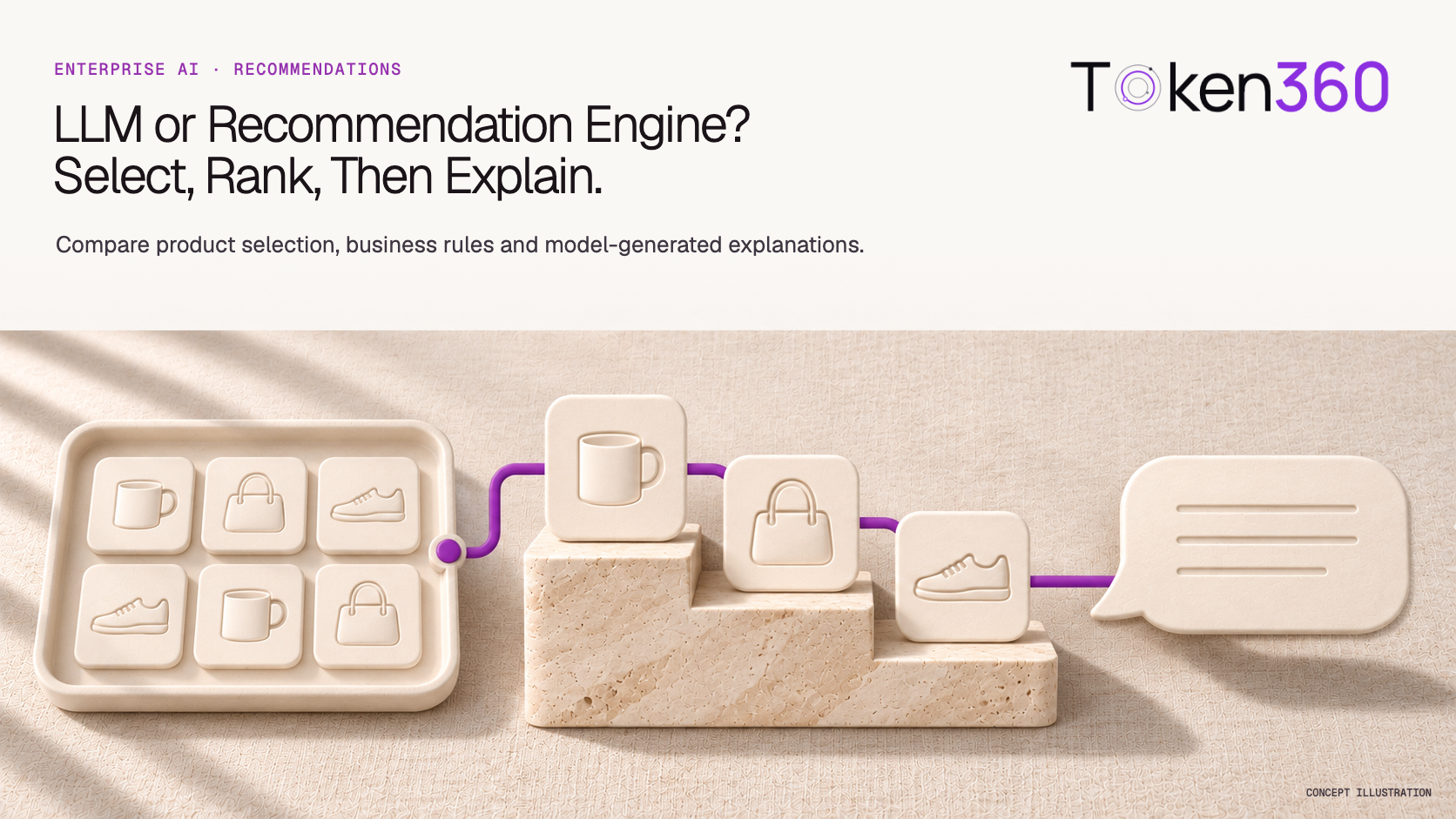
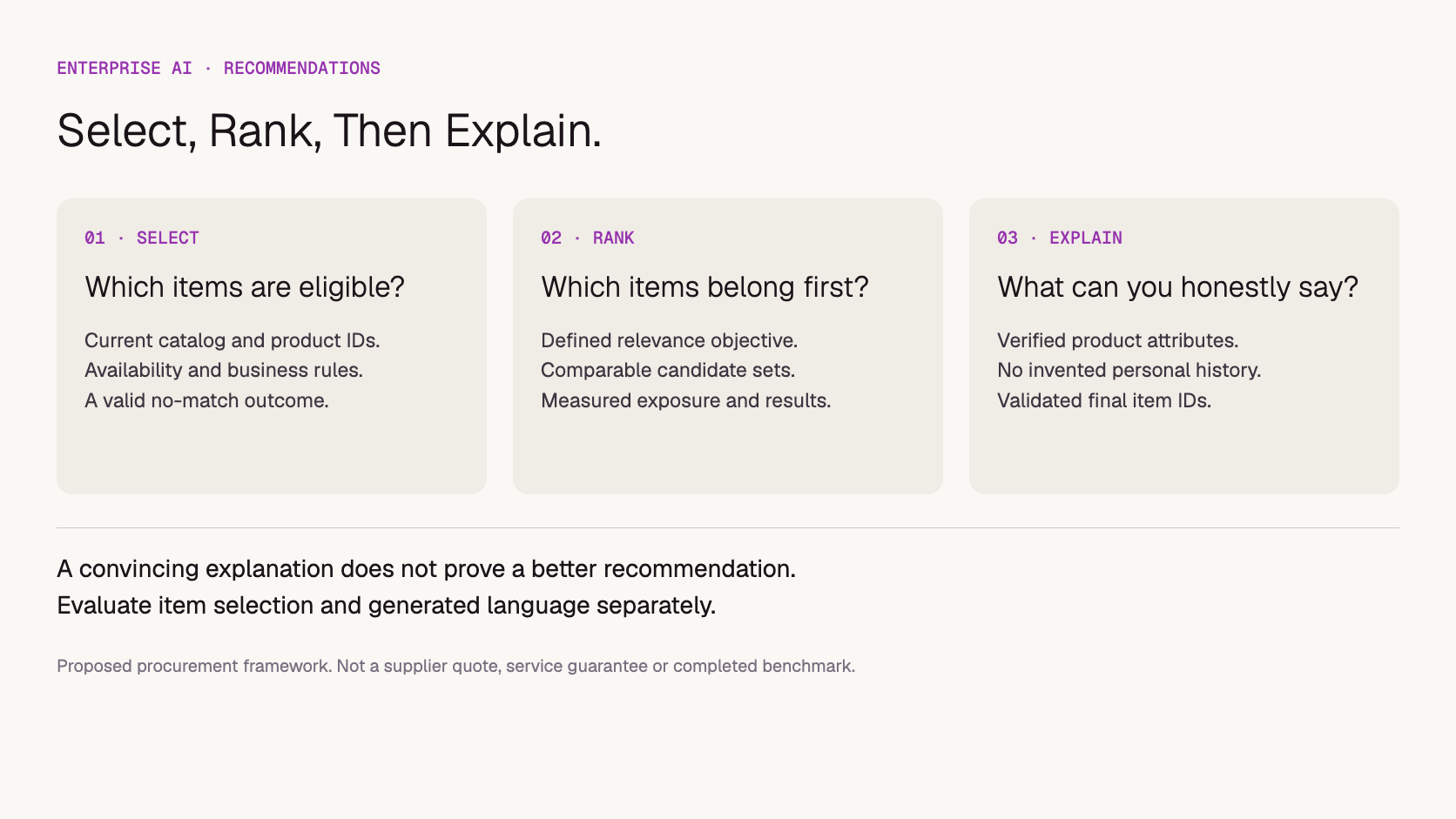
A business should therefore separate three outputs: an eligible candidate set, a ranked selection and a customer-facing explanation. One product may provide several of these. Procurement still needs evidence for each.
Requirement
Recommendation service or ranking system
General LLM API in an application
Select from a large catalog
Evaluate candidate retrieval, ranking and supported catalog scale.
Supply a candidate-selection method; do not assume the model knows the current catalog.
Use behavioral signals
Check supported events, identity handling and update behavior.
Pass relevant signals or build an integration; API calls alone do not establish a learning loop.
Understand a natural-language request
May need a separate language interface, depending on the service.
Can be evaluated for extracting preferences and interpreting constraints.
Explain a shortlist
Check whether reasons are provided and what they mean.
Can draft explanations grounded in supplied product attributes.
Enforce availability and eligibility
Configure supported filters and verify freshness.
Validate returned IDs and current rules in the application.
When is an LLM-based recommendation workflow a reasonable fit?
An LLM-based workflow is worth evaluating when customers describe needs in language and the application can supply a bounded, current set of eligible products. Examples include comparing a few approved options or explaining trade-offs. The case is weaker when the purchase assumes automatic personalization across a catalog without the supporting data and evaluation.
Consider an illustrative office-equipment retailer. A buyer asks for a compact coffee machine suitable for a small shared kitchen. The application retrieves products that meet size, price and availability constraints. An LLM compares their supplied maintenance requirements and explains the differences. This is a proposed workflow, not a Token360 customer result or a tested conversion claim.
In that workflow, the model’s useful contribution may be understanding “small shared kitchen” and producing a clear comparison. It need not invent a customer preference profile or replace the catalog query. If retrieving candidates is the missing capability, first distinguish private retrieval from model fine-tuning.
Can you combine an existing recommender with an LLM?
Yes. A practical design to test is to keep candidate selection and eligibility checks in existing systems, then use an LLM to interpret requests or explain the resulting shortlist. Define whether the LLM may reorder items. Otherwise, a new explanation layer can silently become a different ranking system.
A proposed sequence is: interpret the request, retrieve candidates, apply eligibility rules, rank, generate an explanation, and validate the final product IDs before display. If the model proposes a different order, record both orders and evaluate the change. Do not treat a polished paragraph as proof that the new ordering is better.
Also define failure behavior. If the explanation call fails, the application might still show a validated product list with factual attributes. If the candidate service fails, an LLM should not fill the gap with plausible products outside the approved catalog. These are application design choices, not built-in guarantees of model access.
A proposed evaluation framework, not a completed recommendation benchmark.
What data and controls should you require before launch?
Require stable product IDs, current attributes, explicit eligibility rules and a defined way to update the data. If personalization depends on behavior, specify which events are collected and how they connect to items and sessions. Keep authority over inventory, pricing and restrictions outside an unverified generated sentence.
Google’s commerce documentation describes recording user events with valid product information for recommendations and search. This illustrates the data integration behind a service, rather than an outcome obtained merely by buying access. See Google’s real-time event documentation, reviewed November 18, 2026.
Do not assume a service’s filters reflect every change immediately. Amazon Personalize documents filtering capabilities and different update behavior for different ingestion paths. Review the filtering and update documentation for the actual configuration. A final availability check may still be appropriate before showing an offer or accepting an order.
For the LLM component, reject unknown product IDs and unsupported claims. An explanation such as “your usual choice” requires actual evidence of that preference; a product’s good fit for the current request does not establish past purchasing behavior. A plain attribute comparison is better than an invented personal reason.
How should you evaluate whether the recommendations are better?
Evaluate selection quality and explanation quality separately. Start with eligible-item correctness, relevance to the request and unsupported claims. Compare against the current workflow on the same tasks and catalog snapshot. Only an appropriately designed live experiment can establish whether a change improves business outcomes such as purchases or repeat usage.
A useful pilot includes ordinary requests, ambiguous preferences, new products, customers with little history, unavailable items and requests with no valid match. Specify the expected behavior before reviewing model output. “No suitable item” can be the right answer; filling every slot is not necessarily success.
Record which items were shown, their positions, the candidate pool, catalog version and observed outcome. A click on an item does not reveal whether a product never shown would have performed better. When comparing online variants, keep eligibility and measurement rules consistent and account for the exposure each variant receives.
For an offline review, use a documented relevance rubric and report its limits. For a live test, select the business metric and guardrails in advance, including latency, unavailable-item exposure and misleading explanations. Do not substitute an LLM’s self-assigned confidence for a measured result.
How do you compare recommendation API pricing with LLM costs?
Compare the cost of the same completed recommendation experience, not a token price against an unrelated request fee. Identify what each quote includes: data preparation, retrieval, ranking, model calls, serving and maintenance. Then measure how many calls and retries your design actually needs before estimating production spend.
A recommendation widget may be requested on many page views, while a shopping conversation may generate several turns per visit. Those workloads have different call counts. A lower-priced model can still be the wrong choice if it requires more correction, slower responses or extra calls to produce an acceptable shortlist.
Ask each supplier to price a common workload description: eligible catalog size, expected request volume, peak traffic, refresh frequency, output requirements and the specific component being purchased. Keep recurring service charges separate from implementation costs. For the broader budget framework, use AI API total cost of ownership; this article focuses on what belongs in a recommendation purchase.
You can use the blank recommendation pilot worksheet to capture those assumptions. It contains no sample performance results or supplier prices.
Token360 is relevant when the requirement includes procuring model access for the language or multimodal part of the workflow. A model-access agreement should not be treated as a ready recommendation product. Confirm the chosen model, integration requirements, capacity and commercial scope while assigning catalog, ranking and application responsibilities explicitly.
Token360’s enterprise positioning covers text, image, audio and video model access, with pricing, dedicated capacity, contracts and compliance requirements scoped to the engagement. That does not establish a native recommendation engine, an inventory integration or a conversion improvement guarantee. See About Token360 and discuss the required scope through enterprise procurement.
What else should buyers ask?
Can an LLM recommend products without customer history?
It can be evaluated for matching a stated need to supplied product attributes. That is different from learning preferences from past behavior. Label the experience honestly and provide an appropriate fallback when the request is too vague.
Does a recommendation API always include explanations?
No universal assumption is safe. Check the service’s actual response and the meaning of any reasons or scores it provides. If an LLM writes the explanation, validate it against the selected items and supplied evidence.
Should we replace our current recommender immediately?
First identify the problem. If customers struggle to understand an otherwise useful shortlist, test an explanation layer. If the selected items are poor, evaluate candidate retrieval and ranking. Replacing everything at once makes the source of any change harder to identify.
Evidence boundary: This is a procurement analysis based on primary documentation reviewed November 18, 2026. It reports no Token360 recommendation benchmark, customer deployment, conversion lift or verified replacement result. The workflow and pilot are proposals to test.
Enterprise AI
API
Bring your next idea to life.
Create a video scene in Creator, or explore models for images, audio, and text to find the right capabilities for your project.


 Guides
 Guides
 Guides