Coding Assistant or LLM API: What Should Your Team Buy?
Buy an integrated coding workflow or programmable model access based on the task. Compare subscriptions, API billing, context and integration ownership.
ENTERPRISE AI · DEVELOPER TOOLS
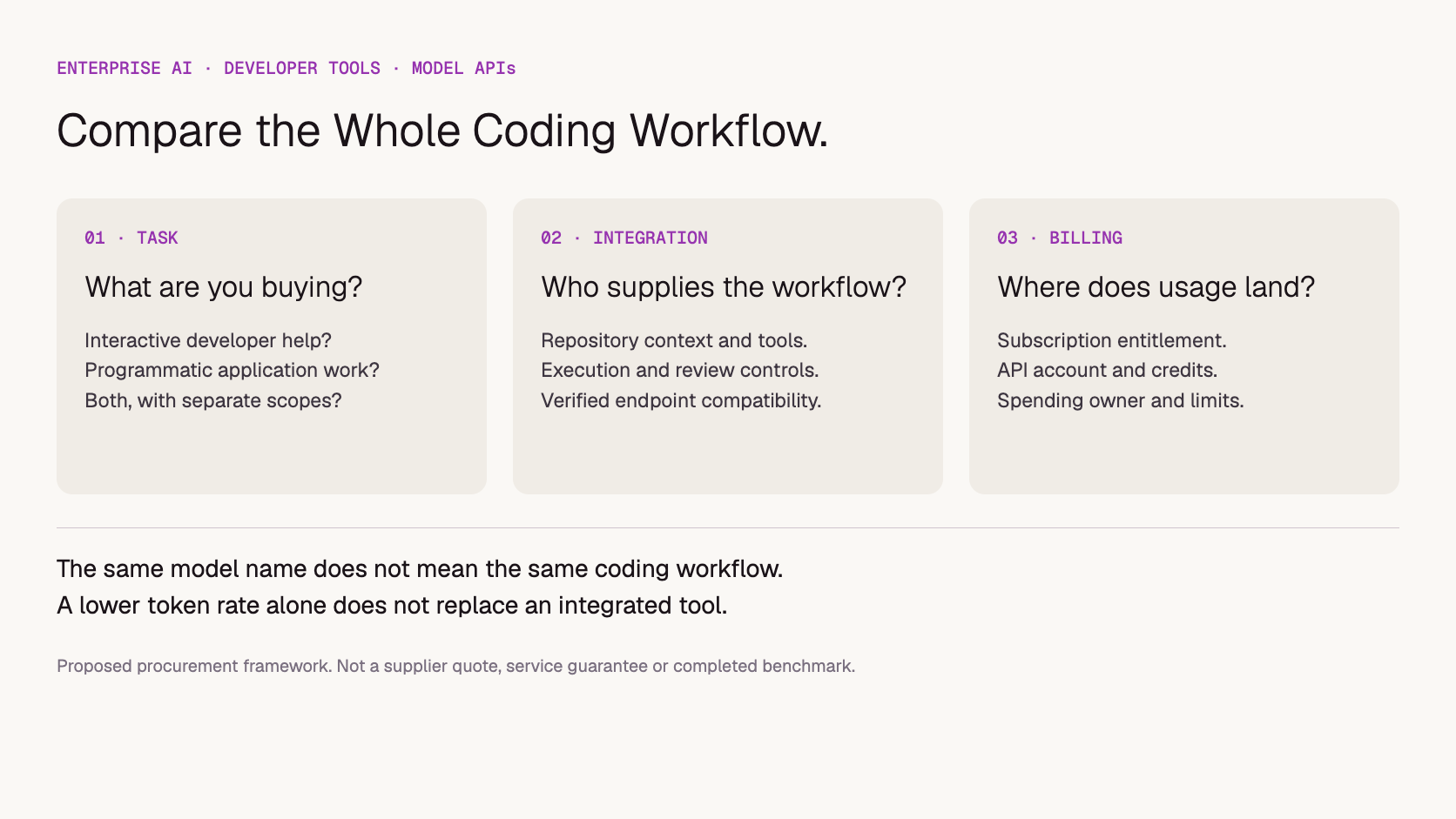
Buy a coding assistant when the main requirement is a ready-to-use workflow for engineers in their editor, terminal or repository. Buy LLM API access when your team needs programmable model calls inside a custom tool or application. Some workflows combine both. Compare the complete tool, integration and billing arrangement—not only the model name.
An engineering team asking for “AI coding access” might mean help writing code, an automated review workflow, or a code-generation feature inside its own product. Those are different purchases. A subscription can deliver a useful developer experience without being a general API entitlement, while an API can deliver model responses without supplying that experience.
What does a coding assistant include that an API may not?
A coding assistant packages model access with a development workflow, such as editor interaction, repository context, file changes or tool execution. The actual features depend on the product and plan. A model API supplies a programmable interface; it should not be assumed to include a complete editor integration, execution environment or review process.
GitHub’s Copilot IDE documentation describes integrated suggestions, chat and agent workflows, with capabilities varying by editor. By comparison, the Claude Messages API reference describes generating a response from structured input messages. These illustrate different product layers, not a performance ranking or an exhaustive description of either platform.
Purchase
Primary requirement
What still needs confirmation
Coding assistant
Help engineers within an existing development workflow
Supported editors, model choices, permissions, limits and review behavior
LLM API access
Call models programmatically from a custom workflow
Context assembly, tool execution, integration, monitoring and billing
Assistant with external model access
Use a supported tool with a separately supplied model route
Exact endpoint compatibility, feature coverage and which party bills each part
A product may offer more than one of these routes. Ask which route the proposal actually covers rather than treating “assistant” and “API” as mutually exclusive vendor categories.
Which requirement should determine the purchase?
Start with the user and the task. If employees need interactive help while coding, evaluate an assistant in their actual environment. If software must submit requests automatically or expose a feature to your customers, evaluate the API and application layer. If both are required, document two scopes even when one supplier serves them.
Consider a hypothetical team that wants engineers to understand unfamiliar modules and draft tests. A ready integration may address that need. Another team wants a service that reviews incoming configuration files and returns a structured assessment. That requirement needs an application workflow, not just developer seats.
Do not confuse these purchases with hiring someone to build the integration. The API provider versus development company guide covers that separate supplier-role question. Here, the comparison is between the software developers use and the model access your systems consume.
Does a paid subscription include API usage?
Check the exact plan and billing route. A subscription may include product usage, API credits, both or neither for a particular integration. Included credits do not necessarily remove the need for a separate API account or spending controls. Record where requests are billed before comparing subscription cost with a model’s token rate.
As reviewed November 17, 2026, Claude’s billing explanation distinguishes paid plans from Console API billing while also noting API credits for certain plans. That is why “subscriptions never include API credits” would be too broad. Verify the current entitlement for the actual product you are considering.
For procurement, capture the subscription owner, API organization, payment source, included allowance and overage behavior. Ask what happens if an employee changes authentication mode or connects another provider. A working login is not enough evidence that usage will land on the intended company bill.
Will the same model perform the same way in both?
The same model name does not make two coding workflows equivalent. Results also depend on the context supplied, instructions, available tools and feedback from execution. Compare complete tasks under documented conditions. Otherwise, a stronger-looking result may reflect better file selection or a working test loop rather than a different underlying model.
A coding tool may gather relevant files, inspect errors and run tests before presenting a change. A direct API request containing only a short description does not reproduce that setup. Conversely, a carefully built API workflow may supply specialized context that a general assistant does not automatically retrieve.
Ask what the tool can read and execute, how the user sees those actions, and which capabilities remain available with an external model route. Do not send a whole repository by default merely to imitate a demonstration. Identify the necessary context and confirm the applicable data-handling arrangement.
Can you use an assistant with your own API provider?
Sometimes, when the tool explicitly supports the provider or compatible endpoint and the required features work through that route. Verify compatibility at the workflow level, not merely whether a chat response appears. Authentication, streaming, tool calls and context handling can affect whether a coding session completes successfully.
GitHub’s IDE documentation describes options for external models and bring-your-own-key configurations in VS Code. That demonstrates a supported pattern within that ecosystem; it does not establish that every coding tool accepts every API provider or that a particular Token360 route is compatible.
Before buying, ask for the exact integration path and test a representative repository task. Record which features use the external model, which still depend on the assistant vendor and which account incurs the charge. If compatibility is uncertain, keep it as a purchase condition rather than presenting it as a confirmed benefit.
How should an enterprise evaluate the two options?
Evaluate accepted work, not just generated code volume. Use representative tasks with known review criteria, keep the repository state comparable and record human correction effort. Include tasks where the expected result is a clear explanation or a refusal to make an unsupported change. This is a proposed evaluation, not a coding benchmark.
Proposed procurement framework. No productivity increase or model-quality result is claimed.
Choose the task set: include the languages, repositories and change types your team actually handles.
Define acceptance: specify tests, review requirements, scope boundaries and how incomplete work is recorded.
Record the environment: capture model route, tool configuration, repository revision and allowed actions.
Measure the whole task: record completion, failures, reviewer effort and charges, not only response speed.
Check administration: verify onboarding, access removal, spending visibility and ownership of the integration.
A small pilot can inform the purchase without proving a universal productivity percentage. Preserve failed attempts alongside successful examples. For a custom API route, include the engineering effort needed to keep the workflow running; the managed-inference responsibility guide explains why model serving does not remove every application responsibility.
Use the coding assistant and API purchase brief to record the scope and results. It is a blank comparison sheet, not a recommendation for a specific tool.
Task,User,Interactive or automated,Tool and plan,Model route,Editor or runtime,Repository scope,Required features,Allowed actions,External API compatibility evidence,Subscription owner,API organization,Included allowance,Overage behavior,Acceptance criteria,Reviewer effort,Observed charges,Integration owner,Decision
Where does Token360 fit in the decision?
Consider Token360 when the requirement includes enterprise model API access. Confirm the required model, interface, workload and any external tool compatibility before treating it as part of a coding workflow. Model access does not by itself supply an IDE extension, repository execution environment or a finished coding assistant.
Token360 focuses on enterprise procurement across text, image, audio and video models. The enterprise team can discuss model access, negotiated pricing, capacity and contractual requirements for the engagement. This article does not claim a verified integration with a named coding assistant or a guaranteed coding-quality advantage.
A useful brief distinguishes interactive developer use from unattended application calls. Include the desired model, supported tool interface, expected concurrency, data scope and budget owner. If the immediate need is simply a ready-to-use coding tool, evaluate that tool directly rather than assuming an API contract is a substitute.
What else do enterprise buyers ask?
Can an LLM API generate code?
Many language models can generate code, but code output alone is not a working development workflow. Your integration still needs the right context, review and any permitted execution tools. Evaluate the exact model and task.
Is a token rate enough to compare with a seat price?
No. The prices may cover different things. Compare the expected workload, included tool features, limits, integration effort and review costs. Do not assume one seat equals a fixed amount of model consumption.
Can we use both a coding subscription and API access?
Yes, where the respective terms and integrations permit it. Assign each a purpose and budget owner so interactive employee work and application traffic do not become an unexplained combined bill.
Does a cheaper API automatically replace our coding tool?
No. It may change the model-supply cost, but replacing the tool requires recreating or obtaining its workflow features. Test the complete alternative before deciding that a lower inference rate makes it a better purchase.
Evidence and limits: Primary documentation reviewed November 17, 2026. Examples are hypothetical. No coding benchmark, integration test, productivity study or vendor price comparison was performed. Plan entitlements and compatibility require confirmation for the purchase.
Enterprise AI
API
Bring your next idea to life.
Create a video scene in Creator, or explore models for images, audio, and text to find the right capabilities for your project.


 Guides
 Guides
 Guides