Use seats for predictable access, usage for countable work, or a hybrid allowance. Define billing units, limits and overage before pricing AI features.
ENTERPRISE AI · PRODUCT PRICING
Price AI features per seat when access and collaboration create value and usage stays reasonably predictable. Price per use when customers receive distinct, countable deliverables and consumption varies substantially. A base plan with an included allowance can combine access with consumption, provided customers understand the unit, the limit and what happens next.
The model API invoice does not dictate your customer-facing price. A SaaS company buying inference still has to decide what its customers are purchasing: access for a team, a quantity of completed work, or both. This article compares those packaging decisions. It does not recommend a universal price or claim that any plan guarantees a margin.
Which AI pricing model fits your customer’s purchase?
Start with what the customer can predict and verify. Seats work when named people need ongoing access. Usage works when completed tasks are the purchase unit. A hybrid plan fits a continuing service with variable consumption. Compare these structures against the same workload before deciding what to put on the pricing page.
Structure
Customer buys
Useful fit
Question to resolve
Per seat
Access for each licensed user
A collaborative assistant used by a defined team
Can a few heavy users consume far more than the plan supports?
Per use
A measured quantity of work
Document processing or media jobs with understandable units
Can the customer estimate and reconcile the bill?
Base plan plus allowance
Ongoing access and a defined quantity
A business workflow with recurring access and variable workloads
What happens when the allowance runs out?
Stripe’s overview of AI pricing models distinguishes subscription, usage and hybrid structures. The selection framework here is an editorial proposal for teams integrating model APIs, not a measured ranking of those structures.
When does per-seat pricing become difficult?
Per-seat pricing becomes difficult when seat count stops explaining consumption. One user may ask occasional questions while another runs automated workflows all day. The same access fee then covers very different workloads. Before offering unrestricted use, define which activities the seat includes and examine heavy-user behavior separately from the average.
For example, a ten-person account might use an assistant only during meetings. Another ten-person account might connect scheduled document processing. Their seat counts are identical, but their requests, context lengths and generated outputs can differ. This is a hypothetical comparison, not a Token360 customer result.
A seat plan can still work. You might include a defined monthly allowance, separate bulk automation from interactive access, or offer a larger plan. Make those boundaries visible before purchase. Calling a product “unlimited” while relying on undisclosed restrictions makes it harder for the buyer to judge what the subscription covers.
What should count as one billable AI use?
A billable use should be a unit the customer recognizes, with a clear completion rule. A report, processed page or generated asset can be easier to understand than raw model tokens. However, each unit needs scope: input size, output type, revisions and failure handling can change both the work performed and the bill.
Consider a document-reporting feature. “One report” is incomplete unless you specify the supported document size, what the report contains and whether regenerating it consumes another unit. A short report from one page and a long report from hundreds of pages may need separate bands or explicit limits.
Choose an event the application can record reliably. A proposed rule might charge once when a requested report becomes available, rather than on every underlying API attempt. If technical retries are absorbed by your business, say so; if a customer-requested revision is charged separately, show that before submission. Neither rule should be assumed from the upstream provider’s billing.
Stripe’s usage-based billing documentation describes metering consumption for billing. A billing system can implement a meter; it cannot decide whether your definition of a completed report is fair or useful to the customer.
How should an included allowance and overage work?
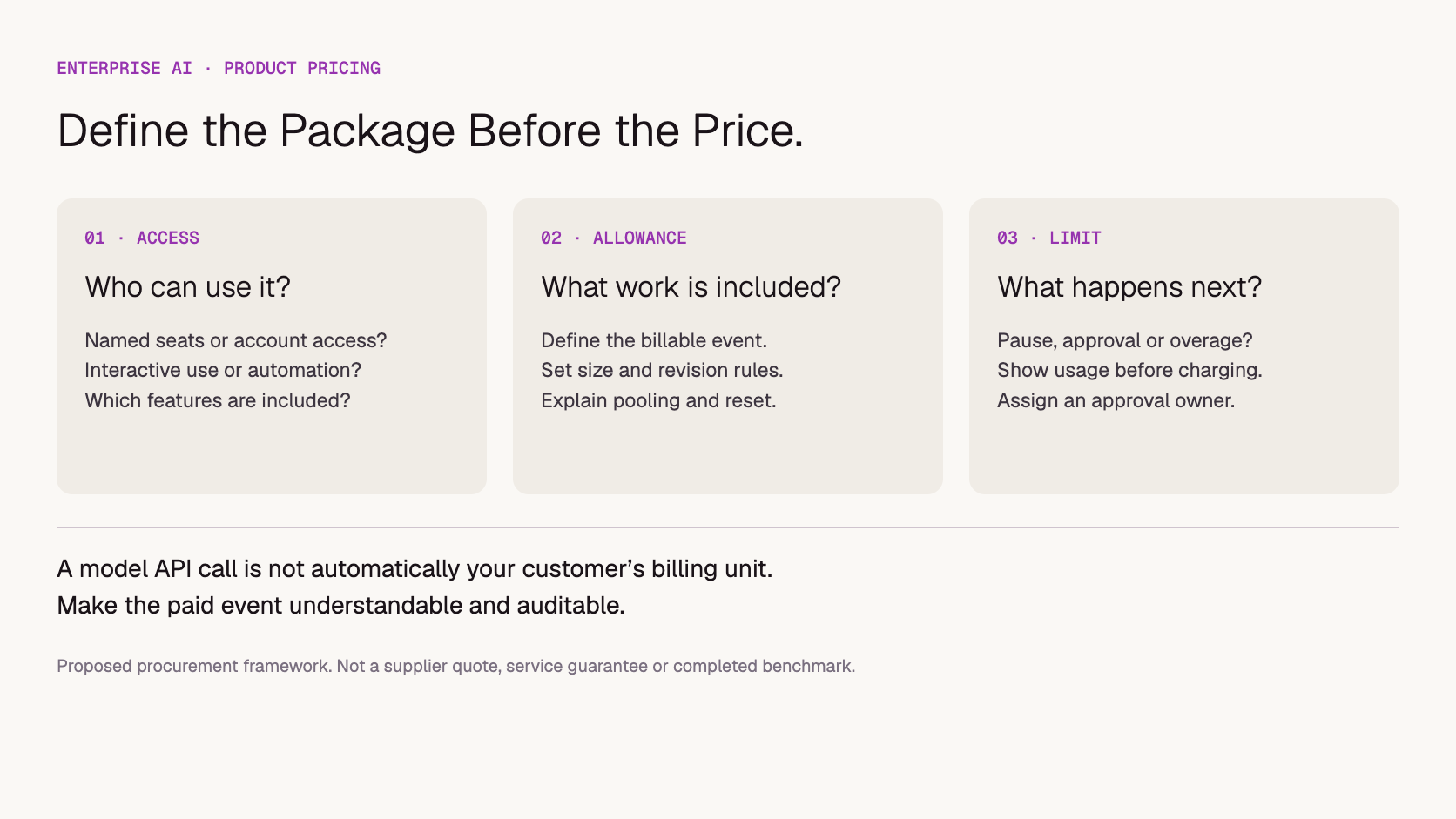
A hybrid plan needs a complete boundary between included and additional usage. State the allowance, reset period, pooling rules and overage price or approval process. Let the customer see consumption before it becomes a surprise invoice. Decide whether reaching the limit pauses work, requests approval or continues under an agreed cap.
Proposed packaging checklist. These are product decisions, not Token360 plan specifications.
For an enterprise account, clarify whether all users share the allowance or each seat receives its own. Specify whether unused units expire or roll over. If administrators can authorize additional usage, explain who has that permission and what employees see when they reach the limit.
Credits can combine different features into one balance, but only if the conversion is understandable. A customer needs to know the credit cost of a task before committing to it. Document how model choice, resolution or other options change that cost. A credit label alone does not make the product cheaper or the invoice more predictable.
How do you test the package before publishing prices?
Test proposed packages against light, typical and heavy usage patterns, then review both the supplier cost and the customer’s bill. Include automation, failed attempts and revisions. Ask whether buyers understand the billable unit and can predict a reasonable monthly range. This is a proposed validation process; no customer pricing experiment is reported here.
Define the purchase: identify the buyer, the job and the event that produces a charge.
Replay representative workloads: use observed usage where available; label modeled scenarios when data is missing.
Calculate both sides: compare the proposed customer charge with inference, infrastructure, support and other relevant delivery costs.
Review the edge cases: check timeouts, duplicate submissions, canceled work and partial outputs against the billing rule.
Validate comprehension: show sample invoices and ask prospective buyers to explain what they would pay and why.
Use the separate AI feature unit economics framework to estimate delivery cost. This article concerns how to package and communicate the charge. Cost coverage sets a constraint; it does not establish willingness to pay or prove that a proposed price will sell.
Record your choices in the AI feature pricing worksheet. It is a blank planning template, not a pricing calculator or a recommended rate card.
What should you confirm with your model API supplier?
Confirm the upstream usage unit, applicable rates, capacity assumptions and change terms before committing to customer-facing packages. Keep those supplier terms separate from your own billable event. A customer may buy one completed report while the application makes several model calls, and the supplier’s charges may follow those calls rather than the report.
Token360 focuses on enterprise access to text, image, audio and video models. Pricing, dedicated capacity, contracts and compliance requirements can be scoped to an engagement. Discuss the intended workload through the enterprise procurement page; a negotiated inference quote is an input to your product economics, not a ready-made retail pricing strategy.
Do not assume that an upstream account balance provides your application’s customer-level allowances, invoices or refund rules. Assign ownership of those controls in your product and billing systems. If the question is instead how departments should share an internal API bill, use the separate internal AI API chargeback guide.
What else do teams ask about AI feature pricing?
Should customers pay directly for model tokens?
Token-based pricing can fit technical buyers who understand the unit. For a business workflow, a bounded task or deliverable may be clearer. Keep internal token measurement for cost analysis even when the customer-facing unit is different.
Can we charge only for successful business outcomes?
Consider outcome pricing only after defining what counts as an outcome, how it is measured and how disputes are resolved. Producing a report is observable; proving that it caused revenue is a different requirement. This article does not validate an outcome-based contract.
Does a cheaper model mean we should lower our product price?
Not automatically. Supplier cost is one input. Review accepted-output quality, support, other delivery costs, customer value and existing commitments. A model price change does not by itself establish a new market price for your feature.
Can we start with seats and add usage later?
Yes, as a product design choice, but plan the transition. Explain which existing entitlements continue, which activities become metered and when the new terms apply. Test billing visibility before introducing charges customers have not previously seen.
Evidence and scope: Reviewed November 17, 2026. This is a product-pricing decision framework based on the cited documentation and approved Token360 positioning. Examples are hypothetical. No willingness-to-pay study, margin benchmark or tested monetization result is claimed.
Enterprise AI
API
Bring your next idea to life.
Create a video scene in Creator, or explore models for images, audio, and text to find the right capabilities for your project.


 Guides
 Guides
 Guides