Plan AI chatbot handoffs with verified context, queue acknowledgments and human ownership. Handle unavailable agents without promising a false transfer.
ENTERPRISE AI · CUSTOMER SERVICE
An AI chatbot should transfer the customer's context, route the case to an appropriate support queue, and confirm when a human has actually taken over. A generated sentence such as “I’m connecting you” is not proof of a transfer. Your application needs a recorded destination, a confirmed queue or assignment state, and a fallback when nobody can accept the conversation.
For an enterprise buying model APIs, this distinction matters. The model may understand the complaint and write a useful summary, while the customer-service system still needs to authenticate the customer, create or update the case, route it, and manage who can reply. A convincing chat response can hide an incomplete operational handoff.
Evidence and scope: This is a proposed design and purchasing checklist, not a customer deployment report or a measured performance comparison. Official documentation was checked November 16, 2026. It does not claim that Token360 provides a native contact-center queue, live-agent console or completed handoff integration.
What counts as a completed chatbot-to-human handoff?
A completed live handoff means an authorized human can access the relevant case and has taken ownership of the customer conversation. A request to escalate, a queued ticket and a connected agent are different states. Track them separately so the interface and reports describe what actually happened.
Google's Dialogflow CX documentation makes this boundary explicit: its liveAgentHandoff response signals that a conversation should be handed to a human, while the remaining procedure belongs to the implementation. It is useful evidence that a handoff signal is not, by itself, a staffed service. See the Dialogflow CX fulfillment reference.
State
Evidence to record
What the customer can safely be told
Requested
Customer or application triggered escalation
“I’m requesting support.”
Queued
Destination system acknowledged the case or queue entry
“Your request is in the support queue.”
Assigned
A named agent or team has accepted responsibility
“Your case has been assigned.”
Connected
The live conversation channel confirms the human has joined
“A support agent has joined this chat.”
Unavailable or failed
No eligible destination, rejected request, or unresolved transfer error
Explain the available alternative without implying connection.
These are proposed application states, not universal API field names. Map them to your support platform's actual events. For asynchronous email support, a successfully created case can be the intended handoff outcome; it should not be presented as a live connection.
When should the chatbot offer a human?
Offer a human when the customer requests one, the issue requires authority the bot does not have, or the conversation stops making useful progress. Define these triggers in the service policy. Let the model help recognize context, but keep required escalation paths and permissions under application control.
An illustrative billing dispute shows the difference. The bot can explain the documented billing policy and retrieve an authorized invoice. If the customer disputes a charge that requires a discretionary adjustment, repeating the policy is not resolution. Route the case to the team allowed to review it, carrying the disputed invoice and the customer's requested outcome.
Do not require customers to complete a fixed number of failed bot exchanges before they can ask for help. Conversely, a single missing order number may be handled with one relevant question if that information is necessary and the customer is willing to provide it. Our guide to when an AI assistant should ask a clarifying question covers that earlier decision.
Use explicit service rules for urgent or sensitive categories. Sentiment can inform triage, but a calm customer can still have an urgent issue. Do not make an uncertain emotion label the only route to priority support, and do not present model confidence as a verified probability that a transfer is necessary.
What context should travel with the conversation?
Send a concise, verifiable case summary together with authorized access to the underlying conversation and action records. Separate customer statements from confirmed account facts, completed actions from attempted actions, and unresolved questions from proposed answers. The receiving agent should understand what remains to be done without trusting an unchecked model summary.
Handoff field
Useful contents
Common mistake
Customer goal
The outcome requested, in the customer's terms
Labeling a complaint “resolved” because an answer was sent
Verified context
Authorized account/case references and verification status
Treating a name typed in chat as authenticated identity
Work already done
Confirmed lookups and actions, with transaction references
Reporting a suggested refund as an issued refund
Open issue
The specific blocker, missing decision or required authority
Forwarding an unexplained transcript dump
Evidence
Relevant messages and permitted attachments or source links
Copying secrets or unrelated account data
Service context
Language, destination, channel and agreed contact preference
Routing to a queue unable to serve the customer
For example: “Customer disputes a duplicate invoice. Invoice records were retrieved; no refund was submitted. Customer requests billing review. Identity verification is incomplete.” This is an illustrative summary, not a real support record. It preserves the unresolved status instead of smoothing it into a successful story.
Generate the summary from recorded events, and let the receiving agent inspect those events. The application should supply action status directly from the system of record. A model's recollection that it “processed” something is insufficient; see the distinction between requesting a tool action and executing it.
Context transfer must also respect access boundaries. Apply the destination team's permissions before exposing transcripts and attachments. Retain a minimal operational record according to your policy; do not automatically send every historical conversation. The same principle applies to permissions on information used in AI answers.
How should ownership change without duplicate replies?
Give the conversation one active customer-facing owner at a time, and update that ownership through confirmed application events. Once a human takes over, stop autonomous bot replies and reconcile any in-flight actions. A late model response should not overwrite the human's answer or trigger a second customer-facing operation.
Microsoft describes contextual handoff through a connected engagement hub that can expose conversation history and relevant variables to the live agent. Its documentation also distinguishes a simple escalation message from a configured transfer connection. See Microsoft's live-agent handoff documentation. That is an integration pattern, not evidence that any arbitrary model API supplies the same workflow.
In your implementation, make repeated escalation requests point to the existing pending case where appropriate. A customer clicking “talk to a person” twice, a reconnecting browser, or a delayed acknowledgment should not automatically create three support cases. Check the destination's acknowledgment and case identifier before retrying case creation.
Human ownership need not disable internal assistance. A bot may draft suggestions for an agent to review, provided those drafts do not reach the customer automatically. If the conversation returns to automation, define who authorizes that transition and what context survives. Do not silently restart the original bot flow after a human has made a decision.
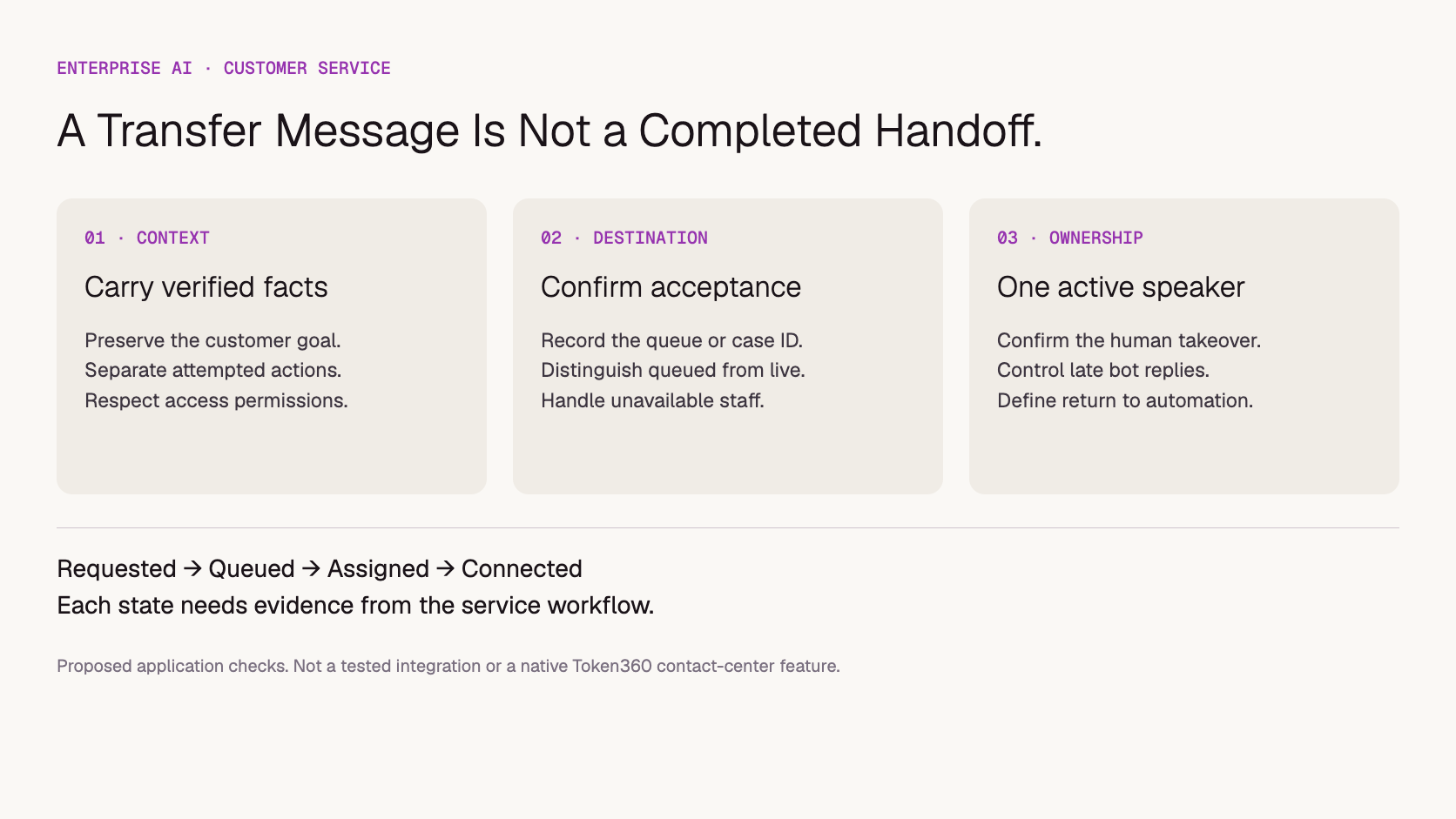
A proposed handoff review: context, acknowledgment and ownership require separate checks.
What happens when no human is available?
Show the actual service option: a queue, an asynchronous case, a callback request or published support hours. Preserve the issue and offer an appropriate next step. Do not promise an immediate connection or invent a waiting time when the support system has not supplied a reliable estimate.
For a queued chat, explain whether the customer must keep the window open and what happens after disconnection. For an asynchronous case, confirm creation only after the ticketing system acknowledges it, then show the reference and supported follow-up channel. A suggested message such as “Your request is saved as case X” must use a real case identifier.
If case creation fails, say so and provide a verified alternate contact path. Avoid asking for sensitive details again merely to fill another form. If a callback is supported, collect only the necessary contact information and confirmation; a customer's presence in a chat does not establish that every contact method on file is appropriate.
The off-hours experience belongs in the purchase evaluation. Ask who maintains queue hours, language coverage, destination availability and response commitments. These are operational dependencies even when the model correctly recognizes every escalation request.
How should enterprises test and measure the handoff?
Test the whole path from request to receiving agent, including context visibility and customer-facing status. Use controlled cases for unavailable staff, delayed acknowledgments, duplicate requests and interrupted sessions. A model-only test that produces the right escalation sentence cannot establish that the customer reached anyone.
Proposed test
Acceptance question
Customer asks for a person immediately
Is the supported route accessible without forced bot troubleshooting?
Transfer acknowledgment arrives late
Does the application avoid false success and duplicate cases?
Customer disconnects while queued
Is the case preserved, with clear reconnect or follow-up behavior?
No qualified agent is online
Does the interface offer the real alternative rather than a fictional wait?
Human joins during a pending bot response
Are late automated messages and side effects controlled?
Case contains restricted attachments
Can the correct team see permitted evidence without unrelated data exposure?
Bot attempted but did not complete an action
Does the summary preserve that distinction?
These are suggested tests, not completed experiments. Record the model and prompt version, application version, destination configuration and observed state transitions when you run them. Keep model behavior separate from queue and integration failures so a routing outage does not become a misleading model-quality score.
For reporting, define the denominator and end state. “Connected live handoffs divided by eligible live-transfer requests” answers a different question from “tickets acknowledged divided by case-creation attempts.” Track waiting time to a clearly named event, whether customers repeat information, and whether the receiving team can continue the work. Investigate abandonment separately; a customer leaving is not necessarily a resolved issue.
Where does Token360 fit in a human-handoff workflow?
Token360 can be considered for the model-access layer of an enterprise application, while the customer-service integration must establish routing, ownership and staffed support. Evaluate the model on intent recognition, grounded summaries and appropriate replies. Evaluate the surrounding system on acknowledged transfers, permissions and recovery from failure.
Token360's enterprise offering covers access to text, image, audio and video models and enterprise purchasing discussions. A procurement review should confirm the specific models, capacity and contractual scope required. Model availability does not establish that your support platform already has a compatible handoff connector.
Ask the implementation owner to demonstrate an end-to-end transfer using your actual support destination. Identify who owns each failure: model request, application routing, support-platform acceptance, and staffing. Review Token360 resources alongside the selected support platform's documentation; request implementation evidence before treating the entire workflow as delivered.
Frequently asked questions
Can a prompt alone transfer a chatbot conversation to a human?
No. A prompt can guide escalation language or produce a structured request. The application still needs an implemented destination, authorization, acknowledgment and ownership transition. The customer-facing message must reflect that actual state.
Should the agent receive the entire transcript?
Provide a concise summary and access to relevant permitted evidence. Full history can help, but it should follow access and retention rules. Remove secrets and avoid forwarding unrelated conversations by default.
Is opening a support ticket the same as connecting a live agent?
No. A ticket records an asynchronous request. A live connection requires an agent to join the conversation. Either can be an appropriate service outcome if the customer is told clearly which one is happening.
Does a low escalation rate prove that the chatbot works well?
No. It may reflect successful self-service, but it may also reflect blocked escalation or abandonment. Review resolution evidence, repeat contacts, handoff completion and customer effort before interpreting the rate.
Enterprise AI
API
Bring your next idea to life.
Create a video scene in Creator, or explore models for images, audio, and text to find the right capabilities for your project.


 Guides
 Guides
 Guides