AI APIs for Manufacturing: Review RFQs Before Quoting
Use AI APIs to organize manufacturing RFQs, trace specifications and flag missing details before technical review, costing and a formal quote.
INDUSTRY USE CASES · MANUFACTURING & DISTRIBUTION
AI APIs for manufacturing can help technical sales teams organize incoming requests for quotation (RFQs), extract requirements and identify questions that need clarification. The useful output is a reviewable request with traceable sources—not an automatic promise that a part can be supplied at a particular price or delivery date.
Manufacturers and industrial distributors may receive a customer email, a spreadsheet of line items and several drawing revisions for the same inquiry. A model can help bring that material into one review view. Engineering, inventory, costing and sales processes still determine feasibility and the terms of a formal response.
Read first: Choose AI models by business use case. This article covers a manufacturer's customer RFQ intake, rather than the information needed to buy AI inference from Token360.
What should an AI-assisted RFQ review actually produce?
It should produce a structured summary of the requested items, their supporting documents and unresolved questions, with a route to the appropriate reviewer. Preserve the difference between a customer's requirement, an extracted observation and an approved supplier response. Combining those states into one confident summary can hide work that remains.
A useful intake record might include the customer reference, part number, requested quantity, drawing revision, material requirement, requested delivery date and source locations. It should also identify missing fields and conflicts. The exact field set depends on the product family and the company's quoting process.
The scope should be explicit. An intake assistant prepares the request for review; it does not independently approve a substitute material, certify manufacturability or commit available production capacity. Those decisions need the responsible systems and people, even when the extracted summary is accurate.
RFQ operations already distinguish request information, replies and decisions. For example, Microsoft's Dynamics 365 RFQ documentation describes configurable reply information and comparison of responses. That is a procurement-system example, not a claim that Token360 implements those functions. The model-assisted intake proposed here should feed the existing commercial workflow rather than replace its decision records.
Which documents and fields need to stay connected?
Keep the original customer package, document identifiers, revisions and line-item relationships connected throughout extraction. A value without its source can be hard to verify, especially when two attachments disagree. Store original text alongside normalized fields so reviewers can inspect the wording that produced the summary.
Consider a hypothetical bracket inquiry. The email requests 500 units, a spreadsheet contains a line for 50, and the attached drawing is marked revision B while the email refers to revision C. A useful assistant flags both discrepancies. It should not pick the larger quantity or assume the latest-mentioned drawing is the one actually supplied.
Information
Record with it
Review question
Part or item identifier
Customer line reference and document link
Do the attachments describe the same item?
Quantity
Original value, unit and source
Is it per delivery, per assembly or total demand?
Material and finish
Exact designation and source wording
Are grade, treatment and finish sufficiently specified?
Drawing revision
File identifier and revision marking
Is this the version the customer intends to quote?
Requested delivery
Customer wording and date context
Is it a requested date or an approved supplier commitment?
Do not delete the originals after normalization. A standardized record is helpful for routing and comparison, but it may not preserve every qualifier or note. Keep the reviewer one step away from the source page or cell rather than requiring a new search through the entire email chain.
How should units, tolerances and missing specifications be handled?
Preserve exact source values and treat normalization as a separate, checkable operation. Do not invent units, fill missing tolerances or interpret an unreadable symbol as a known value. When information is absent or ambiguous, create a specific clarification item and identify the source that needs confirmation.
Dimensions and tolerances are not incidental formatting. A NIST publication on dimensional and tolerance data identifies them as critical engineering information for defining manufactured-part shape requirements. That supports keeping these details explicit; it does not establish that a language or vision model can reliably interpret every drawing.
A hypothetical entry of “10” should not become “10 mm” unless the applicable source establishes the unit. If a conversion is required, preserve the original value, the conversion rule and the normalized result. Have appropriate application checks and technical review handle the transformation rather than burying it inside generated prose.
Separate “not provided” from “not applicable.” An absent finish requirement could mean the customer omitted it, not that no finish is needed. Likewise, a model's confidence statement is not a substitute for a readable source. The next action should be determined by evidence and review, not by how certain the answer sounds.
Can vision models review engineering drawings?
A vision-capable model may help locate labels, summarize visible notes or flag an apparent mismatch for review, depending on the model and document quality. It should not be treated as a general CAD interpreter or engineering validator. Verify critical extracted details against the actual drawing and the appropriate technical process.
Scanned pages, small annotation text, overlapping dimension lines and faint symbols can create difficult inputs. Test these conditions with representative documents before choosing a model. A successful extraction from a clean sample does not establish reliable performance on every supplier or customer format.
Keep visual interpretation separate from geometric conclusions. Seeing a shape in an image is not the same as confirming its dimensions, tolerances or manufacturability. If the workflow needs structured CAD information, determine what the source system can provide rather than assuming a rendered image contains all the necessary data.
For the broader extraction method, see evidence-checked document extraction. This RFQ workflow adds the industry-specific question: which extracted facts are sufficient to move the request forward, and which still require clarification?
How can AI help draft clarification questions?
Turn each unresolved field into a concise question that references the conflicting or missing evidence. Group related questions so the customer can answer without reconstructing the entire inquiry. A reviewer should approve the draft before sending it, especially when wording could imply that a technical assumption has already been accepted.
For the hypothetical bracket inquiry, the draft might ask: “Your email requests 500 units, while line 2 of the spreadsheet lists 50. Which quantity should we use?” A second question can request revision C or confirmation that revision B is the intended quotation basis.
These questions are more actionable than a generic request for “more specifications.” They also create a record of what changed when the customer replies. Attach the response to the relevant line item and update its review state; do not leave the resolution only in an unstructured conversation summary.
Distinguish a request for clarification from a proposed alternative. Asking whether another material is acceptable is not the same as recording approval to use it. The system should preserve the customer's explicit response and the internal reviewer responsible for accepting that interpretation.
When should a request move to costing and a formal quote?
Move the request forward when the responsible reviewers have accepted the information needed for that quoting stage, with any remaining assumptions visible. Use approved commercial and operational sources for price, stock and lead time. A model may help assemble a draft response, but it should not originate those commitments from general knowledge.
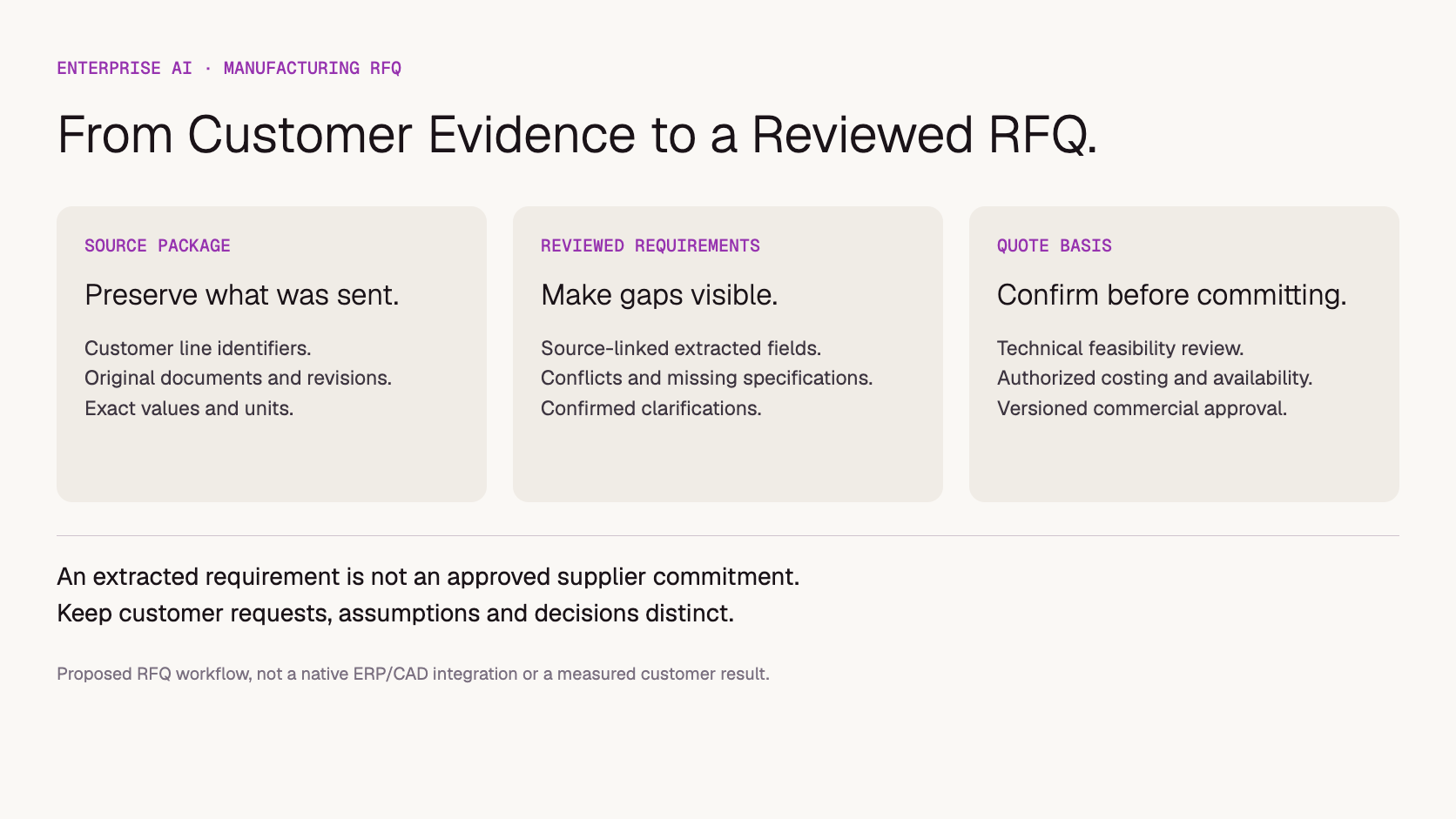
Proposed RFQ intake workflow. Extracted requirements and supplier commitments remain separate records.
For a distributor, a catalog match may identify a candidate item without proving that it meets every customer requirement or is currently available. For a manufacturer, a familiar part shape does not confirm the production route or capacity. Connect the review to the systems used for those decisions.
If a drawing changes after costing, identify the affected lines and send them back through the relevant checks. Do not carry an earlier price or delivery promise into a revised quote simply because the part number is unchanged. The quote should identify its approved basis and version.
The RFQ review register provides blank fields for source evidence, unresolved requirements, reviewer decisions and the quotation basis. It is a planning template, not an ERP connector or an automated pricing tool.
Test whether the workflow makes the request easier to review without hiding ambiguity. Use representative clean and difficult documents, known revision conflicts and deliberately missing fields. Measure extraction errors, missed issues and reviewer effort separately from response speed. A fast summary that conceals a conflict is not a successful intake result.
Field fidelity: Are identifiers, quantities, units and revision markings preserved accurately?
Evidence traceability: Can the reviewer reach the supporting page, cell or message?
Conflict detection: Does the workflow surface disagreements instead of silently choosing a value?
Unknown handling: Are missing specifications kept unresolved?
Routing usefulness: Does the summary reach the right technical or commercial reviewer with a clear next action?
Build a reviewed reference set before measuring results. Label the expected extracted fields and issues, then compare the proposed record with that reference. Keep false alarms visible too: excessive unnecessary questions can add work for customers and reviewers.
Compare the time to a reviewable request, not merely the time to generated text. Record document preparation, extraction, correction and follow-up separately. This article contains no measured processing-time reduction or quotation-accuracy rate; those outcomes need a pilot in the company's actual workflow.
Where does Token360 fit in the RFQ workflow?
Token360 can provide access to models evaluated for text interpretation and, where supported, visual document understanding. The manufacturing team still needs document intake, authorized data access, validation and connections to its business systems. Scope the model choice around the actual document formats and review tasks rather than a general promise of manufacturing automation.
As checked November 11, 2026, Token360's enterprise page describes text, image, audio and video model access, custom enterprise pricing and tenant-wide key audit. Higher throughput is a contact-sales item; priority support and SLAs are marked coming soon. Confirm the required engagement terms. No native ERP, CAD, costing or RFQ application is claimed here.
Before submitting customer drawings, confirm the applicable permissions and service data-handling arrangements. Keep unnecessary customer or commercial information out of the model input where practical. Enterprise requirements should be specified for the selected services rather than inferred from the availability of an API key.
Start with read-only preparation of a review record. Expanding into system updates or outgoing quotations should follow separate validation and authorization decisions. That creates a useful initial scope without implying that a successful extraction test validates the entire sales process.
Frequently asked questions
Can AI generate an RFQ response automatically?
It can help draft a response from approved information. Technical suitability, pricing and delivery commitments still need the company's authorized sources and approval process. An accurate summary of the request is not approval to quote.
Should missing specifications be filled from similar past orders?
Not silently. Prior orders can suggest a clarification question, but they do not establish what the current customer requires. Record any proposed assumption and obtain the appropriate confirmation.
Can one model handle emails, spreadsheets and drawings?
Possibly for selected tasks, but input support and performance vary. Evaluate the actual formats and critical fields, including the preprocessing needed. A single endpoint does not guarantee equivalent accuracy across all document types.
Does Token360 replace an ERP or quoting system?
No replacement is established in this workflow. Token360 supplies model access; the business still needs its systems for product data, inventory, costing, approvals and formal quotation records.
What is a useful first RFQ pilot?
Choose one product family and generate review records from authorized historical inquiries. Have qualified reviewers identify expected fields and unresolved issues, then compare the outputs. Keep the pilot separate from live customer commitments until its limitations are understood.
Evidence scope: editorial workflow analysis using Microsoft, NIST and Token360 sources checked November 11, 2026. The bracket inquiry is hypothetical. No customer deployment, engineering validation, quotation result or measured saving is claimed.
Enterprise AI
API
Bring your next idea to life.
Create a video scene in Creator, or explore models for images, audio, and text to find the right capabilities for your project.


 Guides
 Guides
 Guides