Speaker labels separate voices, not verified identities. Check diarization, timestamps, channels and participant mapping before buying a speech API.
ENTERPRISE AI · SPEECH TRANSCRIPTION
A speech-to-text API can assign words or speech segments to speaker labels if the selected model and endpoint support speaker diarization. Those labels distinguish voices within a recording; they do not automatically prove a person’s name or business role. Enterprise buyers should evaluate transcription accuracy, speaker attribution and identity mapping separately.
For customer calls, interviews and meetings, a transcript can contain the right sentence but attach it to the wrong person. That changes how the record should be used. Before buying transcription capacity, decide whether your application needs readable text, a speaker-labeled record, named participants or all three.
What does speaker diarization add to transcription?
Speaker diarization adds an estimate of who spoke when, usually represented by anonymous labels such as Speaker A and Speaker B. Transcription supplies the words. A useful business record connects those words and labels to time positions so a reviewer can return to the audio rather than trust a polished transcript alone.
For example, AssemblyAI’s pre-recorded speaker diarization documentation describes a response organized into utterances with speaker labels. Google Cloud’s speaker diarization documentation describes numeric speaker tags on words. These are examples of feature designs, not evidence that every speech API or Token360 route returns the same fields.
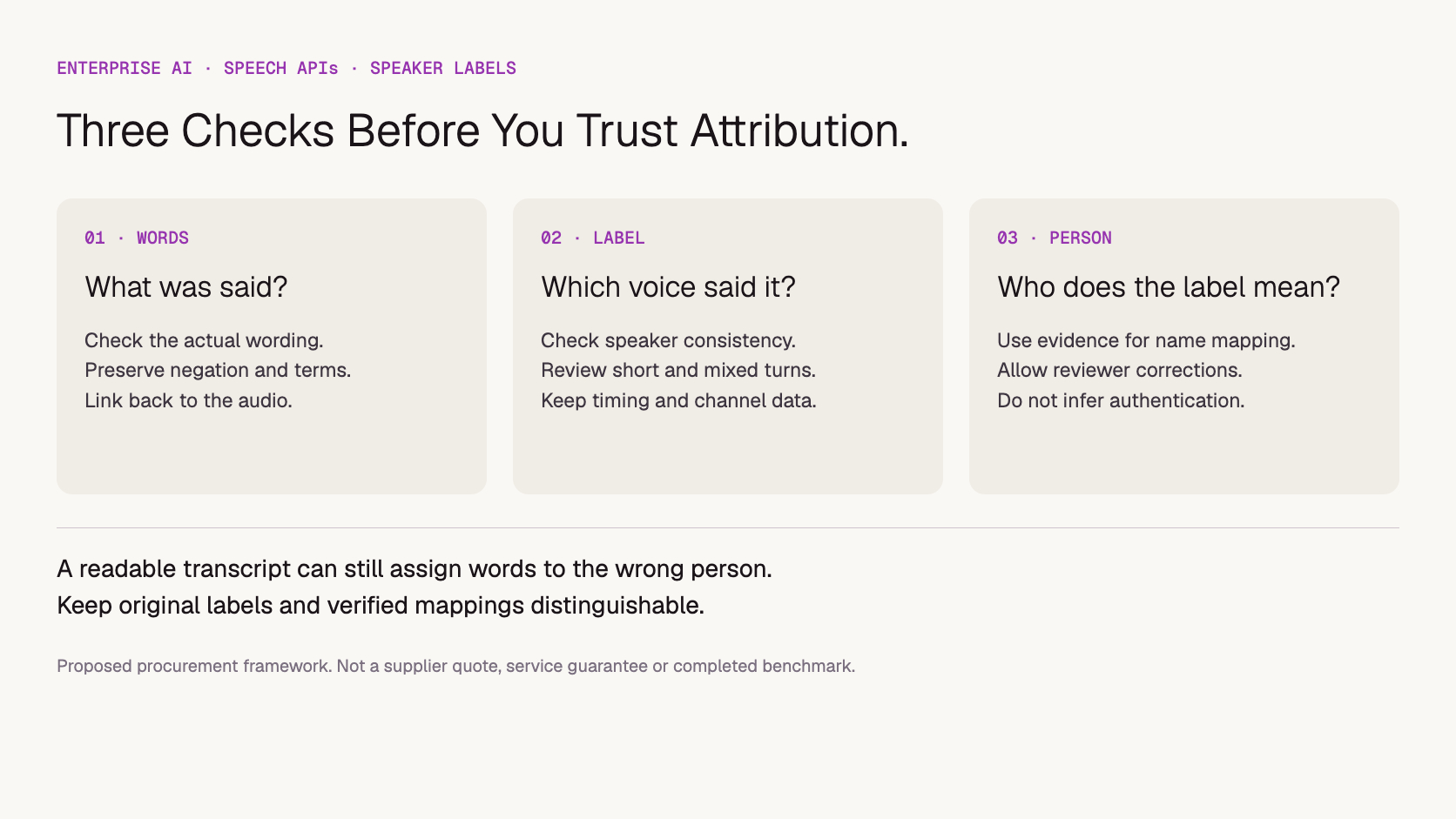
Required output
Question it answers
What to verify
Transcript text
What was said?
Words, negation, names and domain terms
Speaker labels
Which detected voice said it?
Labels stay consistent across turns
Timestamps
Where can we check it?
Units, boundaries and usable audio playback
Name or role mapping
Which participant does this label represent?
Evidence connecting the label to the person or role
If you are still deciding between building with an API and buying a finished meeting product, use the separate speech-to-text API versus meeting assistant comparison. This article addresses the speaker information an API-based workflow needs after that decision.
Does Speaker A mean the customer or a named employee?
No. An anonymous speaker label is not a verified customer identity, employee name or job title. Your application needs additional evidence to connect it to a participant. Treat a label as scoped to the recording or session unless the supplier explicitly documents a different behavior and you have tested that behavior.
A hypothetical call might contain “I can authorize the replacement,” correctly transcribed under Speaker B. If your application assumes B is the customer when B is actually the agent, the resulting business record is wrong despite correct words. Assigning “customer” to the second person who speaks is a convention, not identity evidence.
Possible evidence includes a trusted recording-channel map, a verified participant-to-track relationship or reviewer confirmation against the recording. Keep that mapping inspectable and correctable. A meeting roster alone does not tell you which anonymous voice belongs to which attendee, particularly when people share a microphone or dial in together.
Cross-recording identity recognition is a separate requirement. Do not assume that Speaker A in one recording is the same person as Speaker A in the next. If you need named identity across calls, ask for the specific capability and its prerequisites rather than treating ordinary diarization as authentication.
Should you preserve separate audio channels?
Preserve separate channels when your recording system supplies them and their relationship to participants is useful. Channel attribution and speaker diarization solve different problems: a channel identifies an audio stream, while diarization estimates distinct voices. Inspect what each channel actually contains before treating a channel number as a person or business role.
AssemblyAI documents streaming diarization and multichannel transcription as separate options. That distinction matters when specifying the recording pipeline. Mixing separate streams into one may discard an attribution signal that your application could otherwise preserve.
Do not assume stereo means two isolated participants. Both channels might contain the same mixed audio, or one channel might capture several people in a room. Check an actual export, document the mapping and evaluate the API using that format. Your application’s audio capture design is part of the purchase requirement.
Which speaker errors matter to the business?
Evaluate errors that change the interpretation of a conversation, not just whether the transcript looks readable. Important failure types include merging two speakers, splitting one speaker into multiple labels and assigning a short response to the wrong person. Review critical statements against the audio before using them as evidence of a commitment or decision.
Include interruptions, overlapping speech, short acknowledgments and participants who speak only briefly in a proposed test set. Add the accents, languages, microphones and recording conditions your actual workflow uses. These are test conditions to evaluate, not claims that a particular model will fail them.
Keep three findings separate: the words may be wrong, the words may be correct but assigned to the wrong speaker, or the label may be correct but mapped to the wrong name. Each calls for a different correction. A general “transcript passed” checkbox hides these distinctions.
A downstream summary cannot repair attribution simply by sounding confident. Once speaker evidence is available, use the meeting-summary review framework to check whether action items preserve the actual agreement. Speaker attribution and summary interpretation are separate acceptance stages.
What should the API response and application preserve?
Preserve enough structure to audit each important statement: text, speaker label, start and end times, and the relevant channel when available. Store the participant mapping separately from the raw label. Keep corrections traceable so reviewers can distinguish what the API returned from what a person later confirmed.
Proposed acceptance framework. No transcription benchmark or identity-verification test was performed.
Ask whether timestamps use seconds or milliseconds and whether they apply to words or larger segments. Confirm how missing or uncertain labels are represented. If confidence fields are available, establish what they measure; a word-confidence score should not be assumed to measure confidence in the person’s identity.
For live applications, verify the difference between provisional updates and finalized results. Document which event your application uses to display, store or act on a turn. AssemblyAI’s streaming documentation, for example, describes speaker information in turn events and final word records; the structure must be checked for the exact endpoint you select.
How should you run a procurement test?
Use recordings representative of your workflow and create a human-reviewed reference for the passages that matter. Compare transcription and attribution independently, then test the participant mapping. Record both the API output and any reviewer correction. This is a proposed acceptance process; the article reports no model ranking, accuracy percentage or customer experiment.
Define the need: choose between anonymous speaker turns, agent/customer roles and named participants. Do not request identity recognition when anonymous labels are sufficient.
Prepare the reference: use authorized recordings or synthetic test conversations, with known speaker turns and critical statements marked.
Submit the real input format: preserve channel layout and the audio quality your production system will deliver.
Review each dimension: check words, timing, label consistency and name/role mapping separately.
Test correction handling: confirm that a reviewer can fix the mapping without silently overwriting the original evidence.
Download the speaker-attribution evaluation sheet to record the results. Agree on pass conditions before testing—for example, mandatory review of disputed commitments—and report failures by type rather than presenting a small pilot as an overall accuracy rate.
Recording ID,Model and endpoint,Mode,Language,Channel layout,Reference time,Reference words,Reference speaker,Returned words,Returned label,Returned timestamps,Channel ID,Words correct,Attribution correct,Name mapping evidence,Reviewer correction,Critical business impact,Decision,Reviewer
What should you confirm with Token360?
Confirm whether the exact speech model and endpoint you plan to use return speaker labels, timestamps and channel information in the required mode. Support for audio models does not by itself establish diarization support. Request a sample response, document any configuration requirements and evaluate the result with your own representative recordings.
Token360 supports enterprise procurement across text, image, audio and video models. Its enterprise offering provides a place to discuss the workload, model mix, pricing and production requirements. This article does not claim that a particular diarization model is available through Token360 or that it performs named-speaker recognition.
For a useful discussion, provide recording duration, expected speaker count, language, channel layout and whether you need live or completed-file results. Include the required output fields and review process. Those details are more actionable than asking only for “accurate speech recognition.”
What else do buyers ask about speaker labels?
Will giving the expected speaker count guarantee correct labels?
No. A supported speaker-count setting may guide processing, but it does not prove that each turn is correctly assigned. Test the exact configuration and include recordings whose actual participant count changes.
Can an LLM add names after transcription?
It may propose names from context, but a plausible proposal is not independent evidence. Retain the anonymous labels and require a reliable mapping or reviewer confirmation before treating the names as established.
Do all speech-to-text APIs include diarization?
Do not assume so. Verify model, endpoint, language, input format and processing mode. An API returning plain text may not provide the speaker structure your workflow needs.
Can we use a labeled transcript to assign action items?
It can supply evidence, but first check attribution and the actual wording of the commitment. A correctly identified speaker might be discussing someone else’s task, quoting another person or describing a conditional plan.
Evidence boundary: Primary documentation reviewed November 17, 2026. Examples are hypothetical and the evaluation sheet is a proposed workflow. No tested transcription accuracy, biometric identity capability or universal Token360 endpoint support is asserted.
Enterprise AI
API
Bring your next idea to life.
Create a video scene in Creator, or explore models for images, audio, and text to find the right capabilities for your project.


 Guides
 Guides
 Guides