AI Music for a Three-Second Reveal: Six-Take Case Study
Compare six Sonilo takes for a three-second reveal. Separate measured level rises from percussion timing and choose an edit without overstating the test.
By Yuki Yu
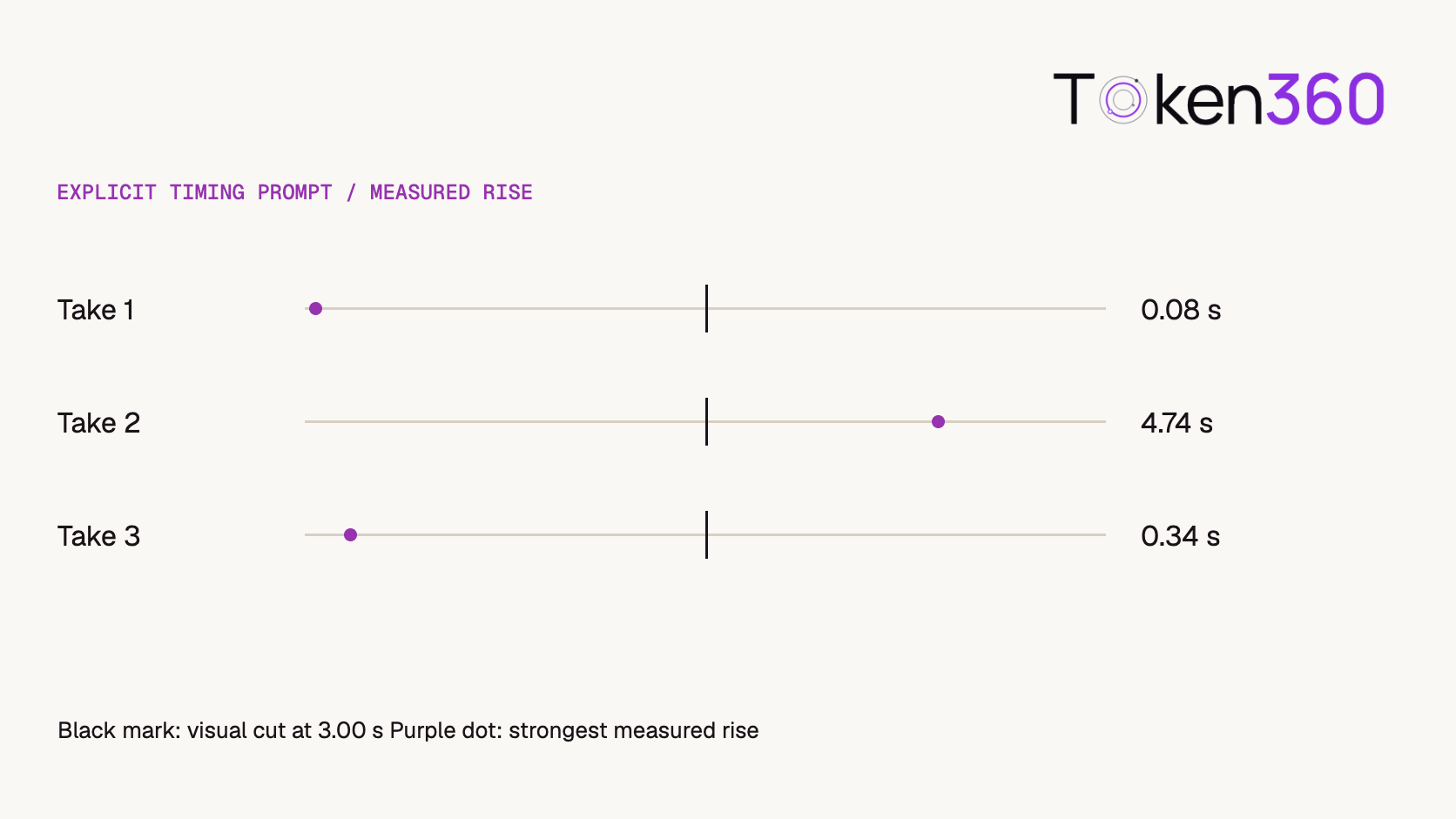
We asked Sonilo for a strong percussion accent exactly when a product appears at 3.00 seconds. In three new takes, the strongest measured rise in the opening six seconds landed at 0.08, 4.74 and 0.34 seconds. None coincided with the cut under our 20-millisecond measurement. This answers a narrow editing question: in these takes, placing the untrimmed music at the start of the film did not align its largest rise with the reveal.
Read first. The Sonilo Text to Music model page is the starting point for generating your own instrumental takes. This experiment examines what happens when an editor places existing takes under a locked picture.
What happened when the prompt specified 3.00 seconds?
The tester generated three takes using the same brief in Token360’s Sonilo Text to Music workflow. The brief requested 30 seconds. Each supplied MP3 decoded to approximately 10.03 seconds. We used the first six seconds of each and kept the original start time. The files alone cannot tell us why the delivered length differs from the brief.
Create a 30-second instrumental product reveal cue. Begin with a soft sustained pad. Put the first and only strong percussive accent in the first six seconds exactly at 3.00 seconds. Keep the rest of those six seconds soft. No vocals.
Explicit timing prompt
Largest measured rise
Distance from the cut
Take 1
0.08 s
2.92 s early
Take 2
4.74 s
1.74 s late
Take 3
0.34 s
2.66 s early
New takes generated with the explicit timing prompt. The black tick is the picture cut.
Take 2 was closest by this measure. Listen for the intended percussion separately: a track’s most abrupt level change can be its opening attack, and a smaller hit can occur near the cue. The measurement does not classify instruments or rule out a quieter accent at 3.00 seconds.
The earlier brief called for a 30-second instrumental product reveal: a sparse piano opening, strings and light percussion building in the middle, and a final chord with a natural decay. The tester accepted all three outputs for that brief. Each cost $0.0874125 at the time, for a total of $0.2622375. The recorded generation waits were 15.35, 13.38 and 13.56 seconds, timed by hand.
The 3.00-second target was introduced during editing. That timing matters to the interpretation: this test measures how three existing tracks fit a new edit. These earlier takes provide an editing comparison with a different creative brief.
Where did the earlier tracks rise?
Music take
Detected rise
Offset from picture cut
Direction
Reveal 1
3.10 s
+0.10 s
After the cut
Reveal 2
3.64 s
+0.64 s
After the cut
Reveal 3
0.80 s
−2.20 s
Before the cut
All three previews start the source music at zero and use its first six seconds. The picture, cut and end time are identical. Watch one version before looking at the next result. Ask whether the sound draws attention as the product appears, or whether a different musical moment catches your ear first.
We decoded each original MP3 to mono PCM at 24,000 samples per second, retained six seconds and divided them into 300 consecutive 20-millisecond blocks. For each block we computed the root mean square amplitude. We compared each block with the preceding one and selected the largest positive rise. The reported timestamp is the start of that later block. Subtracting 3.00 seconds gives the signed offset in the table.
This measure favors a sudden increase in level. A listener may hear the musical accent on a chord change, a low drum hit or a pause instead. It also skips the onset of the very first block because there is no preceding block for comparison. Listen to the previews alongside the measurements before making a creative choice. FFmpeg audio decoding reference.
What would an editor change?
Among the earlier reveal tracks, Reveal 1 is the closest starting point if the director wants a sharp change near the cut. Trimming roughly 0.10 seconds from the music’s beginning would move the detected rise toward the reveal. Listen again after trimming: the opening phrase and final cadence may both change. For the earlier Reveal 2 track, trimming 0.64 seconds trades more of the opening for alignment. To move the earlier Reveal 3 track’s rise to 3.00 seconds, the editor would need to delay the track by 2.20 seconds or choose a different musical event.
We also repeated the new-take calculation with 10- and 40-millisecond blocks. Take 1 moved between 0.08 and 0.55 seconds, take 2 between 4.72 and 5.09, and take 3 between 0.32 and 0.34. The exact marker depends on the analysis window. All three window sizes put the strongest measured rise more than one second from the reveal in all three new tracks. Six total files across two different briefs give an editor concrete audition material, rather than a general model hit rate.
Separate an editing marker from a prompt-compliance verdict
The useful decision in this study is which source to edit around a three-second cut. It is not yet whether Sonilo obeyed every percussion instruction. An amplitude rise can locate an editing candidate without identifying the instrument responsible. Use the two findings separately when approving the soundtrack.
Question
Available evidence
Decision supported
Where is the largest measured rise?
Original audio analyzed in fixed windows
Select a candidate trim or delay, then audition it
Did the first and only strong percussion occur at 3.00 seconds?
No event-labelled listening record
Unresolved; do not report a percussion hit rate
Why is the delivered file about ten seconds?
Thirty seconds in the written brief; no retained UI duration value
Duration discrepancy, with cause unknown
The tester confirmed Token360 Playground as the generation interface. The earlier test instruction requested thirty seconds; the later recollection of three or five seconds was uncertain. Neither establishes the effective duration setting. Before another generation, retain a screenshot of that setting and the submitted prompt. For the existing files, an editor can first mark the percussion by ear, record ambiguous events, and state an acceptable timing tolerance before scoring. That review can improve the interpretation without paying for new audio.
Frequently asked questions
Which track was closest to the reveal?
Among the explicit timing takes, take 2 was closest at 4.74 seconds. Among the earlier tracks, reveal 1 was closest at 3.10 seconds. Its 100-millisecond offset is about 2.4 frames at the film’s 24 fps.
Did any existing track hit exactly 3.00 seconds?
All three detected times differed from the visual cut on the 20-millisecond analysis grid. A listener could mark a different event in the same music.
Does this establish frame-accurate prompt control?
The new prompt specified 3.00 seconds. None of its three strongest measured rises coincided with that timestamp. The small sample and amplitude-based detector limit the finding to these files and this measure.
Can I use the loudest sample as the accent?
A sustained section can contain the loudest sample long after an attack. Comparing adjacent blocks measures a rise. Marking the perceived accent by ear adds musical context.
Why use the original MP3 for measurement?
The preview has been encoded again for video playback. Measuring the supplied source keeps the input to the calculation consistent across all three takes.
Does the original generation wait affect the offset?
The wait tells you how long the tester waited for delivery. Offset is measured inside the finished sound file from its start. The two clocks answer different questions.
Read next. For a single precisely placed accent, compare these music takes with the Sonilo sound-effects test.


 Prompt Library
 Insights
 Insights