Check raster, vector, typography and export requirements before buying a logo API. Compare the cost of accepted editable assets, not just previews.
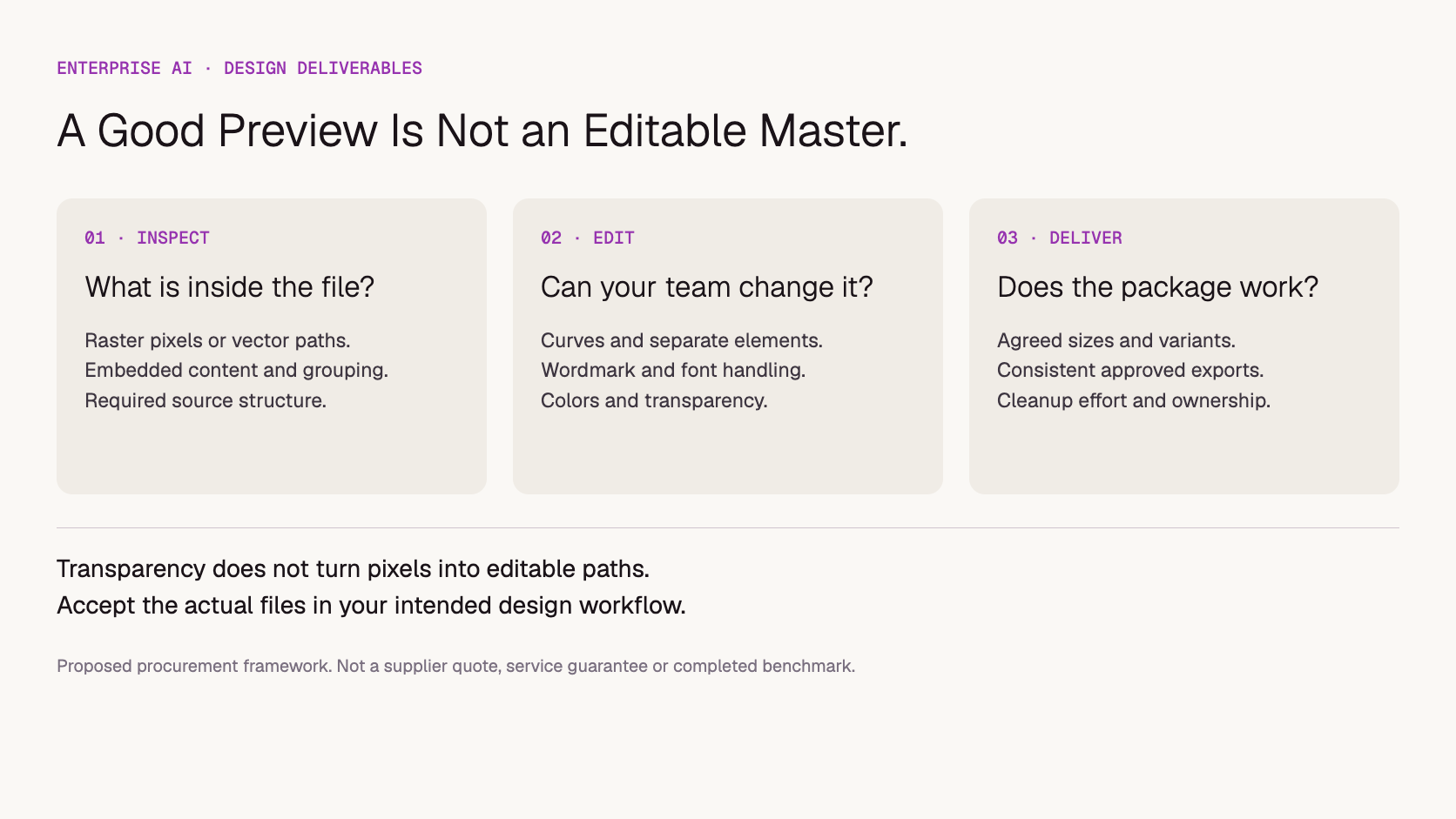
An image API can provide a logo concept without providing an editable vector file. Before purchasing, require an actual output file that supports the changes your design team needs. Judge paths, text and export behavior separately from the preview’s appearance; do not assume a PNG becomes editable because it has a transparent background.
A logo that looks sharp in a preview may still be one flattened image. Your team may need to change a curve, separate the symbol from the wordmark or export the design at a different size. Those tasks depend on the file’s structure, not how polished the preview looks.
For enterprises, agencies and software teams buying image-generation access, the useful distinction is between an attractive concept and an accepted design asset. Specify that distinction before comparing per-generation prices.
What is the difference between a raster logo and a vector logo?
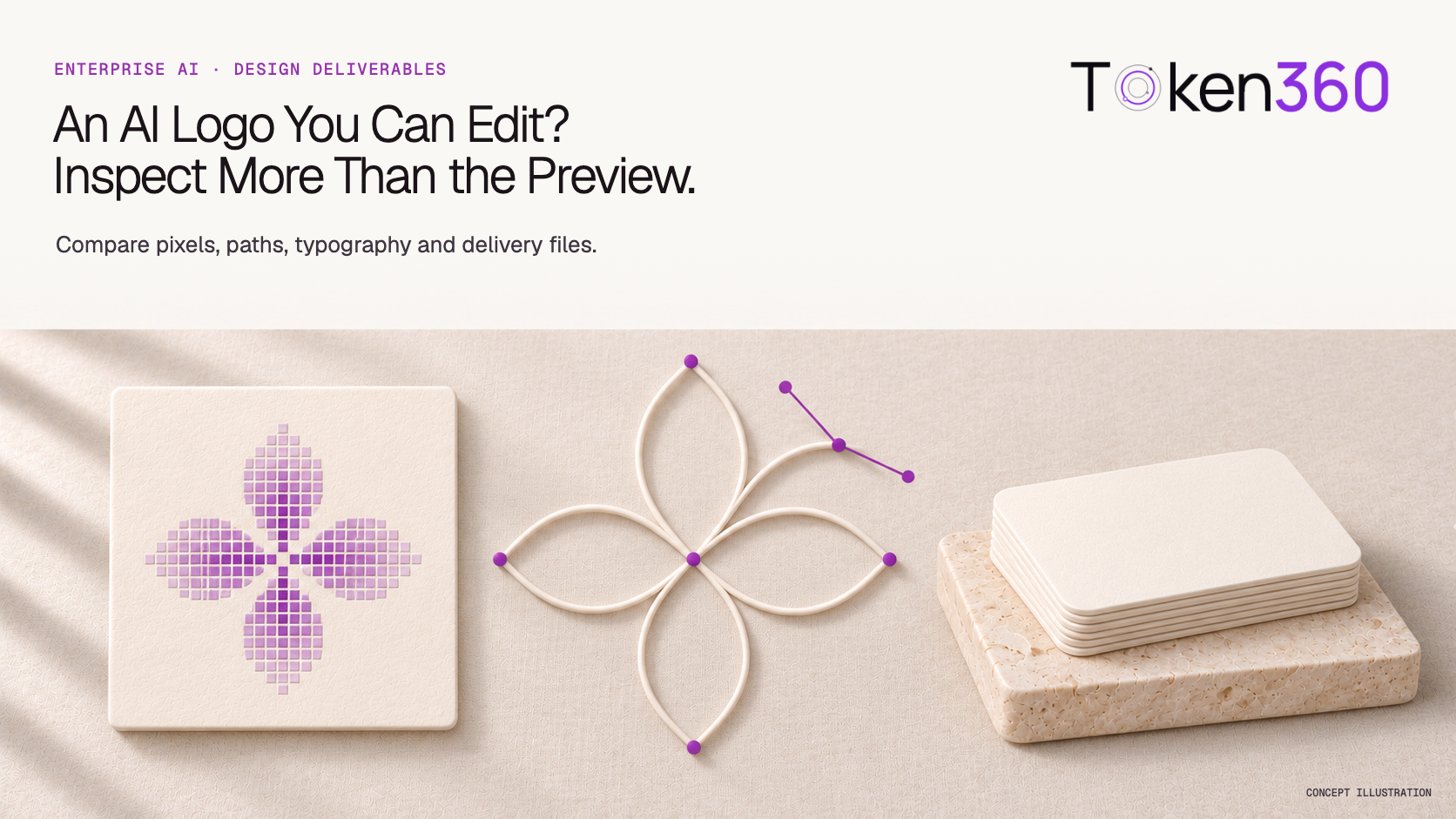
A raster image stores pixels, while vector artwork describes shapes and paths. Both can display a logo, but they support different editing and scaling workflows. A large raster export may be suitable for a defined use; it does not automatically provide the editable geometry needed for a reusable design master.
Adobe’s raster and vector guidance explains the distinction and notes that formats such as PDF can contain both types of content. The file extension alone is therefore not a sufficient acceptance test. This source was reviewed November 18, 2026.
Deliverable
What it supports
What to inspect
Raster concept image
Reviewing a visual direction or a fixed-size application
Resolution, edge quality and background
Transparent raster image
Placing the image over another background
Actual transparency and edge artifacts; not path editability
Vector artwork
Editing geometry and producing scalable variants
Paths, embedded images, grouping and curve quality
Editable design master
Ongoing controlled design changes
Object structure, typography, colors and required dependencies
Approved delivery package
Consistent use across agreed placements
Exports, variants and a clear approved source file
What should buyers require for text, colors and transparency?
Specify whether the wordmark must remain editable text, whether outlined lettering is acceptable and which color values and background variants are required. These are separate acceptance criteria. A correct-looking preview does not prove the requested spelling, font handling, transparent background or color values will survive export.
For a wordmark, check every character and the relationship between letters at the sizes where it will appear. Editable text can depend on an available font; outlined text is geometry and cannot be edited like a normal text string. Choose deliberately and document the required source assets.
Inspect transparency on contrasting backgrounds. A preview checkerboard may be drawn into the image rather than indicate a transparent channel, and pale edges may become visible on a dark placement. This is a file inspection task, not something a prompt alone can certify.
Record exact digital colors in the master file and verify exports for their intended uses. Avoid assuming that a model’s interpretation of a color name is an exact specification. For broader controls over generated campaign material, see keeping AI-generated content on brand.
A proposed acceptance framework, not a tested logo-model benchmark.
How should an enterprise test the delivered logo?
Test the actual files in the target workflow, not just screenshots. Check whether the required elements can be selected and edited, whether exports remain consistent and whether the mark works at the agreed sizes. Record the manual work needed to reach acceptance so that visual appeal does not conceal production cost.
A proposed test can ask a reviewer to change one curve, recolor the symbol, separate the wordmark and export the agreed variants. If those operations require rebuilding the design, record that outcome explicitly. Do not describe a successful open operation as full editability.
Review a small placement, a large placement and a single-color version if those are part of the brief. Fine details that look attractive in a large preview may disappear at small sizes. Conversely, enlarged use can reveal edge or geometry problems. Acceptance should reflect the actual placements rather than an arbitrary resolution target.
Include a revision exercise. Ask for a specific change to the selected concept and compare what else changed. A new generation that resembles the original is not necessarily a controlled edit. Decide whether later changes happen through the API, a design editor or both.
The blank logo delivery checklist records these requirements and the observed editing work. It contains no generated samples, performance rates or supplier ranking.
How do you compare the true cost of a logo API?
Compare cost per accepted delivery package, including iterations, conversion and design cleanup, rather than only cost per generated image. Define the output package first, then measure what it takes to produce it. A lower image price does not demonstrate lower total cost when the required editable files still need to be built.
Ask what each billable operation includes: concept generation, edits, vector conversion, upscaling or additional exports. Keep these separate where the service charges separately, and avoid double-counting steps already included in a bundle. Obtain the current quote for the actual endpoint and workload.
Also assign ownership of final acceptance. If an agency delivers the package, clarify whether it supplies a source master and agreed variants. If your application exposes generation to customers, define how it describes the result: a concept preview should not be labeled an approved identity package merely because it was delivered successfully.
Where does Token360 fit in this purchase?
Token360 can be considered for model access used in the concept or image-generation part of a design workflow. The selected endpoint’s output capabilities must be confirmed. Enterprise access to image models does not by itself establish editable SVG output, a vector-conversion service or a completed brand-design deliverable.
Token360’s positioning covers enterprise access across text, image, audio and video models, with pricing, dedicated capacity, contracts and compliance requirements scoped to the engagement. Bring the required output format and acceptance criteria to enterprise procurement. See About Token360 for company context. No specific vector endpoint availability or design-service offering is verified here.
Ask for an actual returned file and test it in the destination design tool. This article has not verified a native SVG endpoint on Token360. It therefore treats editable vector delivery as a requirement to confirm, not a promised feature.
What else should buyers clarify?
Is a transparent PNG an editable vector?
No. Transparency describes how the background is represented. It does not turn pixels into editable paths. A transparent PNG can still be an appropriate final export for a defined digital placement.
Does an SVG file always contain clean paths?
Do not assume so from the extension. Inspect the objects, embedded content and editing behavior in your application. An SVG preview is not a substitute for testing the required changes.
Does technical acceptance complete brand approval?
No. File usability is one part of acceptance. The organization still needs its normal design, brand and rights review before adopting the asset. This article assesses technical deliverables and does not establish ownership, exclusivity or clearance for any generated mark.
Evidence boundary: Procurement analysis based on primary documentation reviewed November 18, 2026. The symbol in the cover is fictional. No logo generation benchmark, file-editing experiment, cost saving or Token360 vector integration is claimed.


 Guides
 Guides
 Guides