Nano Banana Pro Watercolor Prompt: A Three-Run Test
Three Nano Banana Pro watercolor results share loose washes but vary in subject clarity. See the tested prompt, reference photo and actual output sizes.
Prompt Library · Photo to watercolor · Three-run test
By Yuki Yu · Prompt Library · Blog 171 · Updated November 6, 2026
This loose watercolor prompt produced a similar painted texture across three Nano Banana Pro runs, but the composition shifted and the two lemons were not equally recognizable in every output. It is worth using for abstract watercolor exploration; this test does not establish a dependable workflow for matching subject-led brand illustrations.
Test records reviewed: November 6, 2026. Platform: Token360 API. Input: one licensed real photograph. Samples: three separate generations.
Read first: check Token360’s model input and parameter guidance before preparing a reference-image request. This entry covers a specific watercolor prompt, rather than general image API troubleshooting.
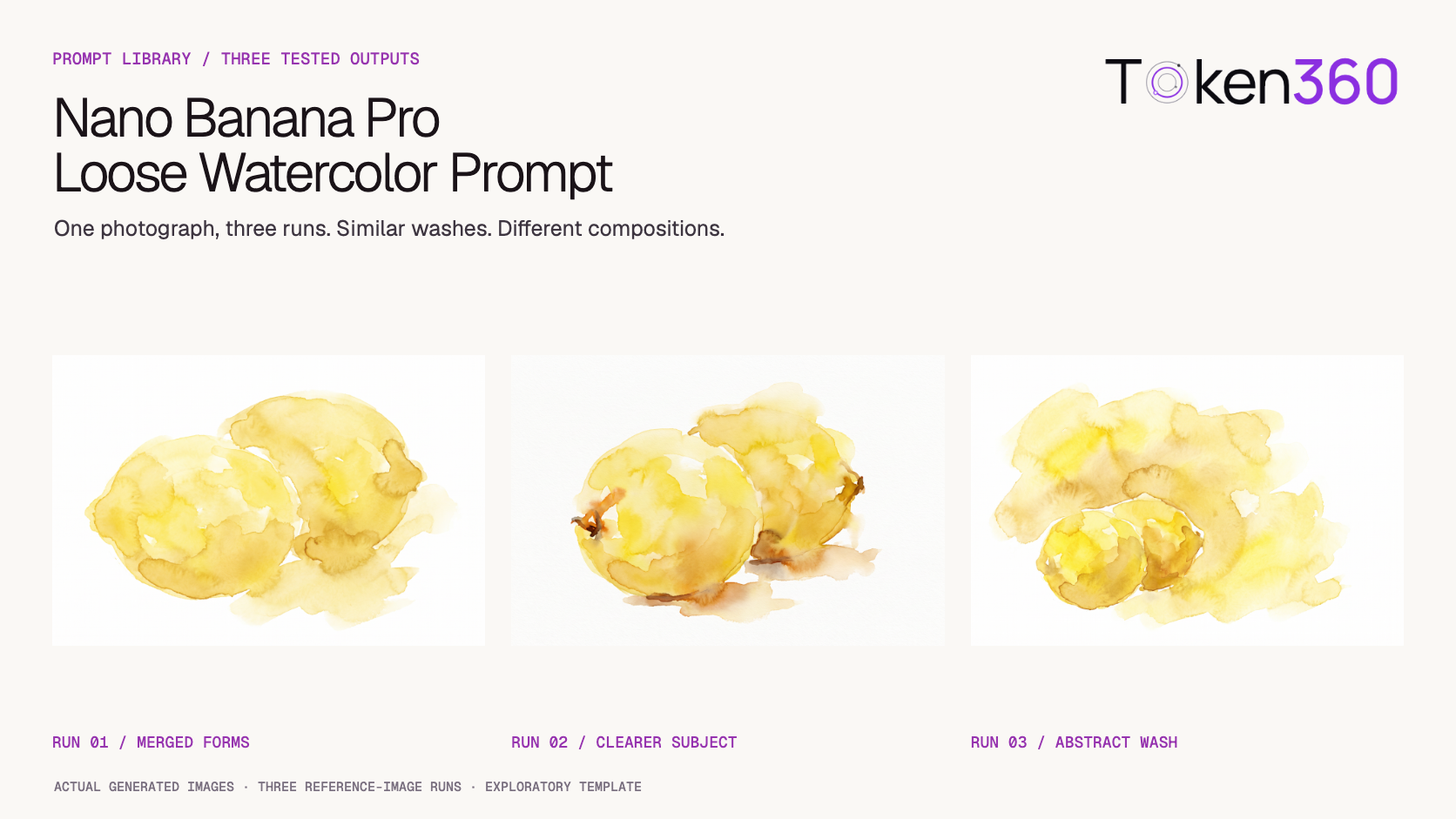
All three outputs used broad yellow washes, translucent overlapping color and visible pigment-like blooms on a white or near-white ground. Subject retention varied: the second image gives the clearest reading of two lemons, while the third becomes an expansive abstract wash. None preserves the source photo’s generous empty space and small subject placement closely.
Criterion
Observed across the three outputs
Practical implication
Loose watercolor texture
Broad washes, soft bleeding and layered yellow pigment appear in all three.
The requested medium is recognizable in this sample.
Minimal detail
Photographic peel detail is substantially simplified.
Useful for an abstract interpretation rather than a faithful rendering.
No linework
No obvious pencil or ink drawing is visible; darker pigment edges remain.
Pigment accumulation is not the same as a drawn outline.
Two recognizable lemons
Clearest in Run 2; overlapping forms in Run 1; weak separation in Run 3.
Review subject legibility independently from texture.
Airy composition
White areas remain, but the washes occupy much more of the frame than the photographed fruit.
The source layout was not closely retained in this set.
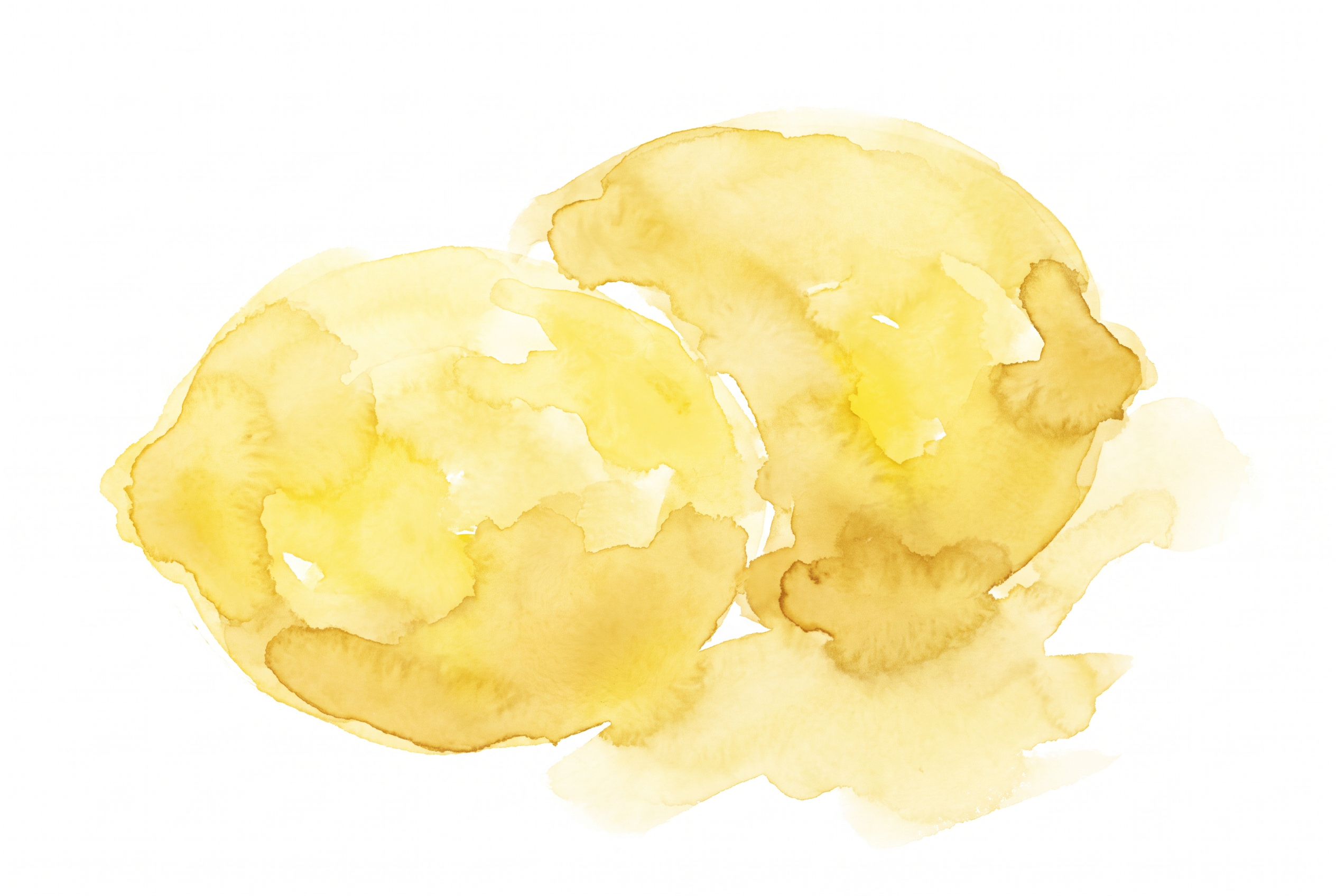
Run 1: convincing washes, merged forms
The first result translates the fruit into large overlapping yellow forms. Translucency and irregular pigment edges make the watercolor treatment clear, but the two lemons partially merge. The painted subject grows substantially relative to the source photo, leaving less usable space for surrounding copy.
Run 1: the medium reads as watercolor; the two subjects are less clearly separated than in the source.
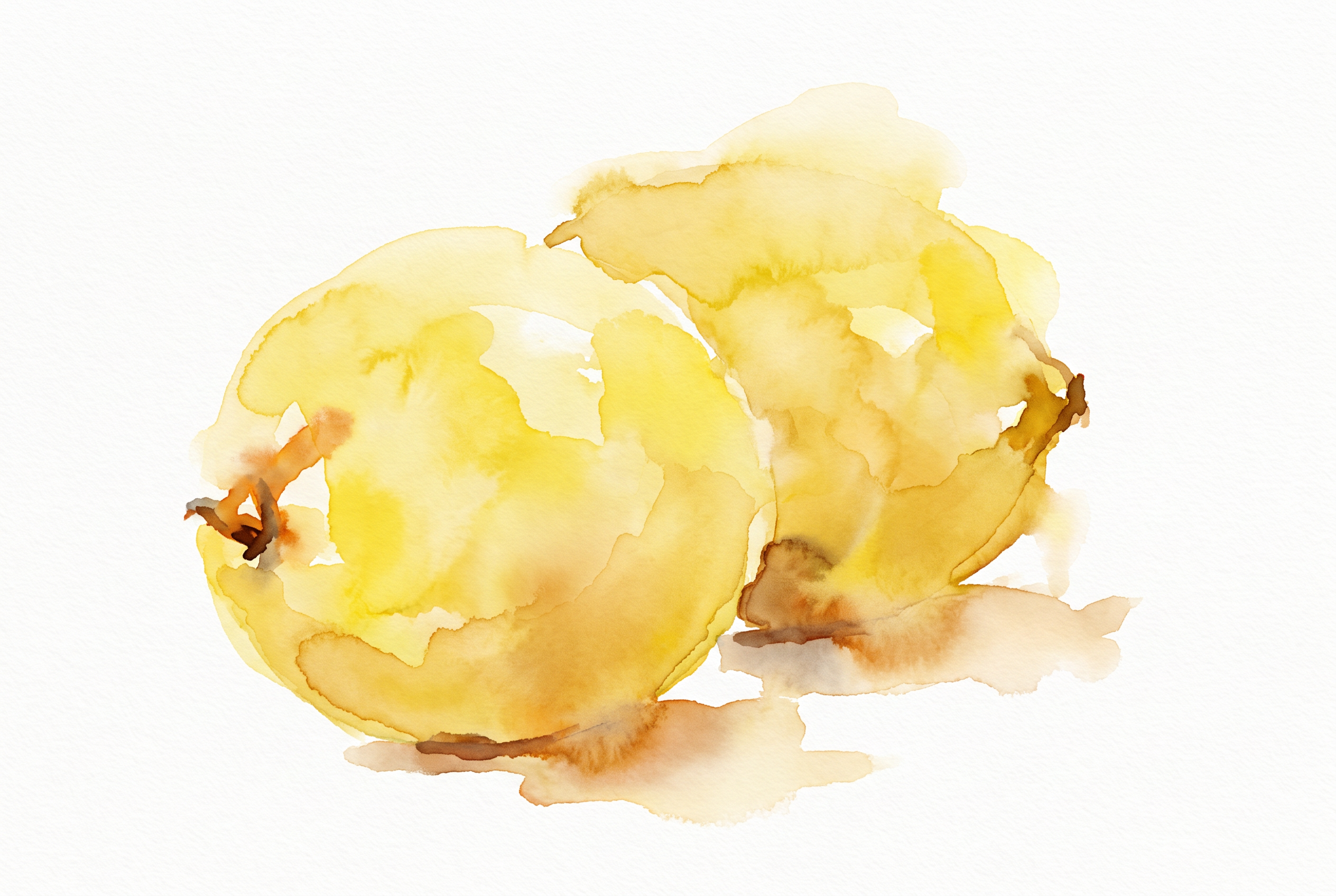
Run 2: the clearest subject-led illustration
The second result most clearly suggests two lemons, including a dark stem-like detail on the front fruit and a readable overlap. It is the strongest candidate here for a subject-led illustration, although brown accents and shadow washes are prominent. This is an editorial selection within three samples, not an objective model ranking.
Run 2: the clearest two-lemon reading in this set. Brown details add weight to an otherwise light treatment.
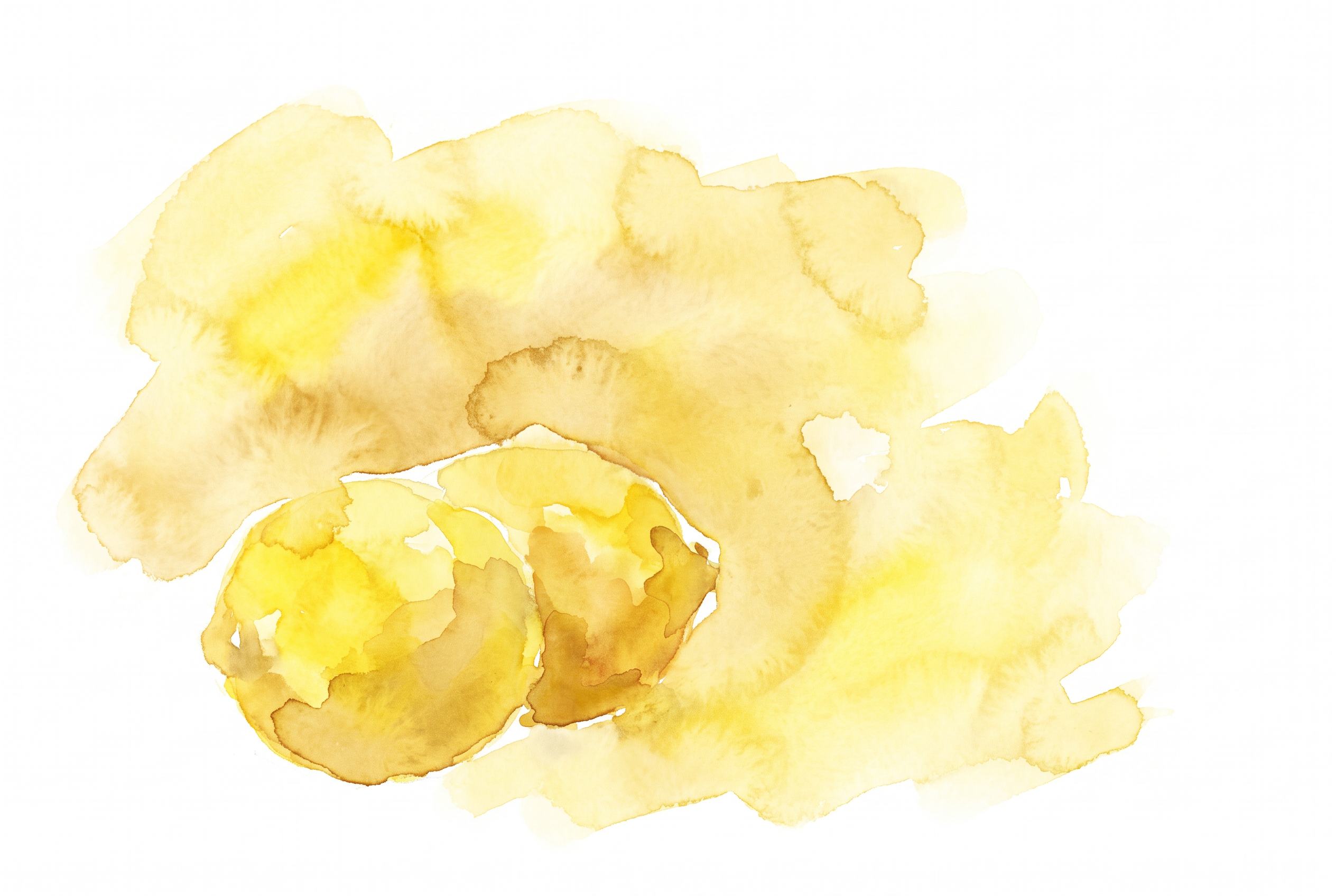
Run 3: closer to a watercolor background
The third result spreads a large pale-yellow wash across the upper frame and concentrates stronger color in the lower forms. The two-lemon relationship is difficult to read without knowing the input. It may work as an abstract background direction, but is a weaker choice when recognizing the fruit is essential.
Run 3: strong abstract wash character, reduced subject clarity.
Which real photograph was used as the reference?
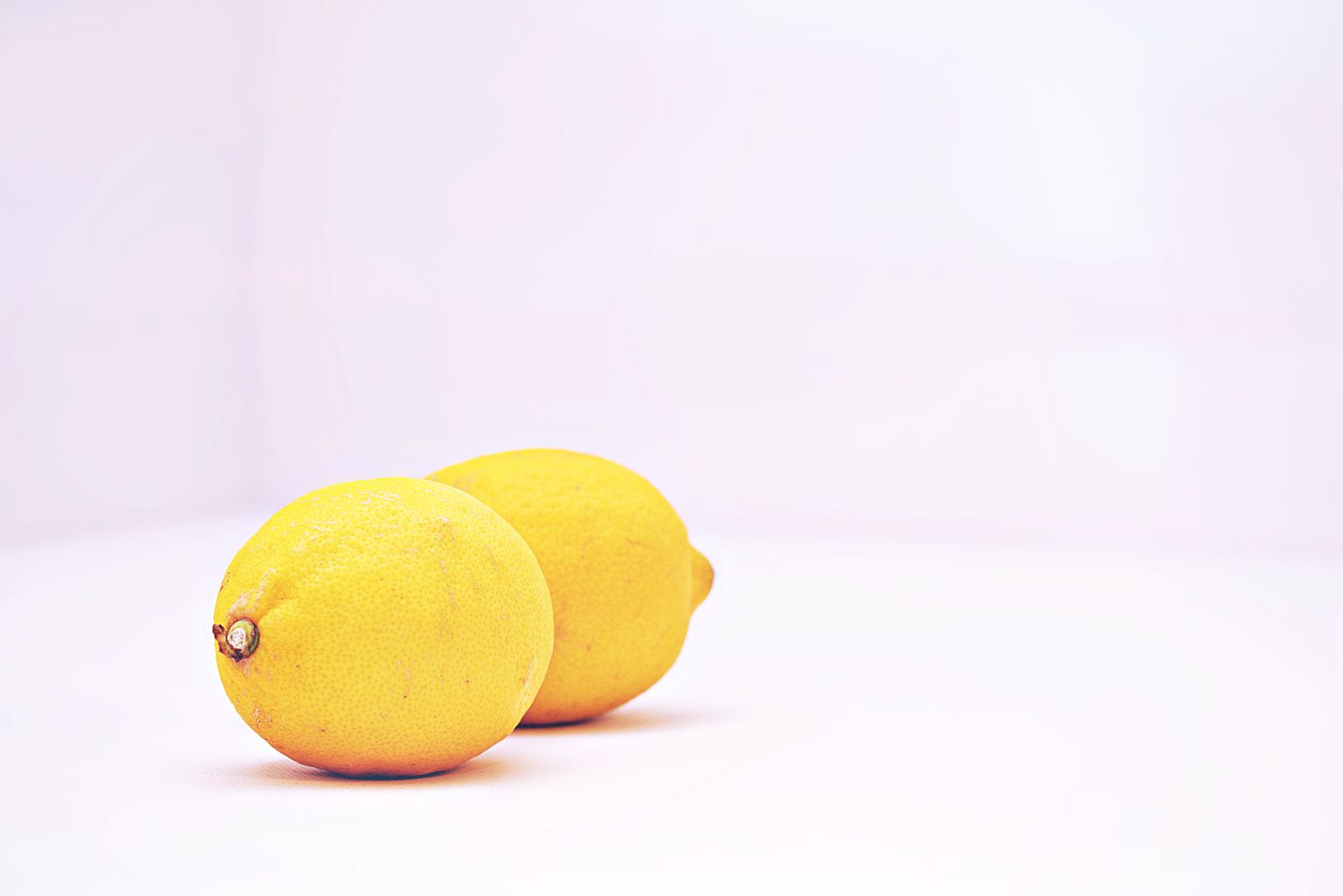
The reference is a real photograph of two lemons by Diana on Pexels. Its simple pale background, overlapping fruit and ample empty space make it useful for checking whether a watercolor conversion retains both subject relationships and layout. The output evaluation compares all three images with this same input, rather than with an AI-generated reference.
Photo by Diana ✨ on Pexels. The local reference used for the API requests is 1600 × 1068.
The photo page lists a Nikon D3400. It is licensed under the Pexels License, which allows free use and modification subject to its terms. Free licensing does not mean the photograph has no copyright; the photographer is credited here.
What watercolor prompt can you copy?
The tested version replaces the original subject placeholder with an explicit reference to the two lemons in the supplied photo. The remaining style instructions are retained: oversized strokes, flowing color, minimal detail, wet-on-wet texture and no drawn outlines. This is a reference-image adaptation, so it should not be presented as a test of the untouched text-only template.
Abstract watercolor wash of the two lemons in the supplied reference photograph, loose oversized brushstrokes, broad flowing color shapes, minimal detail, soft pigment bleeding, expressive wet-on-wet texture, simplified forms, airy composition, no linework, no outlines, white background
Abstract watercolor wash of a [subject], loose oversized brushstrokes, broad flowing color shapes, minimal detail, soft pigment bleeding, expressive wet-on-wet texture, simplified forms, airy composition, no linework, no outlines, white background
The template was supplied by the user as “Loose Watercolor Drift,” attributed to azed_ai on X. The post could not be re-read during preparation. Permission to republish the complete template has not been independently confirmed; attribution alone does not establish that permission. Attribution is retained as supplied; its engagement counts, date and original generation model are not independently verified here and are not used as evidence of quality.
What API settings were used for the watercolor test?
The retained test summary records three identical requests, including the prompt and Base64-encoded reference photo. Each requested one image from nano-banana-pro through Token360, without a seed. The retained records report gemini-3-pro-image as the response model field in every run. Requested dimensions and actual output dimensions differed, so both are documented separately below.
Endpoint
POST https://api.token360.ai/v1/images/generations
Requested model
nano-banana-pro
Response model field
gemini-3-pro-image in all three runs
Count
n: 1, three separate requests
Requested size
1536x1024
Requested aspect ratio
3:2
Seed
Not set
Reference
One 1600 × 1068 JPEG supplied as a Base64 data URL in images
Actual files
Three PNGs, each 2528 × 1696 pixels
Response size label
2k in all three responses
The output ratio is approximately 1.49:1, rather than exactly 3:2. Matching response model names do not establish unreported backend version or routing details. Image request fields are documented in the Token360 image generation API reference.
For a readable integration example,
Copy request-example-run-1.json:
{
  "model": "nano-banana-pro",
  "prompt": "Abstract watercolor wash of the two lemons in the supplied reference photograph, loose oversized brushstrokes, broad flowing color shapes, minimal detail, soft pigment bleeding, expressive wet-on-wet texture, simplified forms, airy composition, no linework, no outlines, white background\n",
  "n": 1,
  "size": "1536x1024",
  "aspect_ratio": "3:2",
  "images": [
    "https://images.pexels.com/photos/1367232/pexels-photo-1367232.jpeg?auto=compress&cs=tinysrgb&w=1600"
  ]
}
. It substitutes the public Pexels image URL for the original Base64 input; it is not a byte-for-byte copy of the submitted request. The test itself used the locally downloaded file.
Why did the lemons become less recognizable?
The prompt explicitly asks for abstraction, simplified forms and minimal detail. Those instructions make loss of photographic detail expected, while the results show that the balance between simplification and recognition varied. The test does not isolate which phrase caused any particular change, and intentional abstraction should not automatically be classified as an artifact.
Similarly, “no outlines” should distinguish drawn ink contours from darker paint deposits. All three images contain some defined pigment boundaries, which can fit the requested watercolor appearance. For a subject-led illustration, the more useful acceptance criteria are whether a reader can distinguish the two fruit forms and use the planned negative space. The tested prompt requests an “airy composition,” but does not explicitly lock the fruit to its original size or position. A layout mismatch therefore limits this use case without proving that the model ignored an exact placement instruction.
How can you try the tested photo-to-watercolor setup?
Use a reference image you are authorized to submit, copy the tested wording and select the documented image-input operation for your model. Record the request separately from the returned file. The steps below reproduce the submitted setup conceptually; they do not promise the same pixels or the same composition.
Choose the reference. Use the linked lemon photograph for a close comparison, or replace it with your own authorized photo. Changing the subject creates a new experiment.
Match the prompt to the input. The tested wording names “the two lemons in the supplied reference photograph.” Replace that phrase if the attached image shows something else.
Verify the current model contract. The saved test selected nano-banana-pro, supplied the image in images and requested one output. Check the current schema before reusing the example.
Separate examples from submitted data. The JSON example below uses a public image URL for readability. The original test used a Base64 data URL. A URL-based attempt is not an exact replay of that input transport.
Inspect the delivered file. Save the original result and check dimensions, subject count, fruit separation and whitespace. Do not infer actual dimensions from the requested size.
Decide against a concrete use case. For a small editorial illustration, recognizable fruit may matter most. For a background, abstraction may be acceptable. Neither decision establishes consistency for an entire campaign.
Keep the prompt and source fixed when comparing variations. If you later test a layout revision, label it as a new prompt version rather than pooling its results with these three runs. No revised prompt was evaluated in this entry.
When is this watercolor prompt worth using?
Use this prompt when a loose interpretation is acceptable and selecting among variations is part of the process. Run 2 is the clearest illustration candidate in this set, while Run 3 better suggests an abstract background. The three outputs do not establish consistent composition or suitability across a full series of different brand subjects.
A useful next test would add a single layout constraint, such as preserving two distinct overlapping lemons in the lower-left quarter with generous white space above and to the right. That revision has not been tested here. Keeping the photo, model and other settings fixed would make its effect easier to assess.
For packaging or social assets, inspect the result at its intended crop and size. This experiment evaluates visual style and subject retention; it does not validate print production or prove that Nano Banana Pro is the best watercolor model.
Frequently asked questions
Will this prompt preserve the source photo’s layout?
The source layout was not closely retained in this set: each output expands the painted forms relative to the photograph. Treat layout preservation as a separate acceptance criterion; a convincing watercolor texture does not prove the composition matches.
Can I use the template without a reference photo?
The supplied reusable template is phrased around a subject placeholder, but this test used a reference image. These results do not validate a text-only version. Keep that distinction visible when adapting or sharing the prompt.
Why did a 1536 × 1024 request return 2528 × 1696 files?
The saved records establish the mismatch, not its cause. All three response records used a “2k” size label. No controlled size experiment was performed, so this article does not claim that the requested size was universally ignored or explain an undocumented backend conversion.
Does the clearest result prove the prompt is stable?
No. Run 2 is an editorial preference among three samples of one photo. A matching illustration series would require testing additional subjects and defining acceptable changes in composition, shape and color.
What are the limits of this three-run test?
The evidence is limited to one photograph, one adapted prompt and three outputs. Visual judgments are editorial observations, not blinded ratings. The original images and local dimensions were checked for this article; request equality and response fields are reported from the retained test summary, rather than a new API run.
All three outputs are shown without retouching. No alternate subjects, competing models or revised layout instructions were tested. The article therefore supports selecting among these results, not a general reliability estimate or a verified recipe for a matching illustration series.
Run 2 is served as a lossless WebP copy to meet the upload size limit. Its decoded RGBA pixels and dimensions were verified against the original PNG. The source PNG and other test originals remain unchanged in the editorial archive.
Developer Guide
API
Bring your next idea to life.
Create a video scene in Creator, or explore models for images, audio, and text to find the right capabilities for your project.


 Guides
 Guides
 Guides