Model allowlists define permitted choices, not default models. Review Token360 member access, routing boundaries and denial tests before deployment.
ENTERPRISE AI · MODEL ACCESS
By Yuki Yu · Documentation analysis · Reviewed November 7, 2026
An AI model allowlist defines which models a workload may use. It is different from choosing a default model or ranking models by price and quality. For a Token360 enterprise integration, review the member’s applicable access policy, then validate permitted and excluded requests. A model appearing in a catalog is not proof of access.
A support assistant may need a reviewed text model, while a creative-production service needs image and video models. Both can belong to the same enterprise without needing the same model access. The useful question is not how many models the gateway lists, but which choices each workload should be able to make.
This guide separates documented Token360 capabilities from a proposed access-review process. Its model labels and team examples are fictional planning aids, not customer deployments or tested account configurations. No live permissions were changed, and no enforcement success rate is claimed.
Read first: the Token360 Enterprise API Guide explains administrative credential roles. This article focuses on the model choices a workload should be permitted to use.
How is a model allowlist different from a default model?
A default model supplies the starting choice when an application does not select another one. An allowlist sets a permission boundary around the choices it may make. Changing a dropdown, configuration file or routing preference does not by itself establish that requests for other models will be rejected at the service boundary.
Control
Question it answers
What to verify
Default model
What does the application normally request?
Whether an explicit override can select something else
Model allowlist
Which model identifiers are permitted?
Which identity and operations the rule covers, and what gets denied
Routing preference
Which eligible route or candidate is preferred?
Whether selection remains within applicable restrictions
Spending limit
How much usage is permitted under a budget rule?
Its scope and enforcement, independently of model identity
For a concrete external example, OpenRouter’s Guardrails documentation lists model allowlists separately from budgets and provider restrictions. It also documents that an empty model list allows all. That is a platform-specific rule, not a portable assumption about empty arrays in another API.
When reviewing an integration, ask a developer to identify the enforcing control, not only the UI that suggests a model. A hidden dropdown option is not evidence that a backend request naming that model would be rejected. Conversely, a visible option may still be unavailable to the current identity.
Where does Token360 expose member model-access controls?
Token360 documents member model-access administration through its enterprise control interface. Review the current member policy before changing it, and keep administrative access separate from the inference credential used by the workload. The existence of a policy tool does not establish the exact effective model set for an account you have not inspected.
As reviewed November 7, 2026, Token360’s Control MCP page describes inherited enterprise access and model allowlists. It names get_sub_account_model_access and set_sub_account_model_access for reading and configuring member policy. These are enterprise administration tools; they do not replace the inference API.
The Enterprise API Guide states that a PROVISIONING key does not provide model-policy access. Do not assume a credential capable of creating member keys may also change the member’s model permissions. Use the documented management role and required grants for the particular administrative operation.
Before making a change, record the target member, current policy mode and model identifiers. Resolve the current schema’s handling of inherited, omitted and explicitly configured values. This article does not infer Token360’s empty-list semantics or publish an unverified write payload. If the intended policy cannot be expressed unambiguously, settle that with the account administrator before rollout.
What should an enterprise include in its approved model list?
Start with the workload’s purpose and the evidence required to approve its model choices. Record exact identifiers and an accountable owner, then distinguish production access from temporary evaluation. A useful list explains why each entry exists and how it will be reviewed; it should not become an unowned copy of the entire catalog.
Here is a constructed planning example. The labels below are placeholders, not callable Token360 model IDs:
Workload
Proposed model set
Reason and review condition
Support response drafts
text-A
Reviewed for the support task; add another only after equivalent evaluation
Marketing asset production
image-B, video-C
Approved for the defined creative inputs and deliverable requirements
Time-limited evaluation
text-A, text-D
Named evaluation owner and a scheduled review of whether access should continue
The review date is a proposed operating practice, not a claim that Token360 automatically expires these model permissions. A team must implement or schedule the review through its supported process. Likewise, approving a model for a marketing task does not approve every kind of customer data for submission to it.
Keep the model list and data-handling assessment connected but separate. Token360’s Security and Data Handling guide calls for evaluating authentication, network restrictions, model access, routing region and upstream policies together. A model name alone does not establish retention, training or residency terms.
For each approved entry, retain a concise reason: task evaluation, input-data boundary, relevant agreement and change owner. Do not fabricate certifications or replace an agreement with a model’s public benchmark score. This record makes a future request to add a model easier to assess on its actual merits.
Does an allowed model imply a fixed provider or available capacity?
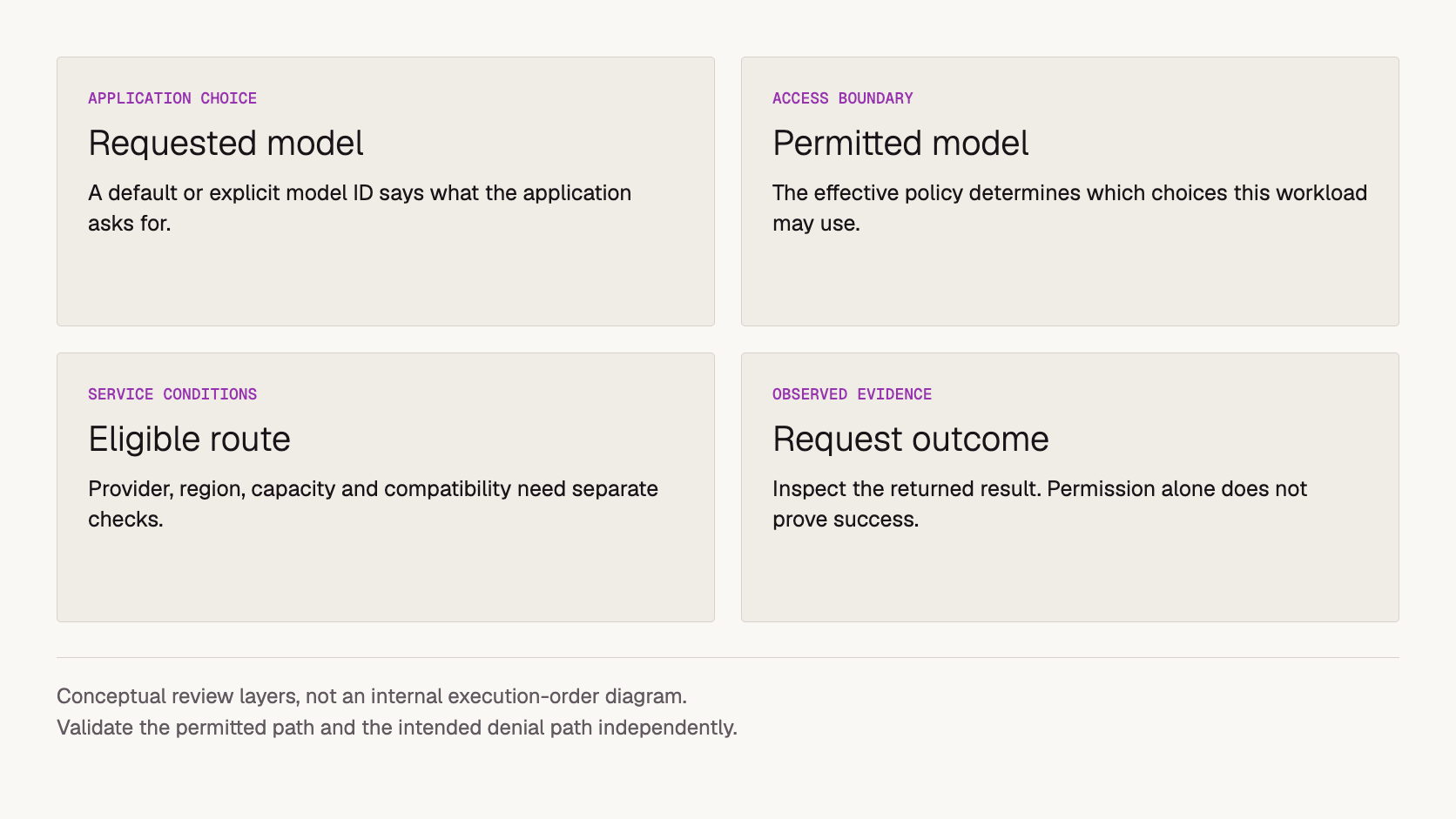
No. Permission to request a model is different from the route serving it, the capacity available at that moment and the application’s result quality. An access rule answers one question in the request path. It should not be treated as evidence that every other condition for a successful response has been satisfied.
Token360’s Routing and Reliability documentation distinguishes a public model identifier from its eligible upstream routes. It does not promise a fixed upstream provider unless enterprise configuration explicitly pins that behavior. It also says not to assume OpenRouter-style request fields for provider ordering or allowlists are supported.
If a procurement requirement names a particular serving provider, region or data arrangement, record that separately and confirm how the requirement is implemented. Adding a model to an application’s list is not a substitute for that agreement. Do not paste another gateway’s routing JSON into a Token360 request and assume the policy will follow it.
Conceptual review layers, not a claim about Token360’s internal processing order. Permission and observed success answer different questions.
Keep fallback candidates inside the reviewed boundary as well. In a proposed application design, a timeout should not silently authorize an unreviewed replacement model. If no permitted candidate is available, expose that limitation or follow an approved exception process. This is a design recommendation, not a claim that Token360 supplies automatic cross-model fallback for every account.
How should you validate an allowlist before production?
Test both intended access and intended denial using the identity that the workload will actually use. Begin by reading the configured policy, then verify behavior through the supported request path. A successful permitted request alone is insufficient: it does not show that an excluded model or another identity is handled correctly.
Use a small acceptance plan with approved test inputs. The following matrix is a proposed plan; these cases have not been run against a live Token360 tenant.
Case
Question to answer
Evidence to retain
Approved model, intended workload identity
Does the applicable policy permit this request?
Policy snapshot, identity reference and returned outcome
Excluded model, same identity
Is the request rejected for the intended reason?
Error details and correlation reference, without secrets
Explicit application override
Does changing the requested model bypass only the default, or the policy too?
Submitted model ID and effective policy context
New or inherited model entry
Does a parent-policy or catalog change alter the effective set?
Before/after policy review and documented inheritance rules
Fallback or recovery path
Does the alternative remain within approved access?
Actual candidate and resulting request outcome
Make a failure diagnostic rather than merely counting failures. An excluded request rejected for insufficient funds does not prove the model-access restriction worked. An approved request failing because of an unavailable route does not prove the allowlist is wrong. Separate policy evidence from unrelated request conditions.
Do not place real keys or sensitive test material in the review document. A non-secret credential reference, member identifier, model ID, timestamp and request reference can help connect the result to the intended configuration. For live testing, agree on the permitted requests and possible charges before running them.
How should a team change or troubleshoot model access?
Treat a model-access change as a reviewable change to the workload’s permitted choices. Identify what is being added or removed, who depends on it and how to verify the result. When a request fails, diagnose the actual policy and response before widening access; an unrestricted list is not a useful default repair.
For an addition, explain the task requiring the model and what evaluation or agreement supports it. For a removal, identify dependent jobs and applications so the operational impact can be reviewed. Preserve the previous configuration for comparison, but do not blindly restore it if that would reintroduce access intentionally withdrawn.
Follow the applicable enterprise approval process where enabled. A submitted policy change is not evidence that it has executed. Confirm the resulting policy and the intended request behavior before telling a team that access is ready. Keep this change procedure separate from ordinary model-selection experiments.
Token360’s troubleshooting documentation identifies several possible causes of a 403 response, including model access, IP rules and enterprise policy. The status code alone does not identify the cause. Capture the returned error details and available correlation IDs, then investigate the relevant layer.
For an inherited policy, inspect the relationship with the parent configuration before editing the member. For a model-ID mismatch, check the public catalog identifier rather than substituting an upstream deployment name. For a genuine access change, involve the authorized policy owner rather than asking the application to obtain broader credentials.
Frequently asked questions
Is a model allowlist the same as an IP allowlist?
No. A model allowlist restricts model choices. An IP allowlist restricts network origins. A request can satisfy one restriction while failing another.
Does an empty list mean no models are allowed?
Not universally. APIs can assign different meanings to empty, missing and inherited values. Verify the selected service’s schema and effective policy; do not infer Token360 behavior from another platform’s example.
Can we put a model family name in place of a model ID?
Only if the selected policy schema documents that format. Do not assume that a family name, wildcard or upstream alias expands into the exact model set you intended.
Does an allowlist prove our data stays in one region?
No. Model access and data location are different requirements. Confirm the applicable routing configuration, agreement and full data path separately.
Has this article verified Token360’s live enforcement?
No. It combines official documentation with a constructed review worksheet and proposed acceptance cases. It does not report successful permission tests or a customer deployment.
Read next: review the member model-policy tools, then the routing contract for the selected integration. About Token360 provides platform context across text, image, audio and video. Available models and agreed enterprise terms should still be verified for the intended workload.
Developer Guide
API
Bring your next idea to life.
Create a video scene in Creator, or explore models for images, audio, and text to find the right capabilities for your project.


 Guides
 Guides
 Guides