Evaluate vision APIs for inventory photos. Define counting units, hidden-stock limits, accuracy checks and review before updating business records.
ENTERPRISE AI · VISUAL INVENTORY
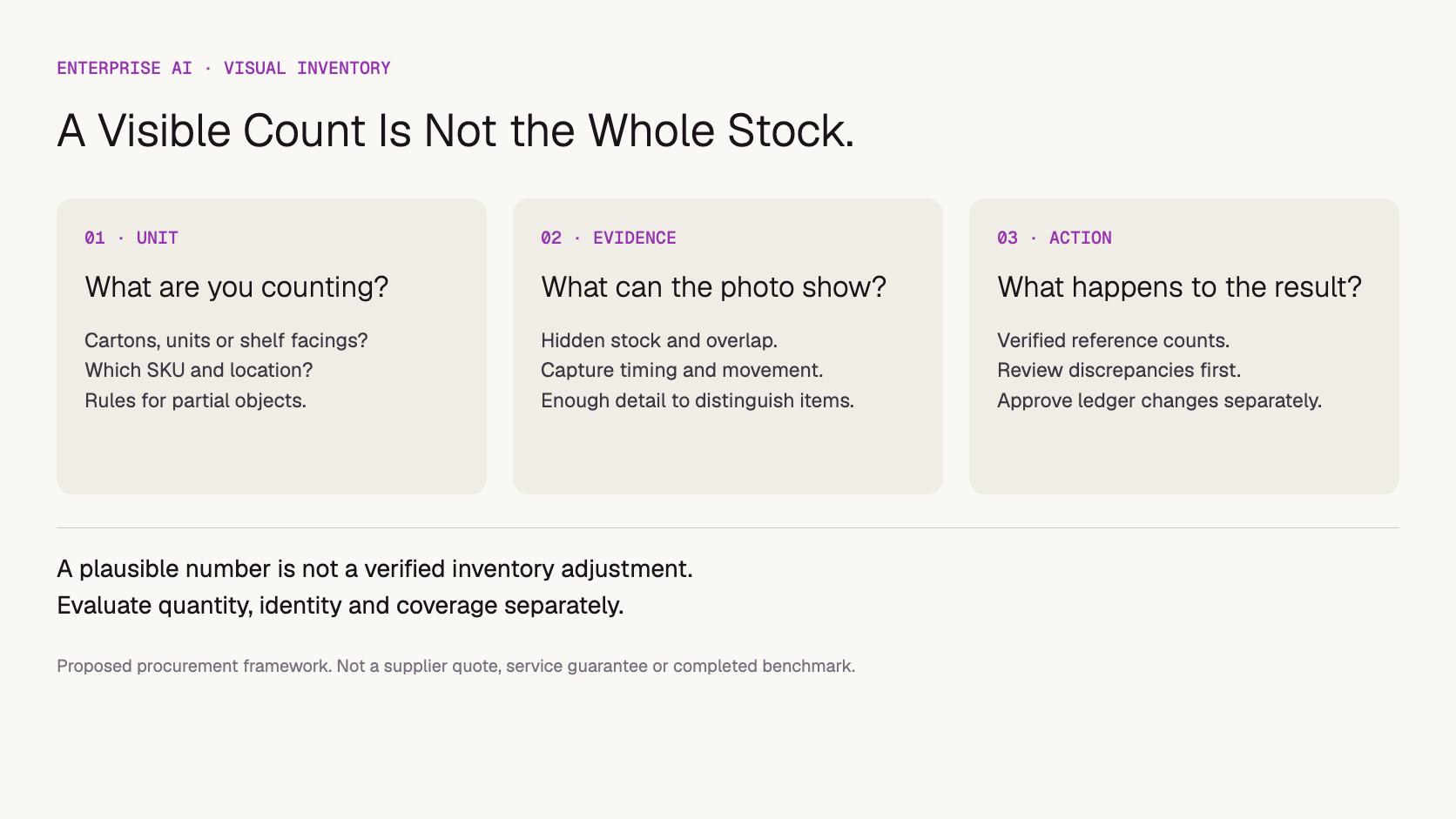
AI can help count visible objects in a photo, but that is not automatically a reliable inventory count. Before buying a vision API for stock checks, define the counting unit, verify what the image can reveal and test missed or duplicated objects. Keep uncertain results separate from the inventory record until reviewed.
A warehouse photo may show cartons without revealing how many units are inside them. A retail shelf image may show only the front row. A model can describe either scene convincingly while still returning a number that is unsuitable for stock reconciliation.
The enterprise buying question is therefore more specific than “Does this model understand images?” It is whether the complete capture, counting and review workflow can produce an acceptable quantity for the business decision.
What can a vision API actually establish from a photograph?
A vision API may identify object types, locate individual instances or answer a question about the image. These are different outputs. Counting requires a defined set of instances and a rule for including them. An image cannot, by itself, confirm stock outside the frame or the contents of opaque packaging.
Google Cloud Vision documents object localization that returns detected objects and bounding polygons. That provides a way to inspect which objects were detected; it is not a guarantee that every relevant item was found. See Google’s object-localization documentation, reviewed November 18, 2026.
For a prompted vision-language model, a numerical response may not include an auditable detection for every item. Claude’s official vision documentation specifically notes approximate counting and localization, with counting difficulties for large numbers of small objects. This is a product-specific limitation to consider, not a measured failure rate for all models. See Claude’s vision limitations, reviewed November 18, 2026.
If the task is simply routing photos into categories, use the separate image-classification procurement guide. This article concerns quantities and the evidence needed before acting on them.
Are you counting packages, visible units or actual stock?
Define the counting unit before choosing a model. A carton, a product inside a carton and a visible shelf facing are not interchangeable. Also define the counting area and how partially visible objects should be handled. Otherwise, two reasonable-looking answers can refer to different quantities and both fail the operational requirement.
Requested quantity
What the photo may support
Additional evidence or rule
Visible cartons
Distinct carton instances in the captured area
Partial-object rule and sufficient visibility
Individual sellable units
Visible units, if distinguishable
Verified pack size and contents if converting carton counts
Stock for one SKU
Quantity only if the SKU is identifiable
Catalog mapping, label or barcode evidence where needed
Total stock in a location
Only the photographed portion
Coverage of hidden areas and a plan to avoid duplicate counting
Stock available to sell
Physical appearance alone is insufficient
Reservations, condition, ownership and inventory records
For an illustrative receiving check, five visible sealed cartons might be a valid carton count. Multiplying by a pack size assumes that the correct product and actual contents have been verified. A printed “12 pack” label does not prove that an opened carton still contains twelve units. This is a proposed example, not a test result.
Should you buy object detection or a prompted vision model?
Evaluate object detection when the requirement is repeated counting of defined object types with inspectable locations. Evaluate a vision-language model when interpreting varied scenes or explaining exceptions is also useful. Neither approach removes the need for representative testing, and a general object vocabulary may not distinguish your specific SKUs.
A detector can expose boxes that reviewers compare against the image. A vision-language model can help describe obstruction or interpret instructions, but requested coordinates and counts must still be checked. A combined workflow could use detections for proposed quantities and language for an exception note. That is an architecture to test, not a verified improvement.
Ask suppliers what the API actually returns: labels, locations, counts, masks, text or a mixture. If a custom model is needed, clarify who provides labeled examples, trains it and maintains it when packaging changes. Model access alone should not be interpreted as a packaged inventory application.
When SKU identification depends on reading labels, examine OCR versus vision-model requirements separately. Correctly reading a label and correctly counting the objects beside it require different checks.
How should you handle hidden items and overlapping photos?
Treat missing visual evidence as a capture problem, not an invitation to guess. Request another view or a manual count when relevant objects are obscured. If several photos cover the same area, define how each physical item is counted once; adding separate image totals can double-count overlapping stock.
A repeatable capture procedure can specify the location identifier, approved viewpoints, lighting, maximum crowding and required coverage. Evaluate that procedure with the actual staff and devices that will use it. An ideal demonstration photo does not establish performance for blurred mobile uploads or densely packed shelves.
Also distinguish a new view from a new moment. If stock moves between photographs, the images may not represent one consistent inventory state. Store capture context and define whether movement must pause during the check. The model should not be asked to infer an unobserved receipt or shipment from conflicting counts.
A proposed acceptance framework, not a completed counting benchmark.
What should a counting pilot measure?
Compare proposed counts against independently verified quantities, with a clear unit and image scope. Report exact-count matches, undercounts and overcounts separately, and keep results for difficult conditions visible. Include the share sent to review. A workflow that achieves acceptable results only after substantial manual correction has a different business case.
Build a held-out evaluation set that includes empty scenes, single objects, dense arrangements, partial objects, look-alike packaging, reflections and multiple product types. Use images representative of the planned operation. Resolve ambiguous counting rules before scoring the model; otherwise the reference labels themselves may be inconsistent.
For each mismatch, identify whether the cause was missing coverage, a missed object, a duplicate detection, wrong SKU assignment or incorrect pack conversion. These require different remedies. A more capable language model cannot reveal an item that was never photographed.
For example, a prediction of ten objects when the verified count is twelve is an undercount of two for that image. Do not let it cancel out an overcount of two elsewhere when reporting quality. Measure absolute errors as well as direction, and review performance by density and capture condition.
Use the blank visual counting pilot worksheet to record these checks. It contains no invented accuracy figures or accepted threshold. Set acceptance criteria according to what an incorrect count would trigger in your business.
When should the result update your inventory system?
Keep a proposed visual count separate from a confirmed inventory adjustment until its acceptance rules are satisfied. A count difference is a reason to investigate, not proof that the stock ledger is wrong. Reconcile location, timing, counting unit and recent movements before approving an update.
A useful record contains the source image, capture time, location, model configuration, proposed quantity, review outcome and adjustment reference. Apply the organization’s access and retention policies rather than keeping every operational image indefinitely. Reviewers should see the evidence behind the quantity, not just a confident sentence.
For higher-impact decisions, start with assistance: prioritize discrepant locations for a recount or prepare a draft inspection record. An application can expand automation later if measured results and controls justify it. This article does not establish a safe universal threshold for unattended stock changes.
What should enterprises request in an API quote?
Describe the counting workload rather than asking only for a price per image. Include image volume, resolution, expected retries, capture conditions, object types and required outputs. Compare the cost of an accepted check, including review and integration, because the cheapest request may not produce the cheapest reliable workflow.
Clarify whether the proposed scope includes a pretrained endpoint, a custom detector, training, annotation tools or application integration. Ask how model changes will be evaluated against your held-out set. Specify the operational latency requirement and what happens if the service is unavailable during a stock check.
Token360 is relevant to procuring model access across text, image, audio and video, with enterprise pricing, dedicated capacity, contracts and compliance requirements scoped to the engagement. That positioning does not establish native inventory counting, barcode support, warehouse integration or guaranteed accuracy. Verify the selected model and responsibilities through enterprise procurement; see About Token360 for company context.
What else should buyers know?
Can a photo replace a physical stocktake?
Only if the complete workflow has been validated for the required scope and controls. A photograph of visible items does not establish hidden stock, ownership or availability to sell. Assistance with selected checks is a narrower claim than replacing the whole stocktake.
Does a correct count mean the right products were identified?
No. A scene can contain the expected number of objects while including the wrong SKU. Evaluate identity and quantity separately when both matter.
Will a more detailed prompt guarantee an exact count?
No guarantee follows from prompt detail. Clear instructions can define the task, but the result still needs evaluation against verified counts. Do not treat a request to “count carefully” as an accuracy control.
Evidence boundary: Procurement analysis based on primary documentation reviewed November 18, 2026. No counting experiment, customer deployment, accuracy rate or validated replacement of manual stocktaking is reported. The examples and pilot are proposals for evaluation.
Enterprise AI
API
Bring your next idea to life.
Create a video scene in Creator, or explore models for images, audio, and text to find the right capabilities for your project.



 Guides
 Guides
 Guides